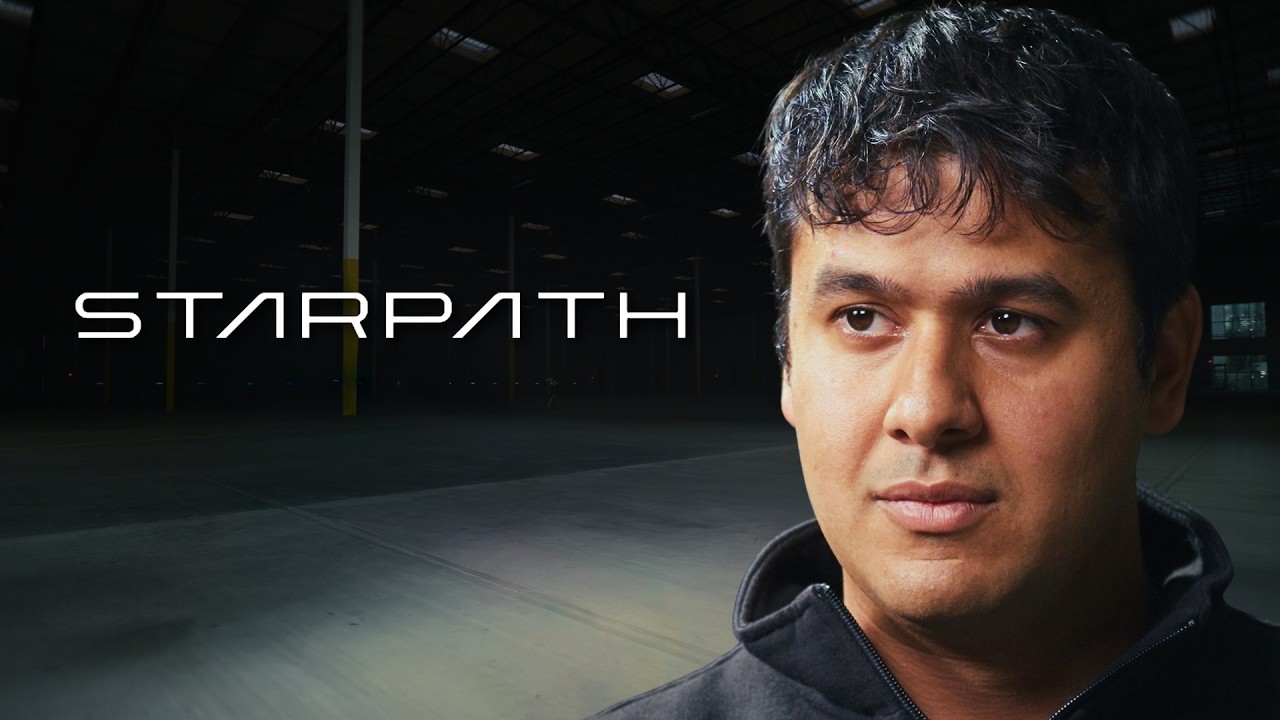
This episode features Saroj Sharaf, founder and CEO of Starpath, discussing the state of the launch industry, the economics of AI data satellites in space, Starpath’s ultra-low-cost solar panel technology, and why superintelligence may unlock Mars colonization by making rocket development economically rational.
The launch market is effectively a monopoly with zero available supply
SpaceX is the only launch company that matters today; they build hundreds of Falcon 9 rockets per year, mostly for their own Starlink constellation.
The current addressable market for launch is roughly 100 Falcon 9–class flights per year, driven almost entirely by telecommunications satellites (Starlink).
Every other launch company (Blue Origin, Rocket Lab, ~10 others) is trying to replicate Falcon 9’s capabilities — a “yesterday’s rocket” — and most have not yet reached orbit.
SpaceX recently exited the commercial launch market: they will not sell traditional launch services to outside customers under any circumstances.
The remaining competitors either have no rocket or are not pricing competitively; the result is a market with demand but zero purchasable supply.
AI data satellites will dominate future launch demand, requiring fully reusable rockets
The next major application is AI data satellites (orbiting data centers), which will outnumber telecom satellites 99:1 by mass and power.
To be competitive with terrestrial data centers ($10–15/W), an AI data satellite must cost ~$5/W all-in (build + launch).
That implies a launch cost of ~$1/W, or ~$200/kg for a 200 kW, ~1,000 kg satellite — Falcon 9 costs ~$1,000/kg and is 5× too expensive.
Scale is also a problem: a 2 GW/year deployment (modest by AI lab plans) requires ~1,000 Falcon 9 launches/year; Falcon 9 is 10× short on flight rate.
The root cause: Falcon 9’s upper stage is expendable. A fully reusable two-stage rocket is the only architecture that can hit the required cost and cadence.
Only two companies are seriously developing such a vehicle: SpaceX (Starship) and Stoke Space.
Game theory creates a “zero-supply” trap: no rational actor will sell launch once they have a working reusable rocket
If a company owns a working fully reusable rocket and believes superintelligence has effectively infinite demand and high margins, the profit-maximizing move is to use all capacity for their own AI constellations, not sell launches.
This logic applies to every entrant: once their rocket works, they also have no incentive to sell.
The market went from “one seller (SpaceX) hoping for a second” to “zero sellers hoping for one” — and nobody wants to be the first to break the standoff.
Starpath’s response: they have an internal deadline; if the market does not fix itself (SpaceX re-enters, or multiple providers competitively bid large-volume contracts at ~$200–500/kg), Starpath will build its own launch company.
The motivation is not just business survival — Sharaf argues superintelligence should be broadly accessible, not concentrated in one company.
Starpath’s solar panel (Starlight Air) achieves a 50× cost reduction by designing from first principles
Legacy space solar panels used rare-earth multi-junction cells on rigid substrates, costing $300–1,000/W; volumes were tiny (classroom-scale per year) so cost didn’t matter.
Starpath ignored the legacy design and asked: what is the minimal material set and simplest manufacturing process that yields a space-qualified panel?
The result is an ultra-thin, flexible panel manufactured using processes borrowed from OLED display production (organic light-emitting diodes) — Sharf calls it an “organic light-absorbing diode.”
All materials are commodity chemicals available globally; the panel is ~paper-thin (20% thicker than paper) and near the physical thinness limit (any thinner would be transparent).
At high volume, the “idiot index” (finished-goods cost / raw material cost) is ~6× — unheard of in space hardware, where indices of 100× are common.
The panel targets $15/W list price, but sells at an order of magnitude less at volume, enabling the $5/W satellite goal.
Launch mass savings compound: the panel is ~1/3 the weight of traditional arrays, directly reducing launch cost
On a 200 kW satellite, traditional solar arrays alone weigh ~1,000 kg; Starpath’s panel cuts satellite mass by ~2/3.
Since launch cost dominates at $200/kg target, mass reduction is as critical as panel cost.
The panel is also rollable, enabling dense packing and simpler deployment mechanisms.
Starpath is building a 50 MW/year “megafactory” in LA (130k sq ft), 10× current total market demand, because customers demand capacity visibility, not just current output
Current total space solar demand (ex-Starlink) is ~5 MW/year; including Starlink, ~50 MW/year.
Customers (major AI labs spending billions on data centers) forecast demand growing on a steep exponential — asking for 75 GW/year within 5 years (1,500× this factory).
Capacity grows in steps (factories); demand grows exponentially. Starpath chooses to build steps above the curve.
The governing word in every customer conversation is “capacity” — they need to see massive installed capacity years before they will commit billions.
Next step: “Austin Giga” at ~1.2 GW/year (~20× LA factory), then continued order-of-magnitude scaling.
Starpath is vertically integrating beyond solar: building ~5 of the ~10 major satellite bus components in the same factory
A satellite bus has ~10 major subsystems (solar, attitude control, thrusters, power electronics, etc.).
For AI data sats, none of these components exist at the required unit economics (e.g., thrusters at $50–80k each in 100k quantities).
Incumbent component vendors refuse the challenge even with $100M upfront development funding.
Starpath’s “hospitality mindset”: after earning the solar contract, they ask “what else can I do for you?” and build the missing components to ensure customer success.
Execution mindset then shifts to aggressive scheduling and delivery.
Superintelligence makes rocket development economically trivial, unlocking the Moon and Mars as side effects
Developing a fully reusable rocket costs ~$5B; Anthropic’s annualized revenue run rate covers that in ~2 weeks.
Superintelligence provides a legitimate, rational economic driver to build the rocket for its own sake (AI data sats), making the rocket “free” for other uses.
The supply chain built for mass-produced AI data sats (automotive-scale) directly feeds Moon/Mars infrastructure (solar, power electronics, thermal, structures).
Mars base requires ~1,000 Starships; AI data sat constellation requires ~100,000 Starship flights — but the goal density per flight is far higher for Mars (10 ships = city).
Once the rocket exists and is paid for by AI demand, Moon tourism, mass drivers, and Mars cities become OPEX-only problems — CAPEX is already sunk.
Sharaf’s personal arc: Starpath started as a Mars solar company (“engineered for Mars, flies anywhere”); the AI data sat pull-forward is what makes the Mars vision financeable.