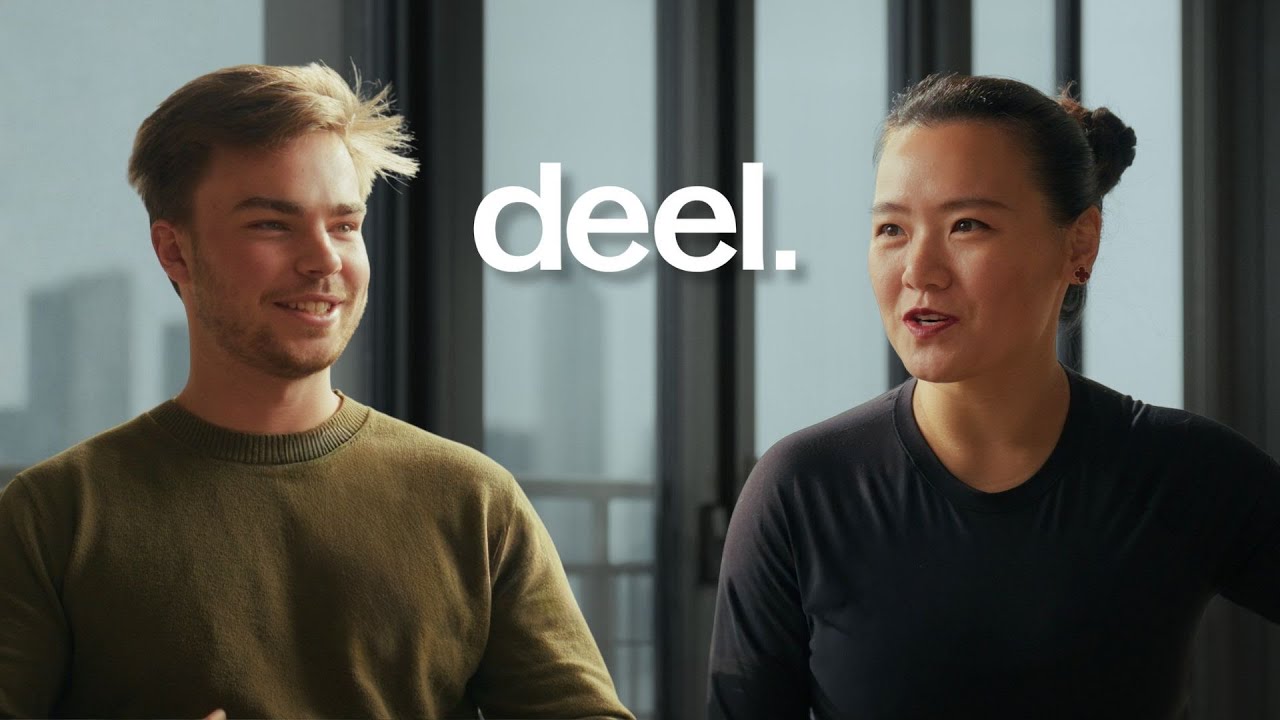
Shuo Wang, co-founder and CRO of Deel, discusses the company’s journey from a YC crypto startup to a $1 billion ARR global payroll and HR platform operating in nearly 150 countries. She shares how Deel was built around a vision of enabling any company to hire any talent anywhere, the operational intensity of scaling entity infrastructure during COVID, the sales frameworks and culture that drove hypergrowth, and the personal experiences—from growing up in China to losing her mother—that shaped her leadership philosophy.
Designing Deel to Scale Quickly
Deel’s mission is to let any company hire any talent regardless of location, which requires navigating 195 countries’ compliance rules, tax regimes, benefits requirements, and labor laws.
The company started as a payment platform and layered on compliance: localized employment contracts, benefits databases, and entity establishment.
Deel now operates 165 entities across close to 150 countries, sometimes maintaining multiple entities in a single country to optimize benefits and taxes for different worker types.
Why Companies Should Go Global Early
Shuo argues that modern communication tools (Slack, Zoom, Teams), fast transportation, and AI-driven translation have eliminated the traditional frictions of distributed work.
She believes founders should think from day one about serving billions of people globally rather than starting in one city and expanding incrementally.
Deel itself practiced this: within its first year it opened over 100 entities across roughly 80 countries, even during COVID government shutdowns.
Building Deel’s Sales Team
In the earliest days, Deel had a single group of account executives focused on SMBs. Shuo built capacity models from first principles: 6 meetings/day × 5 days × 4 weeks = 120 meetings/month; at a 60% qualification rate that yields 72 sales-qualified opportunities; at a 30% close rate that produces ~22 new logos per AE.
Today Deel has roughly 1,000 people in sales (AEs, account managers, SDRs, partnerships) and serves everyone from SMBs to Fortune 500 enterprises, with far more sophisticated data collection, quota-setting, and team design.
Why Shuo Loves Sales
Shuo grew up helping her mother run a motorcycle and scooter wholesale business in Baltimore, which gave her early comfort with rejection and directness.
She walked up to the CEO of Visa at a conference, asked for his number, and pitched Deel on the spot—before the company was successful.
Her MIT mechanical engineering and robotics background trained her to think algorithmically: gather data, identify signals, build models, and apply them to business decisions. She finds problem-solving inherently exciting.
Pivoting Three Times During YC and Being Shameless
Deel entered YC as a crypto payout platform for content creators. When the crypto market crashed and no one wanted to be paid in volatile currencies, Shuo and co-founder Alex Bouaziz pivoted.
They interviewed nearly 200 companies in their YC batch, asking about international hiring and payments, and landed on building a payment platform for international independent contractors.
After YC, Shuo set a goal of emailing 100 prospects per day. Roughly 98% went unanswered; of the 2% who responded, only a fraction converted—but this was how they built the early pipeline.
In the earliest days, both founders handled customer support themselves via Intercom. Shuo says she “dreamed about Intercom” from the volume. The most common question was “When will I get paid?”—and many workers depended on timely payments for weekly rent, medicine, or family care, which gave the team a deep sense of responsibility.
Solving Payment Delays in the Early Days
As a YC startup without money transmitter licenses or banking partnerships, Deel had to rely on third-party payment service providers, which sometimes caused delays due to additional KYC checks or internal system slowdowns.
These delays—payments arriving Monday instead of Friday—reinforced the need to build a highly reliable payment infrastructure, which became a core focus.
Joining YC as a Crypto Payment Platform for Content Creators
Shuo and Alex met at MIT and had known each other for years. In late 2019, Shuo proposed combining Alex’s experience working with content creators and her interest in crypto payments into a YC application.
They submitted the application on the deadline day, leveraging an 8-hour time zone difference between Europe and the US to finish in time.
The original idea used Ethereum smart contracts to automatically release payments to content creators based on performance metrics, bypassing middlemen and banking infrastructure.
The crypto market crashed during YC, and the team realized the fiat off-ramp problem was unsolvable at their stage. They broadened from content creators to all international independent contractors.
How to Make Decisions Before You Have Data
Early on, when things weren’t working, Shuo tried many directions simultaneously. The key question was: what’s the fastest product to build that lets you onboard clients and validate demand?
Deel started with payments for independent contractors, then added Employer of Record (EOR) services—hiring full-time employees on its own entities on behalf of clients—when it became clear companies wanted to hire internationally as full-time staff, not just contractors.
Later, as clients grew and wanted their own entities, Deel added entity setup services and global payroll for clients’ own international subsidiaries, evolving from one product into an integrated platform.
Why It Was So Painful to Open Corporate Entities During COVID
During COVID, most government offices were closed or operating at minimal capacity, making entity registration extremely difficult.
Shuo needed to get her passport and power of attorney verified in person for a European entity. She found that a New York state agency was open but had a two-week waitlist—unacceptable given the pace Deel needed.
She found a third-party agency that worked with the New York agency and negotiated completion within two days, then ordered 50 copies of the verified documents to frontload future entity setups.
Thinking Outside the Box
A major early client needed to hire a software engineer in Hungary within two weeks, but Deel didn’t have an entity there. The team sent ops people to Hungary during COVID, worked with local employees, engaged law firms on the ground, and opened the entity in time to make the hire.
Shuo’s general approach: show up in person, compress timelines by removing scheduling friction, and exhaust every possible angle to solve the problem.
Why COVID Was “A Lifetime Opportunity” for Deel
Shuo recognized early that remote work had suddenly become permanent for millions of companies, creating unprecedented demand for global hiring infrastructure.
She told her team this was a once-in-a-lifetime convergence of product-market fit, market demand, and timing—and that they needed to execute relentlessly.
Deel Speed
“Deel Speed” is a core cultural value: move fast, focus on execution, identify problems, figure out solutions, and ship.
Within one year—during COVID government shutdowns—Deel opened over 100 entities across roughly 80 countries, roughly one every three days.
This speed applies to product (shipping features fast), customer support (solving problems immediately), and payments (delivering on time every time).
Argentina and Brazil
In countries with weak or depreciating currencies, talents and employers wanted to transact in stronger currencies like USD or euros, but local compliance made this extremely difficult.
Deel navigated the local regulatory requirements—licenses, permits, paperwork—to enable USD-denominated payments in countries like Argentina, giving clients access to stronger talent pools.
Interviewing Deel’s First 400 Employees
Shuo and Alex personally interviewed Deel’s first ~400 employees (from several thousand candidates) to ensure cultural fit.
Core cultural values they screened for:
Deel Speed: fast execution and problem-solving
Default optimism: happy, optimistic people who look for solutions rather than giving up
Genuine care: for clients and for each other
Shuo screens for curiosity and problem-solving ability as proxies for happiness and optimism.
Roughly 60–70% of the earliest employees are still at Deel. Many have been promoted significantly—early SDRs are now directors.
Creating Ghostbusters (Special Projects Team)
After reaching $1 billion ARR in five years, Deel had grown so fast that management layers had multiplied and leadership was disconnected from individual contributors.
Shuo realized managers were booking meetings to tell her things she already knew rather than working on new projects. She concluded Deel needed expert-managers who do the work themselves, not people-managers who just add layers.
The Ghostbusters team was created ~3 years ago: special projects people who go into each department, identify inefficiencies, and report directly to Shuo, Alex, or the COO—bypassing middle management to move fast.
One employee, Theory, started as an SDR candidate, moved to business ops, then Ghostbusters, and is now head of crypto at Deel—an example of the career progression paths the company creates.
Having a Co-Founder You Can Rely On
Shuo emphasizes that no founder can do everything alone. She and Alex function as partners with deep trust: he focuses on product and CEO responsibilities; she leads go-to-market and revenue.
Deel now has 17 products covering the full lifecycle of hiring, managing, and paying global talent, all built on their own infrastructure.
Shuo travels nearly every other week for client meetings, conferences, and team offsites. Deel holds three types of offsites: executive offsites (including board meetings, recently in Cape Town), and the annual sales kickoff (Deel Kickoff) where the full sales and go-to-market team aligns on strategy and targets for the year.
Why Offsites Are Important
As a fully distributed company with no headquarters, offsites serve as critical alignment moments: sharing product updates, coordinating sales strategy with product roadmaps, and ensuring operational support is in place.
Shuo describes them as an “upgrade” for the entire company—a way to set the direction for the coming year.
Torturing Yourself into Greatness
Shuo resonates with Jensen Huang’s philosophy of “torturing yourself into greatness.” She references an Asian saying: before you can take on big responsibilities and make an impact, you must suffer—physically, mentally, or psychologically.
Suffering builds strength, focus, and resilience, and is the mechanism through which leaders learn, improve, and become “locked in.”
Learning How to Run a Business from Her Mom
Shuo grew up in China with her grandparents while her mother immigrated to the US alone at age 16, speaking no English and having no money.
Her mother built a successful motorcycle, scooter, and golf cart wholesale business spanning the entire US. Shuo joined her in Baltimore at 16 and helped with sales and operations.
This experience taught her the concept of product-market fit before she had the term: what matters is demand and the product, not whether you speak perfect English.
Her mother died of leukemia three years ago after a year-long hospitalization. Shuo spent that year splitting time between the hospital and running Deel during its hypergrowth stage, focusing only on the two things that mattered: her mom and the company.
Growing Up in China with Her Grandparents
Both grandparents were doctors. The environment was simple and focused: study hard, be well-mannered, be kind, and don’t take things for granted.
Shuo was obsessed with math from a young age—solving problems, constructing proofs, and even trying to build her own mathematical theories and algorithms in middle school (e.g., deriving 12² = 144 and 13² = 169 through algorithmic thinking).
Moving to the United States at 16
Shuo attended the only school in the Baltimore County area offering ESL, one of the only Asian students there.
The cultural shift was significant: in China, only grades mattered; in the US, she could explore sports (badminton), art (oil painting for 3–4 years), and even lobbied her high school to create an AP Calculus class, which she then recruited other students to join.
She became “the coolest kid” at school by making studying cool—a formative lesson in asking for what you want and building something from available resources.
Building an Air Purifier Company in China
After MIT, Shuo co-founded a hardware company in Beijing (2015) building air purifiers, raising ~$800K—enough for a prototype and initial manufacturing but tight for hardware.
As outsiders to the Chinese startup scene (her co-founders weren’t Chinese, and she hadn’t studied in China), they faced cultural friction with manufacturers, assembly lines, and local executives.
They adapted quickly, focused on problems and solutions, and sold the company to iRobot in 2019, right before starting Deel.
Being an Outsider in Silicon Valley
Shuo sees herself as an outsider in every context: in China (where she was Western-educated), in Silicon Valley (where she’s an immigrant who didn’t speak English natively), and in the broader tech world.
She doesn’t view this as a disadvantage—Deel’s mission is inherently global, and being an outsider aligns with building for a global market rather than a local one.
Focusing on One Product vs. Building Multiple Products
Deel now has 17 products, but Shuo insists they aren’t distractions. Each product was built in direct response to client needs and problems collected through close relationships between the product team, sales, and founders.
The products form a streamlined suite that creates compounding growth curves—each new service builds on the existing platform rather than diluting focus.
What PMF Was Like at Deel
When product-market fit hit during COVID, Shuo and Alex were taking 20 meetings per day and working 20+ hours daily, handling follow-ups and customer support themselves.
They quickly built a 24/7 customer support team covering all time zones: Shuo covered Americas and APAC, Alex covered EMEA.
The surge in demand outstripped their ability to support customers, forcing rapid hiring and process-building.
How Shuo Thinks About Risk
Deel has a high risk tolerance, but Shuo warns against chasing trends or copying what other companies are doing just because it seems popular.
She believes in being deterministic about your vision, building long-term solutions, and staying focused rather than jumping between opportunities as the market shifts.
Operating under a clear vision means you can evaluate risks in terms of what’s best for the company’s mission rather than reacting to external noise.
Understand the Problem, Not the Solution
Shuo’s decision-making algorithm: when someone presents a problem with a proposed solution, don’t accept the solution at face value. Understand why the problem exists, why existing solutions were designed the way they were, and then develop your own solution.
Example: when a team says “we need to hire more people,” Shuo asks why. Often the real issue is misaligned processes between projects, and the solution is better process design rather than adding headcount, which would create inefficiency downstream.
Creating an 11-Star Customer Experience
For workers paid through Deel, the ideal experience is receiving the correct amount of money on time, no questions asked.
For HR leaders, CFOs, and CHROs, the ideal experience is telling Deel “hire this person in this location and pay them this amount” and having everything—onboarding, contracts, payroll, compliance, background checks—automatically generated and verified on the platform.
What Makes Alex Special
Shuo chose Alex as her co-founder because of deep trust, complementary skills, and his extraordinary ability to learn anything quickly.
Despite having a civil engineering background and zero legal expertise, Alex read local labor laws for priority countries, mapped out entity setup processes, and hired the relevant people to execute—essentially teaching himself international employment law.
Alex went to college at 16, graduated at 19, and finished grad school before 21.
Poker
Shuo got into poker through a club at MIT and sees it as a mental game about maximizing limited resources—a skill directly applicable to startups.
She views every founder as “kind of a gambler.”
Always Look at the Positives Even in Tough Situations
Shuo’s core personal philosophy is “default optimism.” Even when she was hit by a campus shuttle and run over on her left arm, her first thought was relief that it wasn’t her right arm.
She holds herself to high standards but keeps low expectations, understanding that life is unpredictable—this combination prevents unhappiness when things go wrong and allows her to reset and play the next hand.
She sees every hardship—growing up apart from her mother, being an outsider in multiple countries, losing her mother, navigating Deel’s hypergrowth challenges—as something that made her stronger and more focused on simple, clear goals.