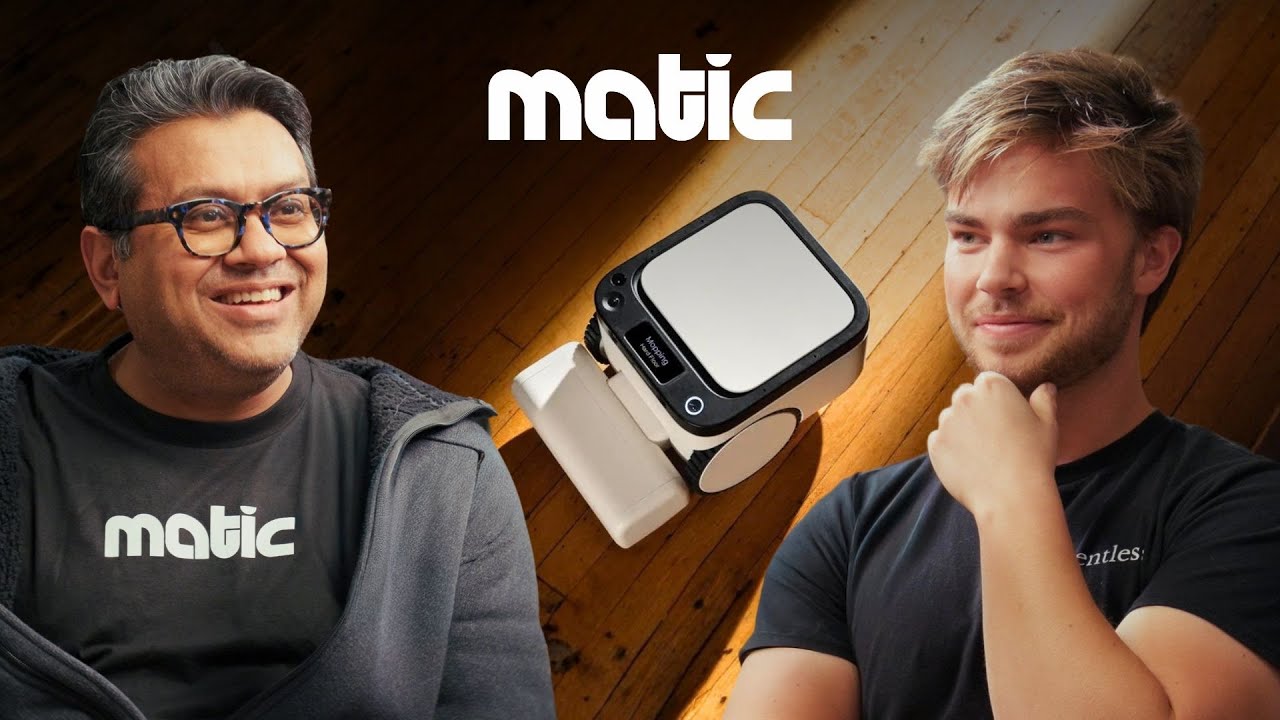
Mehul Nariyawala is co-founder of Matic, a company that spent six years building a vision-only autonomous robot vacuum before shipping its first unit in late 2024. The product has generated unusually passionate early adoption, which Mehul attributes to an obsessive focus on simplicity, solving real customer problems, and treating the entire customer journey as the product.
The Philosophy Behind Matic
Start with the problem, not the technology. Mehul’s first company, Flutter, built gesture detection via webcam — cool technology that solved no real problem. Paul Graham at YC repeatedly told them they were “technology looking for a problem to solve.” That lesson became foundational: Matic exists because people need clean floors, not because robots are exciting.
No one wants a robot — they want a solution. Mehul draws a direct parallel to AI and to Tony Fadell’s philosophy at Nest: people don’t wake up wanting a robot, just like they don’t wake up wanting AI. They want clean floors, great emails, or comfortable homes. The robot is a means to an end.
The goal is an iconic product, not a quick exit. Unlike Flutter (acquired by Google), Matic was designed from day one to never be sold. Mehul watched Nest’s products languish under Google’s ownership and was determined to build something enduring. The aspiration was to build “the Apple of home robotics” — a standalone company that compounds over decades.
Why Robot Vacuums Were Broken
The entire category was built upside down. Early Roombas (2002) navigated by bumping around blind. Later models added single-pixel lidar — still essentially blind, just with one extended hand. Mehul’s analogy: these robots have 20 eyes but no brain. No one was removing the blindfold to build true 3D understanding.
The market was massive but deeply unsatisfying. In 2017, the robot vacuum market was $4.5 billion and growing fast, yet the entire category’s net promoter score was negative one. People kept buying because the need was intense, but they kept disrecommending the products.
Disc-shaped robots are fundamentally flawed. The round form factor can’t clean edges or corners effectively, and the vacuum intake sits two inches away from the wall. Matic redesigned the shape entirely to prioritize cleaning efficacy.
Building a Minimum Lovable Product
Six years of iteration before shipping. Mehul and co-founder Namit (who helped spec Google’s Coral TPU at Nest) started in 2017. They initially thought they’d ship by fall 2020. They shipped in fall 2024 — “off by one digit.”
250+ 3D-printed prototypes. They used 3D printing to iterate cheaply and fast, avoiding the long lead times and expense of injection molding early on. Total spend to get to this stage was roughly $15 million — about one-sixth what typical hardware companies spend, with a team of 70 versus the usual 300.
A problem deck before a solution deck. Before building anything, they documented every customer problem: robots getting stuck on wires, falling down stairs, choking on carpet, being too loud, being ugly, scaring pets and kids. They defined what they didn’t want before designing what they did.
Vision-only as a deliberate bet. Inspired by Tesla’s approach to self-driving, Matic bet everything on RGB cameras and software intelligence rather than adding lidar, bump sensors, and other hardware. Each additional sensor adds exponential complexity — roughly three permanent software engineers per sensor, plus calibration, supply chain, and failure-point costs. The bet: absorb all complexity in software to keep the product affordable and manufacturable.
The Hardest Technical Challenges
SLAM (simultaneous localization and mapping) was not a solved problem. They assumed open-source SLAM libraries would work. After all of 2020 and early 2021, they realized none were remotely good enough — 80% accuracy at best. They wrote their own from scratch over three years, combining neural networks with classical techniques.
Absolute maps, not relative ones. Most robot vacuums build maps relative to their dock — if you move the dock, the robot is lost. Matic built absolute maps so the robot always knows where it is in the home, the way a human does. This required solving the “kidnapping problem” in computer vision.
Precision bar is higher than expected. For trivial tasks like vacuuming, people don’t want to collaborate — they want to delegate. A single popcorn kernel left behind generates a trust-destroying email. The bar for “just works” is far higher than for AI tools where 80% accuracy feels miraculous.
Surviving the Dark Years
COVID almost killed them. In March 2020, they were still mostly bootstrapped with angel funding. They shut down, then brought engineers back within three months — some took 3D printers home to keep iterating. The choice was simple: make progress or die.
Constraining the problem to track progress. They defined base camps: first, can it clean a rug with no obstacles? Then, can it clean a room with obstacles without getting stuck? Then carpets plus hard surfaces? Each milestone was a constrained sub-problem that proved forward movement.
Patience was the hardest thing Mehul ever learned. He’s naturally impatient, and this is the longest he’s held any role. Keeping faith — his own and his team’s — through six years of no revenue was the defining challenge.
Shipping and Scaling
Shipping an incomplete product on purpose. When they shipped in November 2024, the robot didn’t clean edges or under kitchen cabinets. They emailed every pre-order customer with an honest list of what worked and what didn’t, and let people choose whether to receive it. Many early adopters chose to take it anyway.
The “Wife Test” and early evangelists. Their first customers were friends and family — biased supporters. If the product couldn’t make them happy, it was worthless. Later, they placed robots in 20 homes for a year of free testing. Some units were genuinely bad, yet several users refused to return them, having figured out when and where they worked well.
Production hell is real. Scaling from 300 units in Q4 2024 to 3,000 in two months of Q1 2025, targeting 60,000 for the year. At scale, new failure modes surface: 80% of robots suddenly failed noise tests because a motor supplier’s sub-supplier changed the glue on an impeller. Camera delays from ST Micro cost them 60 days. Every scaling step uncovers new bugs.
Hardware forces deliberate growth. Unlike software, you can’t scale instantly. Parts must be ordered 8-10 months ahead. When demand skyrocketed after Tobi Lutke’s tweet, they sold out everything between Black Friday and Cyber Monday — and couldn’t fulfill December orders in time for Christmas. This supply constraint is actually an advantage: it forces you to fix problems before growing further.
Simplicity as Core Culture
Simplicity is harder to maintain than complexity. Mehul draws a number line: WhatsApp on the simple end, Facebook on the complex end. WhatsApp’s purpose is still clear after 15 years. Facebook’s is not. Instagram’s was clear at launch; now no new user can say what it’s for.
Constraints force simplicity. Telegram has 30 employees and one designer. Netflix has ~12,000 employees versus 100,000+ at peers, with only ~50 product managers. When you have 30 people, you only build features that help 90% of users. When you have 3,000, you can always justify a feature that helps “only” 30%.
Delete, don’t archive. When Netflix removed its free trial, they assembled a team to actually delete all related code from their systems. Archiving isn’t simplifying. Mehul applies this internally: keep removing until only the essence remains.
In-N-Out as the model. For 80 years, In-N-Out has never changed its menu, stores, or process. No advertising. Each store does 10x McDonald’s revenue. The lesson: make a promise, deliver it consistently, and resist the urge to add things.
Pain as a Moat
The unsexy work keeps competitors out. Nest thermostat has almost no competition 15 years after launch, despite a clear $130M household market. Why? Because making a thermostat compatible with 60 years of HVAC wiring is tedious, unsexy, whack-a-mole work. Security cameras, by contrast, had hundreds of competitors within months because you could buy a camera from Shenzhen and add OpenCV.
Robot vacuums are similarly unsexy. A Stanford computer vision PhD telling their mom they work on self-driving cars sounds impressive. Telling her they work on robot vacuums sounds like a waste. This is precisely why Mehul chose the category — the tedium is the barrier to entry.
Seven years of pain is a moat. The accumulated knowledge from 250+ prototypes, custom SLAM, vision-only navigation, and production troubleshooting is nearly impossible to replicate quickly.
The Long Game
Matic is a multi-decade products company. The robot vacuum is book one. The mission is to build products that give people their time and energy back — families in the US spend 45-60 hours a week on home chores, three times more than driving. Each subsequent product will solve another intense household problem.
Compounding requires patience. Stripe, Gusto, Amazon — all took years before anyone paid attention. Mehul’s lesson from watching these companies: anything worth building compounds, and there are no shortcuts. Matic will never be sold.
The 11-star experience: A robot that introduces itself to your family by name, rolls out of its box, handles all floor cleaning forever, tells you when it needs help, and only interrupts you when something truly requires your attention. You never think about floor cleaning again.