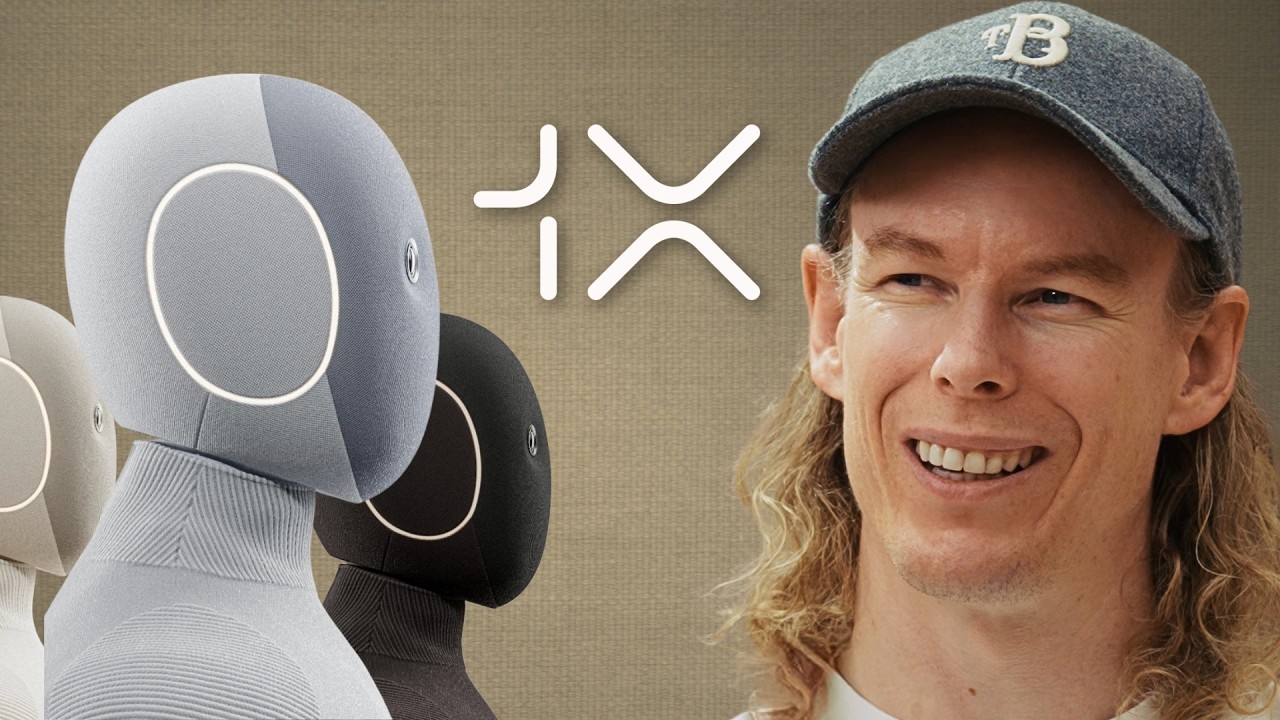
This episode features Bernt Børnich, founder and CEO of 1X, detailing the company’s plan to ship 50,000 Neo humanoid robots in 2027 — a leap from R&D to high-volume production that hinges on in-house manufacturing, a generalist AI strategy built on world models, and a design philosophy that equates simplicity with beauty and scalability.
Shipping 50k humanoids in 2027
1X is ramping two factories in parallel: Hayward (≈10k units/year at full ramp) and San Carlos (≈100k units/year at full ramp), targeting 50k shipped next year with most volume coming online late in the year.
The real gate is not just shipping but ensuring robots don’t come back — quality and yield must improve at each volume step (100 → 1,000 → 10,000) because rare failure modes only become statistically significant at scale.
Prototypes are easy; production is hard — the team iterates through “quality gates,” feeding field lessons back into the fleet before stepping to the next volume tier.
Cars vs humanoid robots
A well-designed humanoid (~1,000 parts, <70 lbs) is mechanically simpler than a car (~50k parts, ~4,000 lbs), but the deployment environment is far less constrained — orders of magnitude more behavioral variance.
Expectation management is key: it will be bumpy; 1X aims for strong customer service and rapid iteration so users don’t face the same problem twice.
Early deployments will target structured, lower-variance environments rather than 50k robots in 50k different tasks.
Living with a Neo
Børnich has lived with 1X robots at home for ~3 years, starting with the wheeled humanoid Eve — that experience drove the push to a full biped (legs aid manipulation, not just locomotion).
The evolution feels surprisingly slow: each hardware iteration requires new data collection, retraining, and redeployment, and the home fleet is small.
The core trust barrier is safety; 1X is working to prove safety formally this year and hopes to share results by year-end.
Automating tasks
Because Neo’s morphology mirrors humans, teleoperation by experts lets 1X test tasks long before automation — providing customer-experience feedback and validating hardware capability.
1X rejects per-task automation (a “deep rabbit hole” given task count and variability) in favor of a generalist approach: train world models on massive, diverse human video/data so the robot inherits broad capability across essentially all tasks.
The new 1X World Model Labs kicked off large training runs this month; early results are promising for solving the general problem on this run.
Bootstrapping: a capable model attempts tasks → generates success/failure data → folded back into training → model improves → fleet deployment closes the real-world loop. This requires a safe robot, a capable model, and a large deployed fleet — hence the 50k target.
Manufacturing ramp
The system was designed from day one for manufacturability: in-house direct-drive motors eliminate complex gearboxes, reducing parts, sensors, control bandwidth, and failure modes.
Trade-off: no existing supply chain — 1X spent a decade building vertical production (company is 11 years old).
Current superpower: ~4 weeks from major CAD change to a new robot walking off the line, enabling rapid hardware iteration driven by line feedback (yield, calibration, assembly issues).
No secret sauce — just grinding through problems; the metric is iteration speed. Problem rate is declining, suggesting they’ll eventually “run out of problems.”
Incorporating feedback
Fleet monitoring and analytics help, but nothing replaces staying close to customers and listening directly.
1X plans significant remanufacturing/field servicing for early units: fixes apply to the existing fleet, not just new builds (e.g., swap a left foot in the field rather than recall).
Sufficiently advanced engineering is art
Børnich sees beauty as a byproduct of simplicity: the minimum-complexity implementation that fully solves the problem. “You don’t design for it to be beautiful inside; if you’ve done your job on system design, it just happens.”
He sees flaws daily (“everything that’s wrong”); beauty is found in simplifications — e.g., wire harnessing complexity driven down via top-down connector/cable budgets and moving-part minimization (if two parts don’t move relative to each other, they should be one part).
Favorite example: motor rotor and shaft made as one part instead of two, halving part count for that assembly.
Keeping teams small
If he could restart, Børnich would keep the core team “way smaller and leaner way longer.” Beautiful, simple products come from tiny, extremely talented teams; headcount adds interfaces and artificial complexity.
Core product design doesn’t scale with people — the advantage is holding the whole system in one head to make cross-cutting decisions. Ideal: no subsystems, just the system.
Understanding the machine
Deep understanding comes from mastering first principles: if you truly grasp why the machine operates as it does, complexity logically dissolves. The goal is to reach the point where the machine looks simple in retrospect.
This requires long tenure and an environment that retains people long enough to build that intuition.
Tooling matters: custom electromechanical design tools (increasingly code-driven) that enforce verifiable correctness. The most valuable people are broad across domains (mechanical, electrical, software, materials) and build their own tools.
Designing for warmth
Hardware warmth: avoid “scary/sci-fi” aesthetics; design technology that blends into society so you stop noticing it’s technology.
Intelligence warmth: world models trained on diverse human data naturally learn social behaviors (handing over objects, body language, predicting other agents) — these emerge from the omni-model, not explicit programming.
Long-term: robots become personalized companions that remember, adapt, and integrate into family/society — “a companion throughout your life that’s always on your side.”
Creating delightful products
Delight is a data problem: tuning training data to produce desired emergent behaviors (surprise, joy, proactive help).
Unsolved research: balancing safety/guardrails with personality — current LLMs are becoming “worse personality-wise” due to over-cautious RLHF (“slapping a smiley on a gut monster”).
1X hopes to curate better behavioral data over time; near-term, “be kind to your robots and they’ll be kind to you.”
Tension: rule-breaking and exploration drive creativity/learning; over-constrained models lose this. Play and curiosity (e.g., a robot shuffling feet in sand to learn dynamics) may be essential.
Creativity
Play as a driver: robots that are curious and playful when idle, exploring the world to build grounded understanding.
Idle time may not exist long-term: as labor cost drops, standards rise (ironed sheets, perfectly arranged glasses) — marginal tasks become worth doing.
Neo platform: opening to developers is critical — 1X can’t solve everything alone. Diverse deployments yield diverse data, which feeds general intelligence.
Collecting real-world data
Human environments are imperfect; cloning human behavior (wrinkled laundry, bad driving) doesn’t yield excellence.
Better: learn world dynamics from all data (consequences of actions), then search for optimal policies given a desired behavior — not imitation, but model-based planning.
Self-driving analogy: human driving data teaches traffic dynamics, not perfect driving; the model then optimizes for safety/efficiency.
World models
Future mirrors LLM landscape: a few dominant general models (best data + evals → flywheel), with niche fine-tunes only for extremely hard, narrow tasks.
Robotics has been a “toy problem” — 4k or even 200k hours is tiny; general intelligence emerges at hundreds of millions of hours.
1X’s bridge strategy: use humanoids to connect vast human video/data (web, egocentric, sensor-equipped humans) to machine execution.
Goal: train models that operate many robot form factors, not just Neo. General → specialized distillation works; specialized → general does not.
Timeline: 2026 still favors specialized models; 2027 likely shifts to general intelligence dominance.
Teleoperation
“You need all the data”: web (99%), simulation, sensor-equipped humans, egocentric video, teleoperated robot data, and autonomous robot exploration.
Intervention data (human corrects robot) is critical at small scale (narrow distribution) but diminishes in importance as model robustness grows — a general model stays in-distribution and self-recovers.
Data is diversity bound
Bottleneck isn’t data volume but diversity: 50k robots × 16 hrs/day = massive daily data, but only valuable if environments/tasks are highly varied.
“You’re almost never data bound, you’re diversity bound.” Lots of same-task data doesn’t help; you need extreme experiential variety.
Deployment breakdown
Mix of enterprise verticals (large customers, ROI-driven adoption → scale → cost/reliability gains), home pilots, and platform/developer units.
Enterprise apps undisclosed but “very material”; not folding (overdone, soft-goods complexity now trivial for AI).
Folding became the standard demo because it used to be hard (deformable, hard to simulate) but is now one of the simplest AI tasks — looks impressive, isn’t.
Chewing glass
Founder journey: “chewing glass and staring into the abyss” — disappointment weekly. The secret is enjoying the journey because there’s no end; each level cleared reveals bigger, worse problems.
Børnich prefers highs+lows over mediocrity; sometimes wonders why he didn’t just build an app, but admits he wasn’t in it for the money — and that wouldn’t have been as fun.