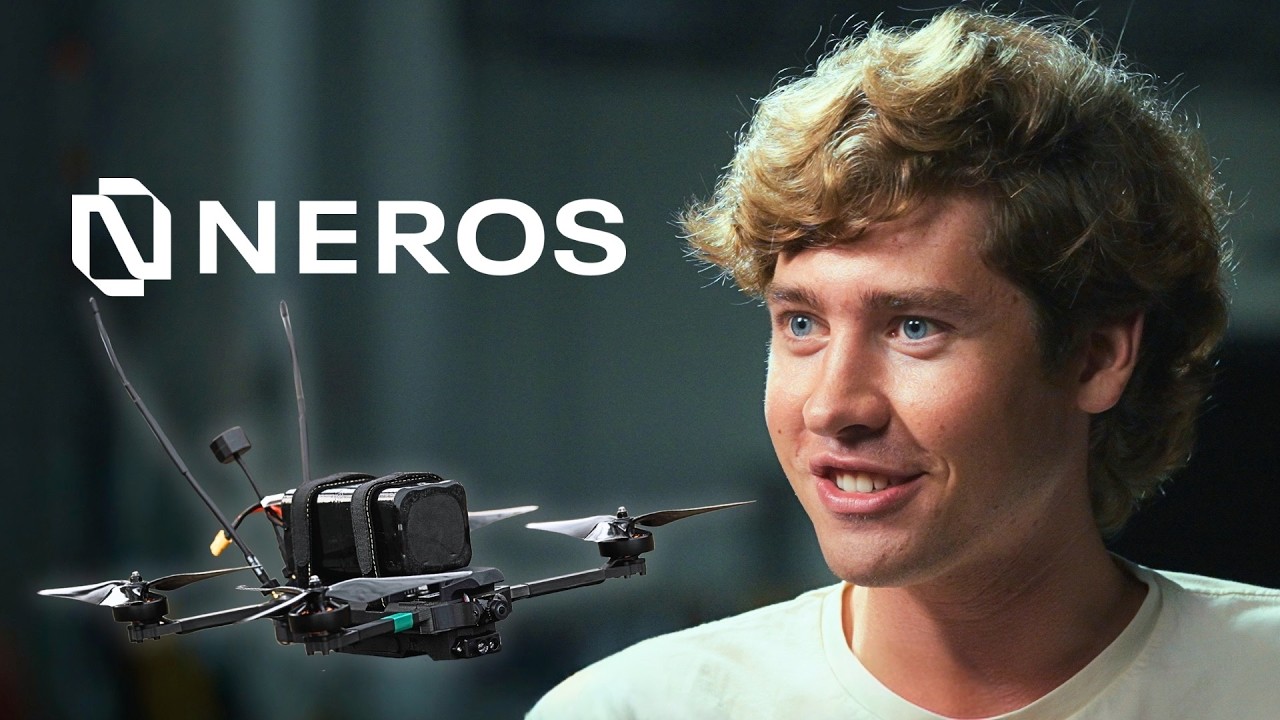
This episode features Olaf Hitchwa, co-founder and CTO of Nuros, discussing the company’s rapid scale-up to a 250,000 sq ft factory targeting 1 million drones/year by 2028, the strategic logic behind their product decisions, manufacturing lessons from China, and why credible deterrence depends on rebuilding America’s industrial base.
Nuros factory ramp and current production scale
Nuros moved from a cramped “small empty box” to a 250,000 sq ft facility in roughly four months and is now completely out of the old building.
Current run rate: ~1,000–1,200 drones/week (one Archer every 2 minutes during business hours), already exceeding any other U.S. drone company’s monthly output.
Target: 130,000 drones/year run rate by December 2024; million-drone/year line designs are underway for subsequent years.
Ground-up redesign of the production line — component feeder stations feeding each assembly station — eliminated constraints imposed by the original folding-table layout.
Drone dominance on the modern battlefield
FPV drones now cause an estimated 70–90% of casualties in Ukraine (per Zelensky and Reuters), a share that dwarfs any other weapon system in history.
The front line is “the drone zone”; drones are the defining weapon system of this generation.
China sells ~14 million drones/year to both Russia and Ukraine (~7M each), creating a perverse dynamic where Ukrainian feedback on Chinese drones flows directly to the Russian side, and Russia often receives newer tech first (e.g., terminal guidance, fiber-optic links).
Western drone production is slowly coming online; multiple companies now announce million-drone/year ambitions, which Hitchwa welcomes as necessary for a credible alternative to Chinese supply.
Product philosophy: user obsession over demo-driven autonomy
From day one, Nuros built based on direct calls with Ukrainian operators who asked for practical solutions: “How do I set off the bomb? How do I make the radio not get jammed? How do I go longer range?” — not AI swarms.
Core principle: ship a working system fast, get field feedback, then fix what breaks. Six-week engineering cycles are sustainable only with periodic breathing room to address deeper pain points.
Autonomy is not a binary switch; “thousand-unit AI swarms” are demo artifacts that collapse on first contact with reality (moving targets, EW, GPS denial, destructive patterns).
Nuros focuses on extreme manual precision and reducing operator burden (e.g., 30-minute commutes to target cause fatigue and loss of situational awareness).
Archer AI: autonomy that assists, not replaces, the operator
Archer AI adds a front-mounted computer-vision stack that can lock onto a target and fly the terminal phase autonomously once the operator is jammed or goes over the RF horizon.
Operator retains full override authority and can retarget in real time; the drone strikes even without comms or GPS.
Solves the “RF horizon” problem: operators can designate a target from altitude, then command the drone to dip behind terrain/trees and complete the strike.
Design decisions are driven by what works for users in combat, not by government demo requirements or congressional wish lists.
Government procurement: building what users need, then telling government what to buy
Government is well-intentioned but often lacks resources to run the deep user studies and combat trials that Nuros conducts (monthly feedback sessions, hundreds of documented successful missions in Ukraine).
Nuros brings Ukrainian operators directly to government stakeholders; their testimony shifts requirements toward proven capability.
The relationship is symbiotic: Nuros explains what the warfighter needs; government explains contracting blockers (e.g., spectrum authorization/JF12 for Marine use), and Nuros funds engineering work to clear them.
Best partnerships occur when government defines the “what” (capability) and Nuros owns the “how” (implementation).
Bandit interceptor: drone-on-drone defense as the only viable counter
First Ukraine trip revealed a society fully mobilized around FPV drones — “the country’s survival” — making clear that only another drone can reliably stop a drone.
Interceptor autonomy is tractable because “hit a dot in the sky” is a structured, math-defined problem, unlike ground autonomy (unstructured, unpredictable humans).
Bandit prototype (serial #3) hits 250+ km/h; major technical challenges ahead: manufacturing at scale, shared component base with Archer (80% line reuse), and flight-dynamics tuning at high speed.
Early development mirrors Archer’s: nights/weekends, hot glue, crashes, tiny team iterating fast.
Manufacturing lessons: from basement to million-unit design
First 30 drones took ~1 man-day each in a Vermont basement; today the line produces one every 2 minutes.
5K–10K/month: supply-chain engineering — dual-source every critical chip, redesign boards (Board A/Board B) with zero part overlap to survive lead-time shocks.
Starlink terminal line (5M+/year) is the only U.S. consumer-electronics production beating China; Nuros hires alumni who bring a “walk to the red” culture — ruthless bottleneck elimination, aerodynamic-drag-level speed targets, and the mindset that “getting it to work once is one-tenth of the work.”
Vertical integration strategy: make vs. buy framework
Nuros vertically integrates when: (1) no supplier exists at target cost (radio: $50 vs. $2–5K quotes), (2) quality control is mission-critical (flight computer bugs risk lives), (3) supply-chain economics favor stockpiling raw components (long-lead chips) over finished assemblies.
Otherwise, buy commodity items (screws, common passives) and focus engineering bandwidth on differentiators.
China trip insights: the ecosystem advantage, not the factory floor
Pre-sanctions visit to a Shenzhen factory revealed 2,000 Russian kamikaze drones/day on simple, labor-heavy lines (dormitory model, 7-day weeks) — impressive scale but not the model Nuros will copy.
The real “secret sauce” is Huaqiangbei: a same-day prototyping ecosystem — chips, PCBs, CNC, injection molding all within walking distance. Board spins in 1 day vs. 6 weeks in the U.S.
JLCPCB runs lights-out, highly automated PCB fabs at massive volume; Nuros was denied a tour.
Building a million-drone/year company requires recreating this industrial-services city domestically: same-day board, camera, lens, molded part.
Credible deterrence and the return to building
Deterrence holds today only because Xi Jinping’s intelligence sees the same Ukrainian feedback: “We speak Chinese here; Chinese drones work.” The window is closing fast.
Reversing course means: (1) returning to a nation of builders — making physical things at scale, (2) reclaiming electronics industrial leadership from Shenzhen, (3) cultural shift: rejecting “I’m too good for weapons” elitism and recognizing that the post-WWII peace was bought by the generation that built the arsenal.
Consumer photography drones are a future target: DJI’s 70%+ market share funds China’s military-industrial base (cargo ships built to PLAN standards). An American competitor requires million-unit economics first, but would flip the funding loop — China buying U.S. drones pointing cameras at their own infrastructure.
Organizational scaling: small teams, perpetual paranoia, dual-mode execution
Engineering teams stay tiny and startup-like (3 years old, “perpetually terrified of big-company bullshit”) to iterate fast on prototypes.
Mass production is a “big ship” — slower to turn, but Hitchwa prefers it: “game of 3D chess” where inventory piles up toward bankruptcy if a station goes down.
Founders (Hitchwa and Saurin) aim to keep calendars free to “unfuck” the worst bottleneck (Elon’s “walk to the red”), deleting unnecessary parts, demanding test data, qualifying every risk.
Business model alignment: government wants credible deterrence; Nuros needs profitable contracts to sustain the factory. Incentives align, but the “aircraft carrier” turning radius requires constant joint strategizing on contracting pathways and user-driven requirements.