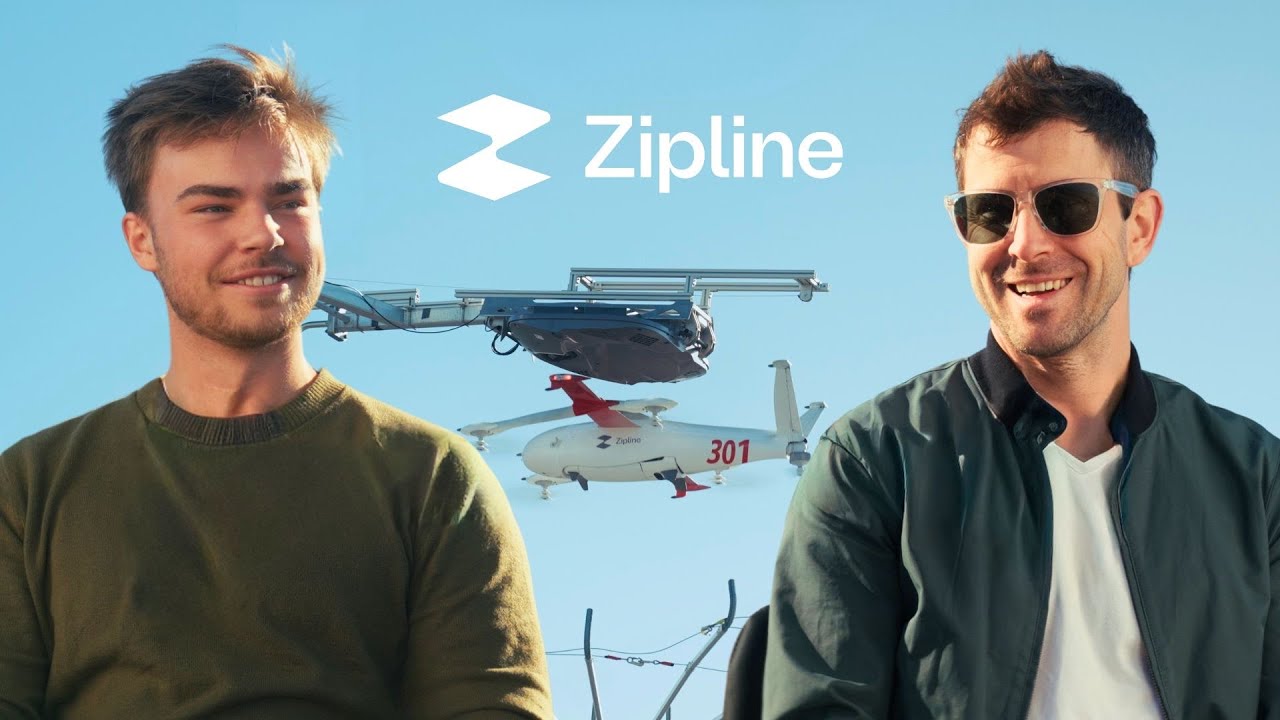
Zipline is an autonomous drone delivery company that has scaled to over 2 million commercial deliveries, starting with blood transfusions in Rwanda and expanding to consumer food and retail deliveries in the US and eight countries. Co-founder and CEO Keller Clifton describes building the company from a scrappy team of 15 in a California trailer park to operating one of the largest autonomous logistics networks on Earth, with 135 million commercial autonomous miles flown and zero safety incidents.
The Core Insight: 100-Year-Old Technology Delivering 5-Pound Packages
Clifton’s founding thesis was that using a 4,000-pound gas combustion vehicle driven by a human to deliver something weighing about 5 pounds is absurdly inefficient, and that a robotic system could do the same job 10 times as fast, dramatically cheaper, and with zero emissions.
He envisioned logistics evolving the same way information did: from people carrying letters on horseback to email, and now from human-driven vehicles to autonomous drones.
The vision is a global automated logistics network that gives everyone equal access to instant delivery, healthcare, and economic opportunity, not just the “golden billion” people currently well-served by existing infrastructure.
Starting in a Trailer Park: Nezero
Zipline began at a site called Nezero, an active cattle ranch in California where the five co-founders leased space for roughly $3,000 a month and lived in construction trailers while designing, building, and flying aircraft every day.
The location served as a cultural filter: it attracted people willing to take epic risks, get their hands dirty, and operate in real-world conditions, traits Clifton considers essential for hardware startups but rare in software companies.
Early prototyping was extremely scrappy, including a recovery system built from deep sea fishing poles bought at Walmart strung between metal hinges, which evolved into “SnapCatch,” a system that has now recovered roughly 1.8 million aircraft.
The company was running out of money every month, board members were openly skeptical about survival, and the sewage system was so overloaded it had to be pumped daily, creating unpleasant working conditions for the team.
Why Rwanda: Shut Up, Just Do Blood
Zipline deliberately chose a small country with a public healthcare system because they believed regulatory permission would only be granted for a use case as compelling as saving lives.
During a meeting with Rwanda’s Minister of Health, Agnes Binagwaho, Clifton pitched autonomous aircraft delivering the entire medical supply chain. She cut him off and said, “Keller, shut up. Just do blood,” explaining that 50% of transfusions go to mothers with postpartum hemorrhaging and 30% to children under five.
Clifton later learned that the morning of their meeting, a mother had died from postpartum hemorrhage due to a cascading chain of failures: the hospital didn’t have blood, the order couldn’t be delivered, someone drove to get it but hit traffic, and by the time they returned she had died. This tragedy made the minister willing to try something radical.
The president of Rwanda was deeply involved and saw technology and innovation as the country’s natural resource, modeling the scrappiness of a startup. The country moved so fast that Clifton could reach ministers or regulators by phone at 10 p.m. on Saturdays.
Clifton reflects that genius and entrepreneurship are evenly distributed globally, but opportunity is not, and that most cutting-edge AI and robotics technology is still focused on wealthy markets when the greatest need and appreciation exists elsewhere.
Scaling in Rwanda: A Nine-Month Shitshow
Zipline signed a contract to serve 21 hospitals but launched with only one, spending nine months struggling to make the system reliable enough for even that single location, doing just a few deliveries a day before something broke.
The team managed blood inventory using Google Sheets, handling four blood types with AB and O positive and negative RH factors, all while integrating with the Rwanda Civil Aviation Authority and the national healthcare system with no prior experience in either domain.
After nine months of all-nighters, they got the system working reliably for one hospital and then expanded to the other 20, eventually growing to 5,000 health facilities across eight countries delivering vaccines, infusions, cancer products, and everything in the public healthcare supply chain.
The Blood Bag on the Roof: Customer Love Meets You Halfway
Early in operations, a GPS algorithm failure caused a blood delivery to land on a hospital roof instead of the designated parking area, missing by 50 to 100 feet during an emergency C-section.
A nurse climbed onto the roof, retrieved the blood bag, and transfused the patient five minutes later. Clifton realized that when the mission is important enough and the need is high enough, customers will meet you halfway, and perfection at launch is not required.
This experience reinforced the philosophy that launching something imperfect but life-saving is acceptable if you can rapidly iterate toward reliability.
Building a New Industry From Scratch
Unlike Tesla, which at least knew it was building a car with four wheels and a steering wheel, Zipline had no precedent for how automated drone logistics should work at scale, including charging, business models, maintenance, regulatory strategy, pricing, or reliability requirements.
Clifton considers Zipline’s practicality its key advantage over well-funded competitors like Amazon, which announced drone delivery on 60 Minutes in 2013 with hundreds of millions in funding. Zipline had a tiny fraction of that budget but prioritized getting real-world operations running quickly.
Safety was paramount, especially since Zipline was delivering life-saving products. The company invested heavily in hardware-in-the-loop (HDL) testing, inspired by SpaceX, connecting actual aircraft avionics to simulators so the plane thinks it’s flying while sitting on a desk, catching 95% of software bugs without risking real crashes.
The remaining 5% of problems only appear in real-world conditions, which is why Zipline built three major test sites operating 24/7 in the US, with a fourth just opened, to encounter edge cases like birds nesting in hardware or solar weather affecting GPS reliability.
Rwanda’s extreme weather, high elevation, and volatile conditions served as “hypergravity training,” forcing Zipline to harden its system to a degree that now makes it the only autonomy company operating at scale in all weather conditions day and night.
Navigating the FAA: Turning a Catch-22 into a Partnership
The FAA faced a chicken-and-egg problem: drone companies needed to operate to prove safety, but the FAA wouldn’t allow operations without proof of safety.
Zipline’s advantage was 40 to 50 million commercial autonomous miles flown outside the US with zero safety incidents, which they presented to the FAA as evidence.
Rather than treating the FAA as an obstacle, Zipline built a productive five-year partnership, finding that individual contributors at the FAA wanted to innovate but were constrained by bureaucracy. Year over year, Zipline expanded what was possible with the FAA as a partner, and Clifton says there are now no regulatory constraints on Zipline’s business.
The Impact: Saving Lives and Building National Pride
Zipline has expanded from Rwanda to Ghana, Nigeria, Côte d’Ivoire, Kenya, and the US, with more countries to be announced.
A University of Pennsylvania study found Zipline reduced the maternal mortality rate in Rwanda by 51%, and global public health institutions estimate Zipline saves about 17,000 lives a year, with plans to scale to 60,000 lives per year through a US State Department contract.
The company hired entirely local teams in each country, creating high-paying jobs for flight operators and fulfillment staff, and promoted from within into global executive leadership, creating a strong sense of local ownership.
Clifton notes that people in the US cities with the most access to technology often appreciate it the least and can be hostile to innovation, while 99% of the world is desperate for technology startups to solve real problems.
WFIO Moments and the 8:30 a.m. Meeting
Zipline jokingly calls company-threatening crises “WFIO moments” (We’re F***ed, It’s Over). Clifton describes multiple such moments, including the night before the president of Rwanda was to inaugurate the distribution center, when the launcher broke at 7 p.m. and the team worked until dawn to fix it, with armed security detail watching skeptically.
The launcher worked perfectly for the presidential demonstration, and then broke again for the next nine months. Clifton notes that every new hardware generation nearly bankrupts the company, comparing it to Tesla’s Model 3 production ramp that nearly destroyed the company 16 years after founding.
Platform 2, Zipline’s next-generation system for consumer delivery, was six months late and nearly killed the company. The team worked through Christmas, canceled vacations, and launched on January 15th with no additional funding available.
Valor Equity Partners, a major investor in Tesla and SpaceX with hands-on hardware scaling expertise, deployed special forces teams into Zipline for a year to help build the disciplined problem-solving process that became the daily 8:30 a.m. meeting, where engineering leaders and individual contributors review the highest-priority issues from the previous 24 hours with no hierarchy or middle management.
Four Innate Characteristics of Great Hires
Clifton says his biggest repeated mistake was hiring for specific experience over innate characteristics, which consistently failed because a fast-moving startup changes direction so quickly that deep expertise in one area becomes irrelevant within months.
The four innate characteristics that predicted success at Zipline were: practical problem solver, fast learner, low ego, and mission-driven. These were considered nearly impossible to teach.
He describes leading a startup as “shameless,” constantly asking the team to believe in new directions after previous ones failed, and quotes the idea that “winning is just going from failure to failure without a loss of enthusiasm.”
Scaling to Consumer Delivery: 15% Week-Over-Week Growth
Zipline’s Platform 2 serves a market 100 to 1,000 times larger than its original healthcare logistics focus, enabling delivery from businesses, hospitals, warehouses, restaurants, and retail stores directly to homes.
Since April, Platform 2 deliveries in the US have been growing roughly 15% week over week, putting the company on a “super vertical” growth curve and reaching thousands of deliveries per day.
The service has a net promoter score of 95, compared to negative 10 to negative 20 for normal delivery platforms, which Clifton sees as evidence of how much people want reliable instant delivery even when existing services are expensive, unreliable, and deliver cold food.
Customers include an 82-year-old grandmother in Bentonville, Arkansas who has ordered 350 times in a year. People are ordering to offices, universities, apartments, town homes, hotels, and public parks.
Families report changing their grocery shopping behavior, doing one big shop per week plus three to four fill-in orders, eating fresher and healthier food, wasting less, and saving three to five hours per week previously spent battling traffic and dragging kids through stores.
Clifton believes the current 5.5 billion instant deliveries per year in the US will grow to 50 billion, which is impossible to serve with human drivers and existing road infrastructure, making automation not just preferable but necessary.