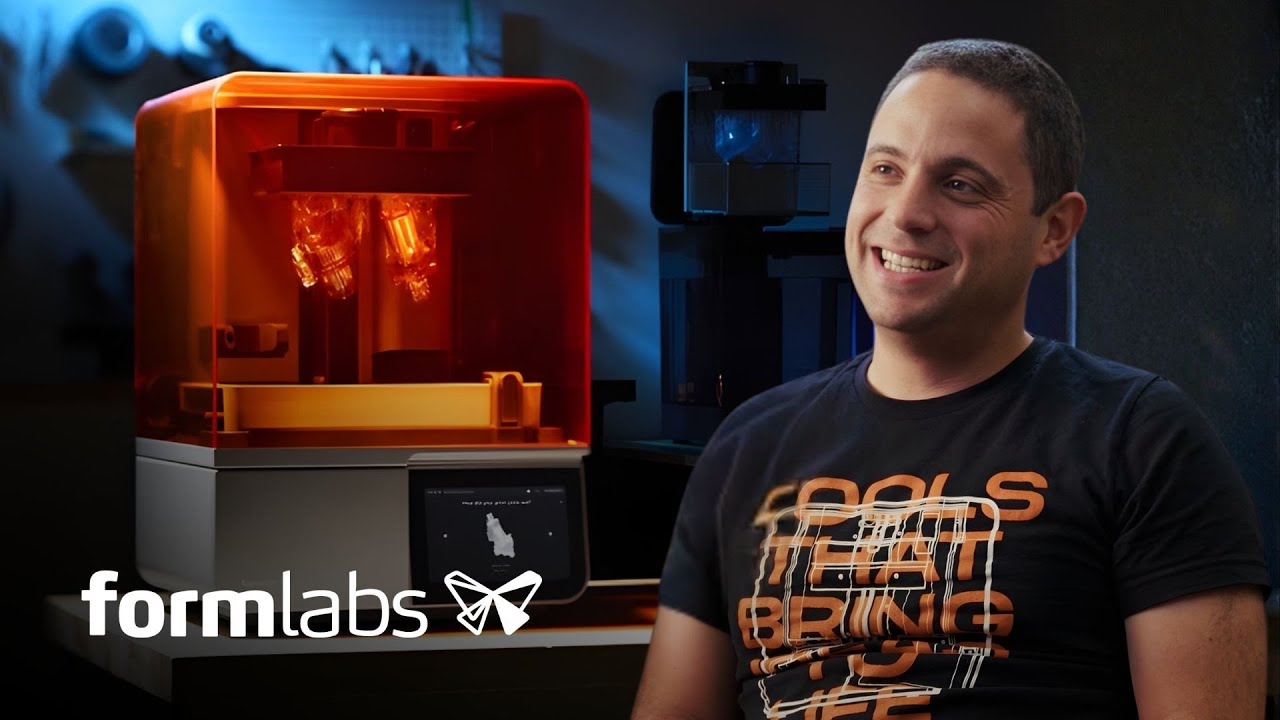
Max Lobovsky is the co-founder and CEO of Formlabs, a 3D printing company that has survived and thrived in an industry littered with failed startups. The episode covers the company’s origin story, near-death experiences including a patent lawsuit from 3D Systems, the strategic decisions behind product development and supply chain, and Max’s philosophy on leadership, talent, and competition with China.
Why so many 3D printing companies fail
The dream of 3D printing is enormous: going from a digital model to a physical object quickly, cheaply, and easily, which is something anyone who has made anything in the physical world knows is usually painful and limiting.
This conceptual appeal has drawn many companies into the space, but the gap between a working prototype and a reliable mass-produced product is brutally wide.
Formlabs succeeded where others failed by combining hardware, software, and materials engineering under one roof, and by maintaining financial discipline that many venture-backed competitors lacked.
Starting Formlabs and the Kickstarter campaign
Max and his co-founders started with the goal of bringing stereolithography (SLA), a resin-based 3D printing process, to the desktop at a professional quality level, something that previously required $100,000 machines.
After building a prototype and raising about $1.8 million in early venture funding, they launched the Form 1 on Kickstarter in 2012.
They raised $3 million on Kickstarter, far exceeding expectations, with $1 million coming in within the first two days.
The celebration quickly turned to stress as they realized they had to scale production far beyond what they had planned.
The 3D Systems patent lawsuit
Just weeks after the Kickstarter, 3D Systems, the largest 3D printing company in the world at the time, sued Formlabs for patent infringement.
The CEO of 3D Systems called Max directly, saying his board had forced him to sue, and their settlement offer was essentially for Formlabs to hand over the company and have jobs at 3D Systems.
Most lawyers told them fighting would cost $3–4 million, far more than the roughly $2 million they had raised, making the lawsuit an existential threat.
Max’s strategy was to slow-roll the lawsuit while the company grew stronger and the patents approached expiration, eventually settling for a relatively small amount.
The lawsuit made everything harder: hiring, fundraising, and customer confidence were all affected, but Max tried to shield the team from unnecessary stress and keep them focused on delivering the product.
Lessons from the lawsuit and early culture
Max learned to compartmentalize stress: absorb it, process it with friends or family, then step back and focus on what the team could actually control.
A board member gave him a principle he still follows: “Stress should only flow upward in a business.” Push people to their limits with ambitious goals, but don’t burden them with problems they can’t solve.
The experience forged a culture of focus on what really matters: delivering a great product to customers, rather than being distracted by investor concerns, legal battles, or other noise.
The Form 1 and the decision to cut features
The Form 1 was designed with a clear list of features that were cut for the first version, including a resin cartridge system, Wi-Fi, and a touchscreen, because they weren’t critical to proving the core product.
Even with those cuts, the Form 1 wasn’t reliable enough: it had a high return rate and required many repairs.
Max reflects that the hardest part of hardware is making something that works reliably at scale across many users with varying conditions and manufacturing variation, and it’s always worse than you expect.
The biggest strategic mistake: choosing SLA over FDM
Formlabs started with two ideas: bring SLA to the desktop, and make a professional desktop printer. The second idea was actually more important.
Max chose SLA because it felt like harder, more valuable technology (lasers, galvanometers, photopolymers) compared to FDM, which he dismissed as “a glue gun on a three-axis.”
In retrospect, FDM is a much larger market category, and if they had applied their professional-desktop-printer idea to FDM, they would be a larger company today.
The companies that were doing FDM at the time (like Makerbot) are irrelevant today, so the window was open.
Max identifies this as the classic MIT startup failure mode: orienting around a hard technology rather than a valuable problem. “You need to orient yourself around the problem, not the solution.”
There is no correlation between how hard something is and how valuable it is. The world cares about what problem you solve, not how impressive your technology is.
Applying the lesson going forward
Max now tries to always consider multiple options and directions rather than fixating on the first exciting idea.
He thinks in roughly three-year development cycles for new printer products, asking what’s the best thing they can get out of the door in that timeframe.
He acknowledges they’re getting good at the three-year view but need to add back in five- and ten-year thinking for things that can’t be done in three years.
Formlabs as a “cockroach” company
Max describes Formlabs as a cockroach: there have been billions of dollars poured into 3D printing startups over the past 10–15 years, and Formlabs is one of the only successful large new 3D printing companies in the Western world.
The business is “unreasonably complex for what’s not that big of a business”: they do hardware, software, and materials engineering; manufacture through contract manufacturers in China; run their own chemical plant in Ohio; and sell in about 100 countries from consumer e-commerce up to multi-million dollar enterprise deals.
Supply chain evolution
Form 1 was built with a contract manufacturer in San Diego; Form 2 with one in Hungary (connected through the chief product officer’s father, who ran the largest independent contract manufacturer there); Form 3 and later products with contract manufacturers in China’s Guangdong province.
For materials, they started with a toll manufacturer and eventually acquired the chemical plant in Ohio once they had enough volume and knowledge to justify bringing it in-house.
Recently they’ve moved some hardware manufacturing to Vietnam to deal with tariffs.
Max’s principle: do as little in-house as possible, and only bring something in-house when you have a unique problem and you’ve reached the state-of-the-art in knowledge about it.
Developing galvanometers in-house
Galvanometers are precision electric motors that position mirrors to scan the laser in SLA printers, and they’re normally expensive specialized industrial components.
Formlabs started with low-cost galvos designed for laser light shows, which weren’t accurate enough, and worked with suppliers to improve them.
As they became one of the largest consumers of galvos in the world, they started a parallel project to build their own, keeping it compatible with the off-the-shelf version as a fallback.
The in-house galvo came online just at the end of the development timeline, and it improved print quality and speed. They still design and build their own galvos today.
The first fundraising round and a lucky break
The hardest early hurdle was the first round of funding. Max describes himself as not great at fundraising, and in 2011 Boston, 23-year-olds with no work experience starting a hardware company was an impossible pitch.
They spent months pitching investors with a prototype that only worked for a few minutes at a time, timing their basement demos carefully.
At a pitch dinner at Legal Seafoods in Harvard Square, they pitched a VC from Best Buy who passed. But someone at the next table overheard and tweeted about it.
A friend sent them the tweet, which had been retweeted by Mitch Capper, founder of Lotus Software and Lotus Notes.
Max’s co-founder David emailed Capper with a one-liner, and Capper ended up leading their first round. Max believes without that lucky break, the company might never have gotten started.
The lesson for the naturally introverted Max: “Helping to make yourself lucky by meeting people actually really works.”
Max’s superpowers
Max identifies two: identifying young, promising people before they’ve accomplished something big and betting on them, and cutting through distraction to focus on what actually needs to get done.
He credits the team’s collective superpowers as the real basis of Formlabs’ success.
How Max identifies talent
His simplest rubric: is the person smart, and are they willing to do the job that needs to be done?
The second trait is the subtler one. Many smart people have a fixed idea of what they want to do that doesn’t align, or they lack the ability to understand what actually needs to be done.
The most capable people are personally flexible: they recognize that different problems require different tools, and they’re willing to pick up the phone, call a supplier, adapt their approach, even if it doesn’t come naturally.
He references the “CEO should also be the janitor” idea, though he sees himself more as an orchestrator. A concrete example he still does: acting as a customer support agent, including on difficult cases, to stay connected to what needs to be done.
Positioning the company competitively
Max tries to meet as many leaders of competitors and similar companies as possible to absorb their perspectives and learnings, treating it as a shortcut to knowledge gained from different vantage points.
He believes you should know what your competitors are doing better than they do, and understand why they’re doing things differently, because there are usually valid reasons behind their choices even if you disagree.
Raising money and financial discipline
Formlabs raised relatively little money until a $250 million SoftBank round in 2021. Max believes the constraints of not having huge amounts of cash were positive, instilling cost discipline that is essential in manufacturing.
He compares this to Tesla versus other EV companies: Tesla’s cost discipline shows, while companies like Lucid and Rivian have negative gross margins.
He thinks they raised too much money and could have built the company with much less.
The decision to raise and the decision to spend should be independent, but even disciplined companies struggle to keep them separate.
He’s glad they raised in 2021 because 3D printing is no longer a hot field for venture capital, but Formlabs is now profitable and growing and doesn’t need the money.
They haven’t been consistently profitable until the last couple of years, but since Kickstarter, most of their spending has come from customer revenue.
He believes they could have spent $100 million less on sales and marketing over the past six or seven years and gotten the same result.
Supplier relationships
For Chinese suppliers (and now globally), Formlabs makes a 3D printed and painted statue of the Chinese zodiac animal each year and sends it to key suppliers.
They hold an annual supplier summit with awards, and some supplier relationships date back to the company’s founding, including a one-owner, 15-machine CNC shop in China whose owner texts Max regularly.
Dealing with tariffs and disruption
Tariffs were highly disruptive internally, with the operations team spending months in weekly meetings tracking the latest policy changes and trying to understand overlapping and contradictory announcements.
Once they worked through the changes, the impact on costs was moderated because Formlabs is so international, with manufacturing in the US and other countries, so no single country-pair trade flow is dominant.
Max believes tariffs have actually helped Chinese companies over American companies on net, because within most product categories, things are made in the same place (e.g., Apple and Huawei both make phones in China), and Chinese companies adapt to disruptions faster than American ones.
Max’s mental model for dealing with problems
First principle: focus on the problem, not the solution. Problems are rarely stated correctly when they reach you; someone says “we’re having a problem with this supplier” when they actually mean “the product is too expensive to manufacture.” Understanding the root problem is essential.
Second principle: be lazy. Learn as much as possible from what others have done. Very few problems are totally unique. Find the right analogy: when entering a new market like Japan, study three companies doing something similar and learn from their approaches.
He references a German general’s theory of four types of officers (lazy vs. hardworking × smart vs. dumb): the lazy and smart ones are suited for highest leadership because they’re careful about how they spend their time, making sure each thing they work on is truly worth doing.
3D printing in Ukraine
Formlabs printers are used extensively in Ukraine for making drone parts and for making prosthetics, literally the same technology used to blow people up and to repair them.
Max was born in New Jersey but his parents grew up in Ukraine, and he’s planning his first trip there, combining a personal visit with philanthropy and supporting 3D printing adoption.
He supports Ukraine defending itself but doesn’t take a position on how customers use their products, which range from dentists to people making sex toys to drone manufacturers.
China as the global leader in manufacturing
Max has been traveling to China since 2014 and has seen enormous development firsthand. He believes China will be the global leader in essentially every field of technology in the coming years.
He sees China as better organized around the mission of making it easier for people to make things and encouraging problem-solving in the physical world, which is closely tied to his own mission with Formlabs.
He views the transition away from American global dominance as likely irreversible in the long term, driven by basic math: China has four times the population and is hardworking, entrepreneurial, and smart.
Maintaining a complete modern technology stack now requires roughly a billion people, which no single country can provide. The US cannot go it alone.
He doesn’t think this means the US is finished, but any realistic path forward requires alliances that collectively reach a billion people.
Bell Labs as an inspiration
Max grew up in New Providence, New Jersey, next to Bell Labs headquarters in Murray Hill, and his mother worked there. He’s fascinated by Bell Labs, where a few thousand people invented half of modern computing and telecommunications.
Two key lessons from Bell Labs: first, assembling very smart people from diverse fields together creates something no individual university group could; second, AT&T had an extremely diverse problem space (from telephone handsets to switching equipment to telephone poles that last 50 years), which gave open-ended research a rich set of real problems to solve.
Modern attempts at Bell Labs (Google, Microsoft) have the profitable monopoly but lack the diverse problem space, so they end up throwing solutions at the wall without deep problem expertise.
Formlabs has the rich problem space but not yet the super-profitable monopoly. Max doesn’t think they’re in the Bell Labs phase yet; they still need to make a lot more money first.
Is this Max’s last company?
Max regularly considers whether Formlabs is the most impactful thing he could be doing, and keeps coming back to yes, but he’s not certain that will always be true.
He has other interests, particularly in aviation: airships or ground effect aircraft as a middle ground between ocean cargo and air freight, and eVTOL/flying cars.
He uses a version of Steve Jobs’ mirror test: if today were his last day, would he be happy doing what he’s doing? When too many days in a row feel like no, it’s time to change direction.
He’s gone through periods of lower commitment but has always returned to Formlabs after considering alternatives. A weekend in San Francisco talking to a hundred people with big ideas is a useful way to stress-test his commitment.
The hardest thing Max has overcome
Learning to be a team player in the sense of being open and broadcasting his personal motivation, enthusiasm, and dreams to a large organization and customer base.
This doesn’t come naturally to him. In a 20-person company, everyone intuitively knows what you’re after, but at scale you have to communicate in a broadcast fashion with no immediate feedback, which he finds difficult.
He’s much more comfortable in interactive one-on-one conversations where he can read the other person and adapt.