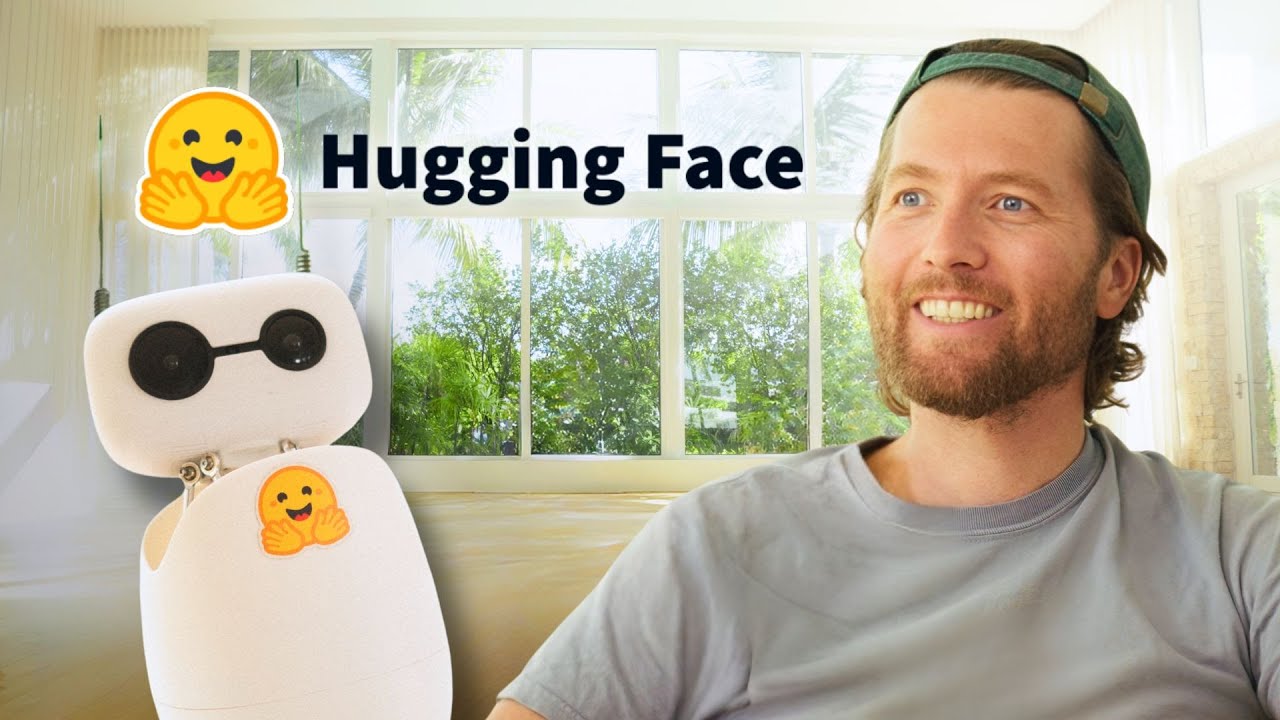
Clem Delangue is the co-founder and CEO of Hugging Face, the open-source platform often described as “GitHub for AI,” hosting over 6 million models, datasets, and apps used by 11 million AI builders worldwide. In this conversation, he discusses the company’s new open-source desktop robot called Richie Mini, the philosophy behind open-source AI, how Hugging Face’s unusual decentralized culture works, and why he believes open source is the key to preventing AI power from concentrating in a handful of companies.
Richie Mini: an open-source desktop robot for AI builders
Richie Mini is a $400–$500 open-source desktop robot that Hugging Face began shipping recently, with over 5,000 pre-orders. Most of it can be 3D printed, it ships unassembled (Clem’s took him five hours to build), and it is fully programmable — users build their own apps on top of it using the latest open-source AI models.
The idea came from seeing AI builders struggle with the lack of affordable hardware. Early-entry robots cost $20,000–$100,000, which is prohibitive for experimentation. Richie Mini is meant to sit next to a laptop and let people tinker.
Clem sees tinkering as one of the most impactful things for AI right now because AI has strong natural tendencies toward concentration of power. If only a few companies can build AI, everyone else is doomed to be merely a user. Open-source hardware and software fight that tendency.
The vision is twofold:
Software side: As new models (Gemini, GPT, etc.) are released, builders should be able to instantly translate new capabilities into robotics apps — object recognition, teaching kids, playing games.
Hardware side: Because it is open source, the community is expected to modify and improve it — adding wheels, grippers, better motors — the same way the IKEA effect makes people value furniture they assembled themselves.
The robot is deliberately friendly and joyful in design. Clem believes transparency and approachability help counter the fear and sci-fi dystopian narratives that surround AI.
Hugging Face’s origin story and community-driven DNA
Hugging Face started around 2016–2017 as a Tamagotchi-style conversational AI app (a chatbot before ChatGPT). The pivotal moment came when co-founder Thomas Wolf noticed Google had released the influential BERT model in TensorFlow, but the community mostly used PyTorch. He spent a weekend porting it, tweeted it on Monday, and got a thousand likes — which felt like “breaking the internet” at the time.
Researchers immediately started adding their own models to the repository — including the team behind the original GPT and the team that would later create Mistral. This organic community contribution became the foundation of Hugging Face as a platform.
The founders were “three random French guys without much network or special access.” The community made them what they are, which is why every decision at Hugging Face is filtered through the question: how does this benefit the community?
Incentives and monetization
The Hugging Face platform is 99% free. Clem deliberately designed the business so that making open source more popular directly benefits the company — aligning incentives rather than fighting human nature.
He contrasts this with API-first AI companies that get trapped in a monetization race: the more money they make from APIs, the more they invest in training, and the harder it becomes to justify open-sourcing anything.
Hugging Face has forgone opportunities to build proprietary models or its own compute cloud, choosing instead to partner with AWS, Google Cloud, and inference providers like Fireworks. The principle is: if someone is already doing it well, don’t reinvent the wheel — focus on what the community still needs.
Decentralized culture and hiring generalists
Hugging Face has an unusual flat structure with very little specialization. There are no dedicated HR or community management teams. Anyone can tweet from the main Hugging Face account. Everyone is responsible for hiring, communicating, and interacting with the community.
They hire generalists rather than specialists — people who can do technical work, communicate, and hire. This brings fresh perspectives: engineers who hire think differently about recruiting than HR people would, and non-engineers who think about product bring different ideas.
This culture enables serendipity. The PyTorch BERT port happened because Thomas Wolf was free to pursue an idea that had nothing to do with what the company was “supposed” to be doing. Richie Mini emerged the same way — team members were excited, so they experimented.
Clem’s main job as CEO is to say yes, empower people, remove roadblocks, and reassure teams that they can release early and imperfectly rather than waiting for perfection.
Trust as the core asset
Clem believes trust is the most powerful economic force and the thing Hugging Face optimizes for. The company is widely loved among AI builders, which he attributes to never having done a “rug pull” — the community has watched them consistently prioritize openness for years.
Trust compounds over time. In the first six years before ChatGPT, Hugging Face had little revenue. But that slow period built the trust that made people willing to invest their time, models, and datasets on the platform. You cannot fake or accelerate this.
The platform now has over 6 million models, datasets, and apps, with a new repository created every 8 seconds. This scale creates powerful network effects — similar to GitHub — making it practically impossible for a new competitor to catch up.
Philosophy: Sisyphus and the joy of building
Clem’s favorite book is Albert Camus’s The Myth of Sisyphus, about a man cursed to push a rock up a mountain for eternity, only for it to roll back down. Camus’s conclusion — “one must imagine Sisyphus happy” — resonates deeply with Clem’s view of entrepreneurship.
Happiness comes from the task itself, not from reaching the top. If you align your joy with the daily work of building — hiring, experimenting, releasing — you become much harder to stop. Each time the rock rolls back down, it’s a little more your rock: you gain more agency, more freedom, more alignment with who you are.
He also draws on French philosopher Clément Rosset’s idea that joy comes from the gap between the meaninglessness of the world and the enjoyment you find in it. The things that drive you most powerfully are not the ones with obvious higher purpose, but the ones that bring you joy despite — or because of — their apparent vanity.
Great companies as embodiments of their founders
Clem believes great companies are living reflections of their founders’ souls. A common failure pattern is founders starting with genuine excitement, then pivoting to chase what they “should” do based on investor pressure or imagined playbooks — eventually building a company they don’t even enjoy working for.
His advice to founders: focus on what you’re excited to build, check whether you could wake up every morning for five years doing it, and ignore the noise about what a “big company” is supposed to look like.
He follows Jeff Bezos’s “two-way door” philosophy: most decisions are reversible, so take action, see how it feels, and walk back if it doesn’t. He tries to do at least one experiment per week driven by excitement rather than rationalization.
He deliberately avoids to-do lists and assistants because he believes if something is truly important and exciting, you’ll remember to do it. If it needs to be on a list, it probably shouldn’t be done. Avoiding unnecessary complexity keeps life aligned with what genuinely matters.
Why open source matters
AI has extremely strong natural tendencies toward concentration of power, capability, and wealth. Without intervention, only a few companies will be able to build AI, and everyone else will be reduced to being a user — a “very scary dystopian world.”
Open source — the ability to freely share models, datasets, and tools — is the antidote. It gives every organization the foundations to build AI products without starting from scratch.
The future Clem envisions is not a few giant generalist models but millions of smaller, specialized, customized models — just as every company writes its own code rather than sharing one giant codebase. Smaller models are easier to iterate on, faster and cheaper to run, and better at specific tasks (e.g., a banking chatbot doesn’t need to know the meaning of life).
He sees the current moment as a critical juncture: the US was the leader in open-source AI from 2016–2022 (transformers, BERT, GPT-1 were all open), but around 2022, US companies began closing up as money poured in. China stepped into the vacuum and is now leading in open-source models (DeepSeek, etc.). This is a risk because:
American startups are building on Chinese foundations, inheriting Chinese cultural biases.
It gives China more influence over the direction of AI development.
The country that leads in open-source foundations accelerates its overall AI progress.
There are encouraging signs of a US comeback: xAI open-sourced Grok 3, OpenAI released gpt-oss, Allen AI and Nvidia are releasing models and datasets, and the current US administration’s AI action plan explicitly calls for fostering open weights and open datasets.
Trends in robotics
Robotics is at an inflection point where better, more affordable hardware is converging with rapidly improving AI software. But the field is currently siloed — every robotics lab builds its own incompatible software-hardware stack, which slows progress.
Hugging Face is pushing for more open-source standards and sharing in robotics through its LeRobot library, which has become one of the most popular robotics libraries. The hope is that collaboration will unlock a “ChatGPT moment” for robotics.
Clem notes that many of the smartest people in AI are thinking about robotics beyond the humanoid form factor, exploring designs optimized for specific tasks rather than general human-like movement.
The hardest thing
The most difficult part of the journey for Clem personally is when long-time team members leave to pursue new challenges or start their own companies. He has learned to accept it, especially since many former Hugging Face employees go on to build impactful things and sometimes contribute back to the ecosystem, but it remains the most emotionally challenging aspect of being a founder.