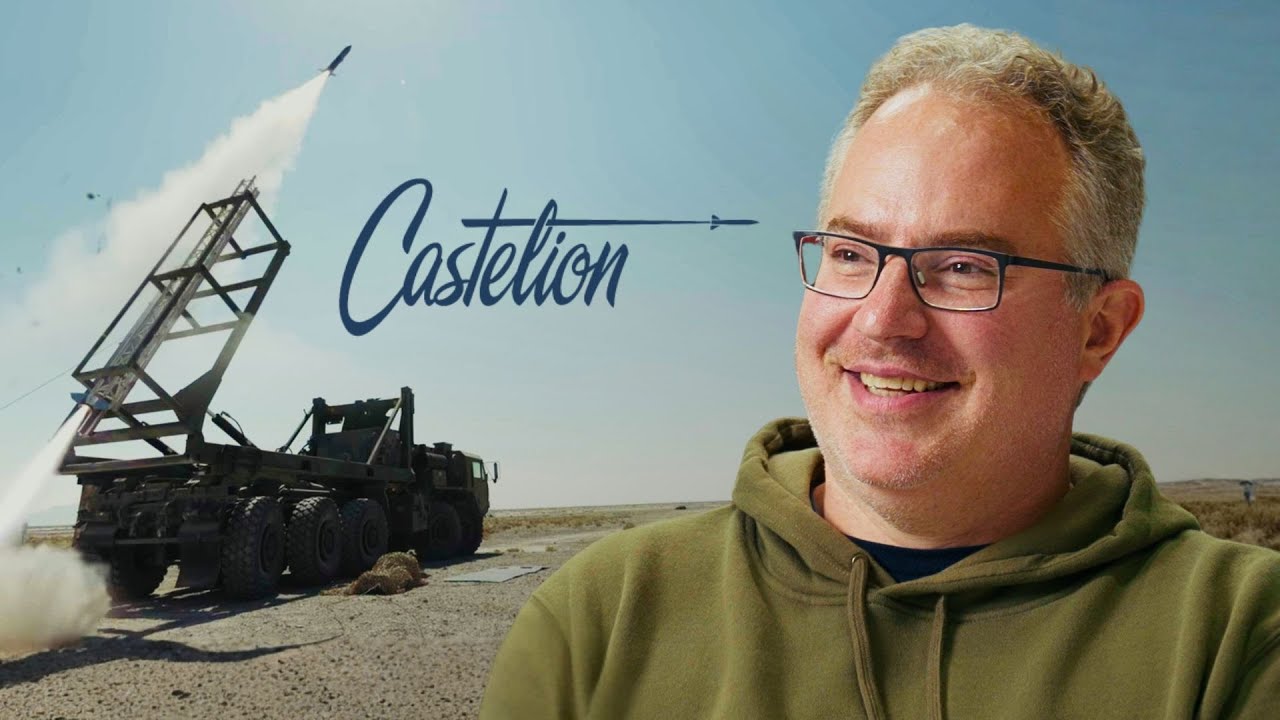
Castelion is a defense startup building hypersonic missiles to restore US deterrence against peer adversaries like China. Co-founder and CEO Bryon Hargis, a former SpaceX engineer, explains that the US has lost the ability to hold adversaries at risk with anything between economic sanctions and nuclear war. Hypersonic missiles — which travel extremely fast at high altitudes over vast distances while being highly survivable against interception — fill that gap. The company’s approach borrows heavily from SpaceX’s rapid iteration philosophy, aiming to develop and produce missiles faster and cheaper than traditional aerospace allows.
What hypersonic missiles do and why they matter
Hypersonic missiles solve a specific strategic problem: China’s anti-access/area denial (A2/AD) bubble makes it extremely difficult for the US to get close enough to credibly threaten targets and deter actions like an invasion of Taiwan.
Three capabilities combined: they close vast distances quickly, travel extremely far at high altitude where drag is low, and are highly survivable — hard to intercept.
The result is “deterrence in a can” — giving policymakers a credible option between sanctions and nuclear escalation, a middle ground the US has effectively ceded over recent decades.
SpaceX’s influence on Castelion’s approach
Traditional aerospace development is painfully slow and risk-averse. The standard systems engineering V-process breaks a problem into requirements, decomposes them into subsystems, designs to meet them, then verifies and validates — typically taking 5–7 years before a first prototype is even built and tested.
The core problem: with only one learning cycle per seven years, engineers never get good at building real hardware. Most programs get cancelled during the design phase due to cost and schedule overruns. Engineers may spend eight years on a single subsystem of a single program without ever seeing a full lifecycle.
SpaceX revived the Apollo-era approach: the same process, but compressed into much shorter cycles, repeated rapidly. This lets engineers learn what actually matters versus what they wasted time worrying about, and — critically — learn production by actually building hardware repeatedly.
The key insight is that the bottleneck is labor cost, not hardware. SpaceX could afford to blow up stainless steel prototypes in Boca Chica because the real cost is the engineering team’s time. Faster iteration means lower total cost.
Hargis’s biggest takeaway: the fastest learner wins. China, Iran, and North Korea can’t afford to do aerospace the US way, so they iterate quickly. North Korea’s missile program was mocked until it worked — then it became scary. Given enough tries, anyone can solve a problem.
Starting Castelion: raising money in a hostile environment
Defense hardware selling only to the government is the triple whammy for fundraising. When Castelion started in late 2022, defense was “anti-hot,” hardware is hard to raise money for, and government-only sales is unappealing to investors.
The first three months were unpaid. The founding team worked for nearly nothing on analysis, design, and early business development, trying to win any contract — even a tiny one — to show investors traction and generate cash to pay people.
Reputation was the initial currency. Hargis leveraged personal relationships from his years in the industry. People who didn’t know Castelion knew him and were willing to give a chance based on trust built over decades. He describes it as lending personal credibility to the company.
The paradox of fundraising: money flows to those who don’t need it. Once Castelion started succeeding, investors showered them with cash they didn’t need. When things were tough and they desperately needed funding, it was nearly impossible to get. The best business development is simply doing what you said you’d do — eventually people believe you and give you more leash.
Operating under resource constraints
Hargis is comfortable operating with nothing because he’s been there before. Resource constraints are freeing — they eliminate options and force focus. Even with a bankroll now, Castelion still operates as if resource-constrained to avoid dumb decisions.
Every employee knows the daily burn rate. Hargis shares the company’s full financial position monthly so people can make educated decisions about spending. The message: “This isn’t my money or the company’s money — it’s our money. When it runs out, none of us get paid.”
The strategy is to knock down investor risk categories (technical, market, team) with each round of funding by choosing demonstrations that can be done with available capital and people, unlocking the next contract, which reduces market risk, which unlocks the next round.
Testing is cheap enough that running out of cash from failed tests is never the fear — unlike space, where you might get three or four attempts maximum. The constraint is labor: how fast can you iterate before payroll burns you down?
Doing business with the government
Government sales are nothing like commercial deals. There’s no equivalent of the Daimler-Tesla go-kart moment where a single demo closes a deal. It’s always drawn out, involving multiple offices in the executive branch, Congress for authorization and appropriation, and the Pentagon — any of which can slow or stop things for reasons unrelated to you.
Hardware demonstrations are the only thing that moves the needle. Government customers respond to seeing physical hardware work. Software-only demonstrations are an uphill battle because that’s not how their brains are wired. Castelion deliberately underplays its enormous software capabilities because customers aren’t ready to hear about it — they just want to know if these people can build a missile that works.
The key to government trust: just do what you said, repeatedly. The first time you deliver on a promise it’s a fluke. The second time it’s a pattern. Eventually people give you bigger slices and more leash. Even when you’re already working two steps ahead, you have to go back and prove you did the basics.
Contingency planning is essential because government timelines are unreliable. Castelion plans for expected timelines but has backup plans for delays. Private capital has backfilled gaps in government funding, avoiding the “valley of death” where S&T funding ends but acquisition programs take years to materialize — a pattern that kills many defense companies through forced layoffs and flatlining.
Building the team and culture
The most important trait Hargis screens for: relentlessness. In sales and in startups, you get told no 50 times, you get kicked repeatedly — before starting, during starting, and continuously after. If that deters you, it’s not the lifestyle for you. Success has a huge degree of luck, but what you can control is getting up again and again.
Passion for the mission matters more than career ambition. Hargis asks candidates where they want to be in five years. Someone who just wants to manage a huge team can do that anywhere. He wants people who will happily grind in a ditch with him. At a recent government meeting, when employees shared why they joined — despite better-paying options elsewhere, despite the chance to start a billion-dollar AI company — it was the most heartwarming moment he can recall.
Co-founders are like a marriage you can’t easily exit. Hargis chose Sean and Andrew because he’d worked with them for years and knew their character. Sean in particular tells Hargis immediately and bluntly when he’s screwing up — a trait Hargis values above almost anything. You need someone who will point out your blind spots, tell you when you’re being an idiot, and pull you aside when your frustration is negatively affecting the team.
Vectors must be aligned. Bigger teams don’t mean better outcomes — unaligned vectors in an organization cancel each other out. Small, focused teams with shared goals and the authority to act can accomplish extraordinary things. At ~150 people, Castelion punches far above its weight because everyone rows the same way on a limited number of highly related things, unlike the traditional defense consulting model of scattered cost-plus contracts.
Focus and the product model
Castelion deliberately does one thing extremely well rather than many things poorly. The company follows a product model (like Anduril) rather than the traditional defense consulting model of taking every contract and spreading across unrelated work.
The first missile is the slowest they’ll ever build. Product two will be faster because the muscle is built, designs exist, production facilities are being constructed, and they’re not starting from zero. They’re assembling the car while driving it — once the car is built, it goes faster.
The venture community says “go big or go home,” but Hargion rejects that. He’d rather do a medium-hard thing, scale, then tackle the hardest thing, than go directly to the hardest challenge where the probability of smooth execution or customer adoption is near zero. He wants Castelion to make a difference, and you can’t do that if the company dies on the way.
Production hell and the road ahead
Castelion hasn’t hit production hell yet but fully expects to. Hargis anticipates living on the factory floor under blinking fluorescent lights, with forklift noise and strobe music to stay awake. The team is already scheduling time for the first iteration of production to be broken — they expect to have to redesign and “unfuck” things, probably multiple times.
The philosophy: bake misery into the plan. Every internal schedule has a second or third iteration built in. If a plan doesn’t involve fumbling, Hargis doesn’t believe it. The gremlins are coming — plan for unknown unknowns because they will find you.
Celebrating wins is a genuine cultural failing. Wins are always delayed, then everyone’s exhausted and already on to the next thing. No one orders the pizza. Hargis has assigned an employee to plan something fun for the company once a quarter because they never do it organically.
The hardest problems are the ones you don’t fully control. Raising money was brutal but is easier now. Convincing a bureaucracy to trust you — when you don’t even know who’s upset or why — is harder. Getting range access for increasingly complex, long-range testing is a national-level challenge: safety review processes assume static configurations, but Castelion’s rapid iteration means changing configurations between tests. This is why China has caught up to and passed the US in hypersonics — they can test constantly, and testing is learning.
The bigger picture
Hypersonic flow is too complex to model trustfully without test data, but you can’t get test data without building and testing — a catch-22. Models are incomplete and only as good as their input parameters, which are initially wrong. The only way to anchor models is through flight tests or wind tunnel time.
Aerospace and manufacturing are cool again. Hargis sees a new generation excited to build things — the “Gundo” movement, defense tech startups, people who want to take on hard challenges. The wind is finally in the sails.
Hargis wants to see incumbents recover their cultural edge. Some will die, but he hopes some find their roots again and get back to kicking ass the way he imagined them when he was ten. Competition makes everyone better.
The ultimate mission: give the country back long-range non-nuclear deterrence so that the next generation doesn’t have to go to war unless they choose to. That’s what “deterrence in a can” really means.