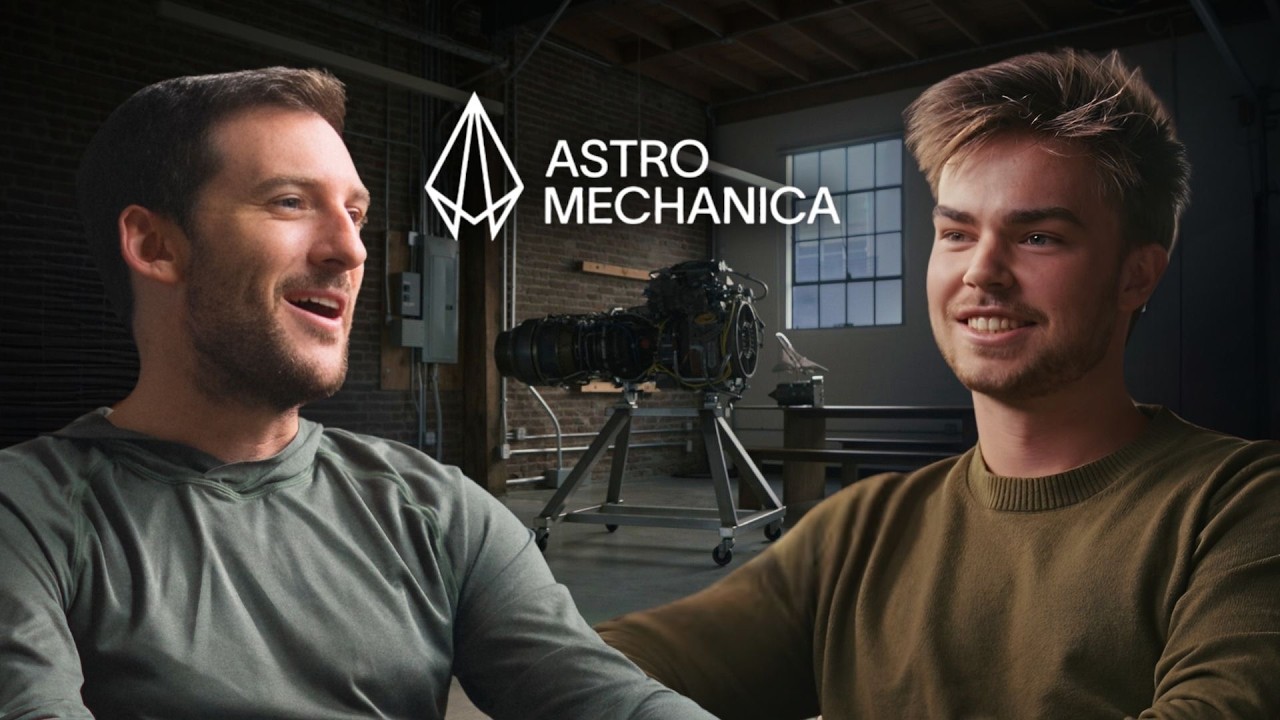
Ian Brooke is the founder and CEO of Astro Mechanica, a company building low-cost, long-range supersonic aircraft. His goal is to make supersonic travel affordable and accessible, not just for the ultra-wealthy. The episode explores his philosophy on design, the economics of supersonic flight, and the long-term roadmap for transforming air travel.
The Problem with Supersonic Flight and Why Concorde Failed
Concorde was economically unsustainable due to low fleet size, low utilization, and extremely high operating costs.
Supersonic flight inherently increases drag and fuel consumption, and the engines of that era were even less efficient, compounding the cost problem.
Aircraft are more like infrastructure (e.g., bridges) than consumer goods—they need to be in the air as much as possible, fully loaded, to amortize their high fixed costs.
Concorde couldn’t achieve high load factors or fleet scale, making it impossible to drive down per-seat costs.
Private Jets vs. Airliners: A Cost Comparison
Private jets have very low utilization and maintenance costs dominate their economics, yet they achieve per-passenger-mile cost parity with airliners.
A Gulfstream flying from San Francisco to Paris or Tokyo costs at least $200,000–$250,000 for the whole aircraft one way, regardless of seat count.
Astro Mechanica’s target is around $2 per nautical mile, making a similar flight less than $10,000 for the whole jet—roughly 20x cheaper than a Gulfstream.
That translates to about $2,000 per person for a five-passenger aircraft on a long-range route, still not economy-class cheap, but a radical reduction from current private jet costs.
The Strategy: Don’t Start with the Airliner
Ian’s strategy is to avoid going straight for a high-volume airliner, which requires economies of scale that a new company can’t achieve on day one.
Instead, start with niche, high-value applications where customers will pay a premium for fundamentally new capability—such as government contracts or space launch.
Use those early products to build a “financial engine” that funds further development and de-risks the company.
Scale progressively: first serve the equivalent of first-class customers, then business class, then eventually economy—potentially with different aircraft for each stage.
This mirrors Tesla’s roadmap (Roadster → Model S → Model 3) and the logic that it’s easier to start as a Lamborghini than a Toyota.
Vertical Integration and Controlling the Full Stack
Ian argues that making flight cheaper requires control over every part of the equation: engines, airframes, and operations.
Aviation has been stagnant for decades, so meaningful improvement requires changing everything at once.
Vertical integration is expensive but necessary when you need to rethink the entire system.
Over time, as things stabilize, modularization and market efficiency can take over—but in the early days of something genuinely new, you need complete control.
Designing for the Full Lifecycle, Not Just the Purchase Price
Ian’s core philosophy is to frontload effort in design so the product lasts forever and is easy to maintain.
He dislikes piston engines because, despite being cheaper and thermally efficient, they are unreliable compared to turbine engines, which have far lower in-flight shutdown rates.
A cheap part that takes enormous skill and time to install is actually expensive when you account for labor and downtime.
Well-designed products are built with the assumption that someone—possibly an unskilled person—will need to fix them in the future.
He values “cost per use” over upfront cost: spend more on the thing so it endures and is cheap to operate over time.
Building the Team and the Company
Astro Mechanica started the year with 12 people and grew to the mid-40s, feeling like a different company every six months.
Ian spent years struggling to tell the story and raise money, getting rejected by YC four or five times, because he’s not a natural storyteller.
What finally worked was building a physical demonstrator—proof of work made the concept believable to engineers, investors, and recruits.
The company snowballed: prototype → credible team → more capital → better people → more proof.
Key hires include Ashley Pel (COO, ex-Bridgewater), Matt Perkins (ex-SpaceX, electrical engineering and software), and Greg Crowland (chief engineer of XBoom).
Ian sees his real job as assembling the right group of people—curating a team where each person thrives on what he dislikes (e.g., accounting, detailed analysis).
Ian’s Thinking Style and Personal Philosophy
He thinks spatially and visually, not in words—he imagines physics, airflow, and systems as shapes and dynamic models in his head.
He has a highly nonlinear, parallel-processing mind, connecting tangentially related concepts simultaneously.
He’s deeply interested in how brains work, feelings, and consciousness, which informs how he builds teams and designs customer experiences.
He’s extremely patient but also quick to dismiss dead ends, and he’s driven by a long-term vision that has been sharpening for over a decade.
He sees himself as a “seed” with a specific shape he’s meant to grow into, and fulfillment comes from doing work consistent with that shape.
The Long Road and the Emotional Cost
Ian has been working toward this vision for roughly 20 years, with the specific supersonic aircraft concept crystallizing over the last 10.
He feels constant anxiety about being behind the curve—others are always doing similar things, and he worries about missing the boat.
He doesn’t enjoy suffering per se, but he’s cursed to keep raising the bar so high that he’s always failing in the short term.
Wins never feel like wins; he immediately moves the goalposts and focuses on what’s still wrong.
His happiest moments are sensory: loud engines, fast speeds, beautiful machines—small joys that fuel him between milestones.
The hardest thing he’s overcome was school, which he hated so much he left as soon as he could, moving to Milan at 18 and later dropping out of a physics degree to start a company.
The Ultimate Vision
The end goal is to give everyone the private jet experience—a four-hour flight from SF to Paris—at a price that eventually approaches economy class.
For Ian, failure would mean building something amazing that only the wealthy can access, or building something that never scales.
The product isn’t really the aircraft—it’s the factory that makes it, and the team that runs it. The company itself is the thing being built.