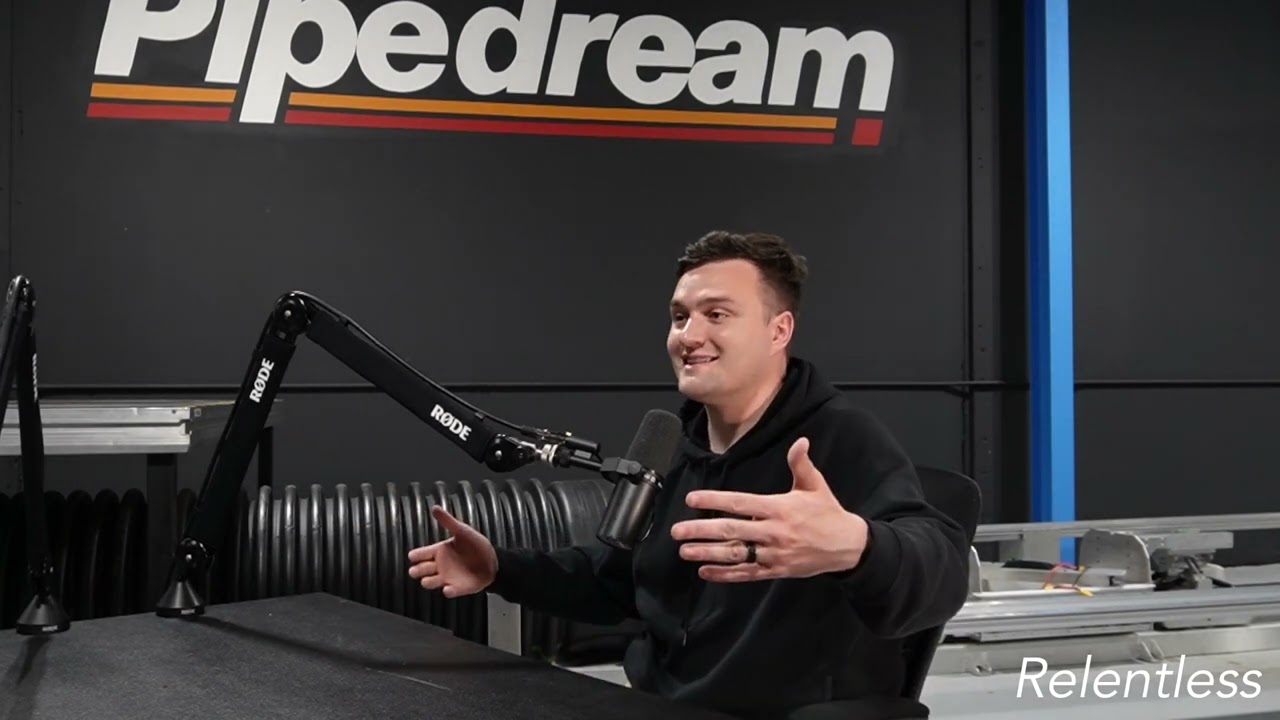
- Garrett Scott, founder of Pipedream Labs, is building underground autonomous logistics infrastructure — a network of subterranean tubes and robots that move goods within and between buildings at high speed, aiming to make delivery so fast and cheap that sending items back is as easy as receiving them. The company is based in Oklahoma and has already completed a nearly mile-long city installation in a top-50 US city in just two weeks of permitting. This conversation traces Garrett’s path from a mechanically-inclined kid in Dallas to a first-principles thinker obsessed with logistics, bias, and long-term compounding businesses.
Early Life and Formative Ideas
-
Growing up in Dallas gave Garrett an infrastructure-positive mindset
- Dallas was constantly upgrading — first to have fiber, always building — which taught him that infrastructure deployment is a people problem, not a technological one
- This contrasted with coastal cities where old infrastructure makes everything feel impossibly hard
- Dallas is a corporate city, not a startup city — it attracts people who want stable jobs to raise families, not risk-takers
- There’s no incentive structure for entrepreneurship there, despite having cheap living costs, great infrastructure, and lots of money
-
Garrett was a natural entrepreneur from childhood, even without the vocabulary for it
- In middle school (age 10–11), he emailed Starbucks, McDonald’s, and Chick-fil-A pitching a geofenced pre-ordering system for drive-thrus — his compensation ask was “Starbucks for life”
- In third grade, he ran a business where people paid him to send “lecturers” (kids who repeated annoying sayings) to annoy other kids — he sold the IP for $60 (four $20 bills) on the last day of school
- He made a website tracking professional Christian athletes around age 7–8
- These early ventures taught him about arbitrage, market efficiency, and the importance of actually testing ideas
-
His parents instilled a deep bias against marketing — which he had to unlearn
- Coming from a Christian background, his mother especially valued living “beyond reproach” — always honest, transparent, trustworthy
- Marketing got lumped in with dishonesty: if you have to sell something, it must not be good enough
- This created a mental model where good work should speak for itself, and self-promotion signals either ego or a bad product
- He eventually realized markets are inefficient — a hammer on a wall doesn’t sell itself; you have to draw attention to it
- Engineers especially suffer from this: they assume people will naturally seek out the best solution, but most people don’t even perceive the problem the way engineers do
- He’s grateful he learned “just do the work” first, then learned marketing second — the order mattered
Education and the Startup Awakening
-
Homeschooling in Dallas was more like assembling Lego pieces than isolation
- His mother, who is very smart, let him run at his own pace after he outgifted the gifted-and-talented program
- Dallas has a developed homeschooling ecosystem with co-ops, classes at other people’s homes, and self-paced curricula
- He got through calculus by high school and developed the self-starting muscle that would define his career
- Socially it was normal — he played on basketball teams against public schools, ran track, went to parties
-
He chose mechanical engineering because he wanted to be “the best at making things”
- He loved physical, lasting impact — hammers, screwdrivers, stop signs
- Mechanical engineering was recommended as the most all-encompassing discipline
- He didn’t yet understand software or scalability
- He became disillusioned in college: there’s no real career path in mechanical engineering — you’re either a project manager or a CAD monkey, with very few strategy or design roles
-
Discovering Paul Graham’s essays and “This Week in Startups” was a religious conversion
- Jason Calacanis’s podcast had an enormous impact in the flyover states — he’s “like a deity” to entrepreneurs in Middle America
- The message was liberating: there’s no magic to starting a business, just find a problem and lose yourself in the work
- This countered the Middle American conditioning that you need credentials, an MBA, or accolades
- Meeting other people who had just “gotten their hands dirty” confirmed it was possible
Early Ventures in College and After
-
Wolf (2014): Grocery delivery on an 18-hour cycle
- Before Instacart had reached Oklahoma, Garrett pitched aggregating all orders into one morning milk run to drive down per-order cost
- He printed flyers, knocked on doors, and got 10 people interested
- One woman tore through the terms and conditions point by point, making him realize the friction of onboarding
- People told him “people like going to the grocery store” — he backed off, but wishes he’d kept going
-
Coffee delivery: A business he still believes in
- Coffee is the only SKU where people want the exact same thing at the exact same time every day — perfect for batched delivery
- Margins work because coffee is ~1/8 product, ~1/2 service, rest profit — you can absorb the delivery fee
- They used a single origination point (a closet, not a storefront) and made it hyper-personal: hand-typed names, little messages, door hangers instead of curb delivery
- They ran it for 3 months, got to 50–100 orders a day, a few hundred customers, a few thousand dollars in revenue
- His co-founder (a coffee snob with a beautiful copper machine found on Craigslist) took a bodyguard contract that kept getting extended, and the business dissolved
- Garrett still thinks this is a fantastic business, especially now with short-form video as a distribution channel
-
Dropcorn (2016): A proximity-based digital interaction layer
- Idea: within a quarter mile, you should be able to pull up a browser and access all relevant digital information — payment, identity, location — without downloading an app
- Inspired by wanting to tip a guitarist at a restaurant but having no cash and QR codes not yet being mainstream in the US
- Each user had a personal profile; when you entered a space, it auto-populated with relevant digital items (menus, Venmo profiles, polls, file shares)
- Built the first version in a weekend, launched on Reddit, grew to 10,000 daily active users through word of mouth
- Use cases included airdropping presentations to everyone in a room, sharing files via color-coded location pins
- He shut it down because the traction wasn’t enough to justify full-time effort, and the concept was ultimately too convoluted
- He sees this as a necessary “growing up” project — everyone needs to build their version of the note-taking app or to-do list that they think will crush the market
-
Gift Rappers: Connecting people who wanted personalized rappers with talented local rappers
- Two-sided market: lots of supply, lots of demand
- Rappers turned out to be terrible at sticking to deadlines — they have something to say, they’re not interested in “welcome to this charity event” content
- He kept the domain (giftwrappers, without the W) as a museum piece of how things can go wrong
-
Blank Coin: A gamified charity giving app
- $5/month subscription gave you coins to donate to charity, creating a positive feedback loop
- Brands could give coins as discounts (write-offs), increasing the supply of coins to give
- Designed to create social pressure: “so-and-so gave their blank coins to this cause”
- Applied to YC’s nonprofit track with this idea
The Two-Year Business Apprenticeship
-
After graduation, Garrett decided to learn business by having to make money to survive
- He avoided getting an engineering job (felt like the worst option) and didn’t know startup jobs existed
- Spent about a year building apps and small businesses to pay rent — “pushing a baby bird out of the nest to learn to fly on the way down”
- This was the funnest time of his life
-
Working at Martin Bionics (prosthetics company) introduced him to no-code and Bubble
- He worked two days a week as a design engineer but would solve any problem he heard about
- Built an app for dynamic socket fitting using Bubble overnight — the owner was shocked it was done the next morning
- The owner, J. Martin, taught him a core heuristic: “if something feels simple, it should be — someone is probably adding unnecessary difficulty”
- This maps to Jeff Bezos’s idea that if common sense and data disagree, the data is probably wrong
- Garrett’s core skill: being the best Googler — knowing that with 7 billion people, someone has probably solved your problem, it’s just buried
Thinking Clearly: Bias as a Core Study
-
“Art of Thinking Clearly” by Dobelli changed how Garrett sees the world
- Read it during an internship at Falcon Jet (aerospace/private jets) in Little Rock, Arkansas, where he spent free time at the library consuming psychology and business books
- The book lays out 92 cognitive biases, each in one chapter, explaining the evolutionary origin, why it’s maladaptive in modern life, and how to counter it
- He thinks about it every single day
- Biggest biases in business: sunk cost bias, commitment/consistency bias, and the false sense of safety from overabundance of data (even when the data is wrong)
-
He studied Berkshire Hathaway shareholder meetings obsessively
- Listened to every meeting from 1994 to 2023 (each 4–6 hours) — 12 times through
- ~2,500 hours total, mostly while working out
- The goal was pattern matching: load enough good decision-making into his intuition that bad ideas never even occur to him
- Warren Buffett and Charlie Munger think with such clarity that it’s intuitively obvious once you hear it, even if you wouldn’t have come up with it yourself
The Path to Pipedream
-
Garrett wanted one thing he could work on for 10 years
- He noticed his early ventures were “burning and churning” — semi-successful ones were worse because they owned him
- Criteria: 10 years of growth, in an industry where the long-term direction is predictable
- Jeff Bezos’s framework: work in an industry where things aren’t going to change that much — in logistics, things will get cheaper and faster, and if you make that happen, you win
- He’s been passionate about logistics his whole life: grocery delivery, coffee delivery, the magic of things coming to you
-
The key insight: making returns as easy as delivery unlocks a new mode of commerce
- Buying movies on iTunes felt like the pinnacle, but downloads took hours, so you kept everything in local storage
- Our homes are essentially local storage — washing machines, shelves, refrigerators all exist because we have to keep bulk inventory
- If delivery is fast enough and returns are effortless, we interact with physical goods like Netflix — try a shirt, wear it once, send it back
- This changes everything: grocery lists become absurd (“wait, you went to the warehouse yourself?”), spices are sold in exact amounts, businesses like Offer Up become fully automated
-
He started with drones but moved underground
- He’s a massive drone fan — worked on projects including the “Yellow Drone Project” (quadcopters that docked on roofs for on-demand photography)
- Realized drones are relatively simple (accelerometer, four rotors, package, safety promise, regulatory approval) and many companies already have the hardware
- The missing piece: efficiently interacting with buildings (getting goods to the right floor, the right unit) and solving high-volume longer-distance transport
- That’s what Pipedream builds
Building Pipedream
-
Talking to the right people mattered more than talking to city officials
- City government officials are hard to reach, busy, and give generic answers
- Utility companies that work with cities are far more helpful — they know the relationships, the processes, the real constraints
- A mayor of a top-50 US city told Garrett: “If you have the money to do it, we’re going to let you do it”
-
The franchise fee model makes cities financially incentivized to approve utility infrastructure
- Cities get a percentage of topline revenue from utilities using their easements
- In one city, this makes up 30% of the overall budget
- They’re motivated to grow existing utilities or add new ones
- Pipedream’s first network permit was approved in two weeks — nearly a mile of underground installation through public right-of-way
-
Underground utilities are easier than people think
- Horizontal directional drilling has made it possible to install underground infrastructure without stopping traffic
- The “dancing bear” phenomenon: once the machines stopped interrupting daily life, people forgot they existed
- There’s stigma around underground work because it’s invisible, but the machines (Ditch Witch, etc.) are everywhere once you know what to look for
-
Historical precedent: pneumatic tubes in 1860s New York
- The Postmaster General built ~20 miles of pneumatic tubes for mail delivery in New York
- It was working well, and he wanted to expand nationwide
- He lost to horse and buggy lobbyists, resigned in protest, and died shortly after (possibly folklore)
- The real problem with pneumatic tubes: they require perfect pressure across the entire network, and any small gap breaks everything — you have to dig to fix it
- Chicago also had a massive tunnel system that flooded when a seal broke
Hiring and Decision-Making
-
Pipedream’s version of Amazon’s “bar raiser” program
- Every hire must be so good that compared to the rest of the group, it’s embarrassing — “that person shouldn’t work here” because they’re so far above
- The process is blind: written evaluations passed to the next person without discussion, then reviewed together
- This removes biases: does this person seem cool, did someone vouch for them, do I like them
- It’s a one-way door — hiring mistakes drain the organization and are hard to undo
-
Finding Ken (CTO) validated the bar raiser approach
- After 100+ candidates, Garrett and the team were exhausted and almost settled for someone “as good as us”
- They pushed for two more hours, found Ken, and it was immediately clear he was on another level
- Ken thinks differently, works as hard or harder, and has been indispensable
- Same pattern across other key hires
-
One-way doors vs. two-way doors
- Borrowed from Bezos: some decisions are irreversible (one-way doors) and deserve intense debate; others are reversible (two-way doors) and should be made quickly
- At Pipedream, protocol-layer decisions (pipe diameter, rail specifications) are quasi-one-way doors because of development time
- Hiring is treated as a one-way door
- The person with the most “give a shit” is probably right — high-conviction people only raise concerns on things they deeply care about
- Bike shedding (named after a nuclear reactor committee arguing about the bike shed color) is the enemy — people raising trivial concerns to feel smart
-
Removing bias is the core skill of startups
- Bezos: if you can make three good decisions a year, you’re golden
- Warren Buffett: aims for one great decision every five years
- The biggest mistake a smart engineer makes is optimizing something that shouldn’t exist
- Garrett gives every new hire “Art of Thinking Clearly” and “Zero to One”
Fundraising and the Shed in Oklahoma
-
The hardest phase: talking to 100–200 investors who all said no
- Common objections: “love the idea but it’s not possible,” “you’re not the ones to do it,” “if [big company] can’t do it, you can’t”
- They were operating out of a shed in Oklahoma — a fair point
- Some suggested pivoting to software or something easier
-
Their coping mechanism: target 250 nos
- They reframed fundraising as “how do we get to 250 nos fastest?”
- Blind faith in the law of big numbers: 250 nos should yield 1 yes
- They got a yes before hitting 100, and everything snowballed from there
- Each “no” became part of the process — “onwards and upwards”
-
Fighting the “this can’t be the next Apple” bias
- Garrett’s own brain kept saying “this is definitely not what future greatness looks like”
- They built a “Zoom wall” in the shed — wood panels, poster board with a 3D-looking Pipedream logo — to look more established on video calls
- They built an infinity mirror to create a perception of progress
- He hates the pageantry but acknowledges it works — you have to work with human biases, not pretend they don’t exist
- Smart engineers often refuse to do this (“I’ll just be so good I can’t be ignored”) — that’s not how it works
Content and Hype
- Pipedream is working on a hype video
- Garrett admits this is his shortcoming — the team is overly careful about showing exactly what something is, with no framing or polish
- They’re inspired by how SpaceX and Tesla’s hype videos generated excitement even before products were fully realized
- Most footage is already shot; the video should be out within weeks of this conversation
- They follow an “Iceberg” strategy — showing about 20% of what they’re doing, letting people slightly underestimate them
- Google did the same thing: always underreporting how many pages they’d indexed, so competitors would celebrate beating a number that was already outdated
- In Hardware, hype is fleeting — you need to be sure whatever you promote has staying power
Philosophy and Resilience
-
Business is a sinusoidal wave — you only feel the ups and downs, not the overall upward trend
- In a down, the only thing you know for certain is things will go up
- In an up, the only thing you know is it will suck soon — batten down the hatches, don’t celebrate
- You have to mute the spikes — the higher the high, the lower the low
- If you attribute upward momentum to yourself, you’ll attribute downward momentum to yourself too
- External validation is dangerous: being called a genius feels as good as being called an idiot feels bad, and both are wrong
- The answer is always in the middle: maybe a little smart, a little lucky
-
Short-term memory on difficulty is essential
- Like how women don’t retain the memory of childbirth pain (evolutionarily useful), entrepreneurs forget how hard things were
- The team can go through the most demoralizing failure on a Friday and come back Monday ready to rock
- This is a feature, not a bug
-
Ego is the enemy in startups
- Hardware especially requires you to change years of work on a dime when you learn new information
- You have to be willing to look like an idiot for a while
- Self-confidence has to come from within, not external validation — because valleys will come, and you need to retain confidence without the pedestal
- Travis Kalanick played the ego game and kept riding up — it works until it doesn’t
- Most startups have peaks and valleys; staying power requires emotional stability throughout