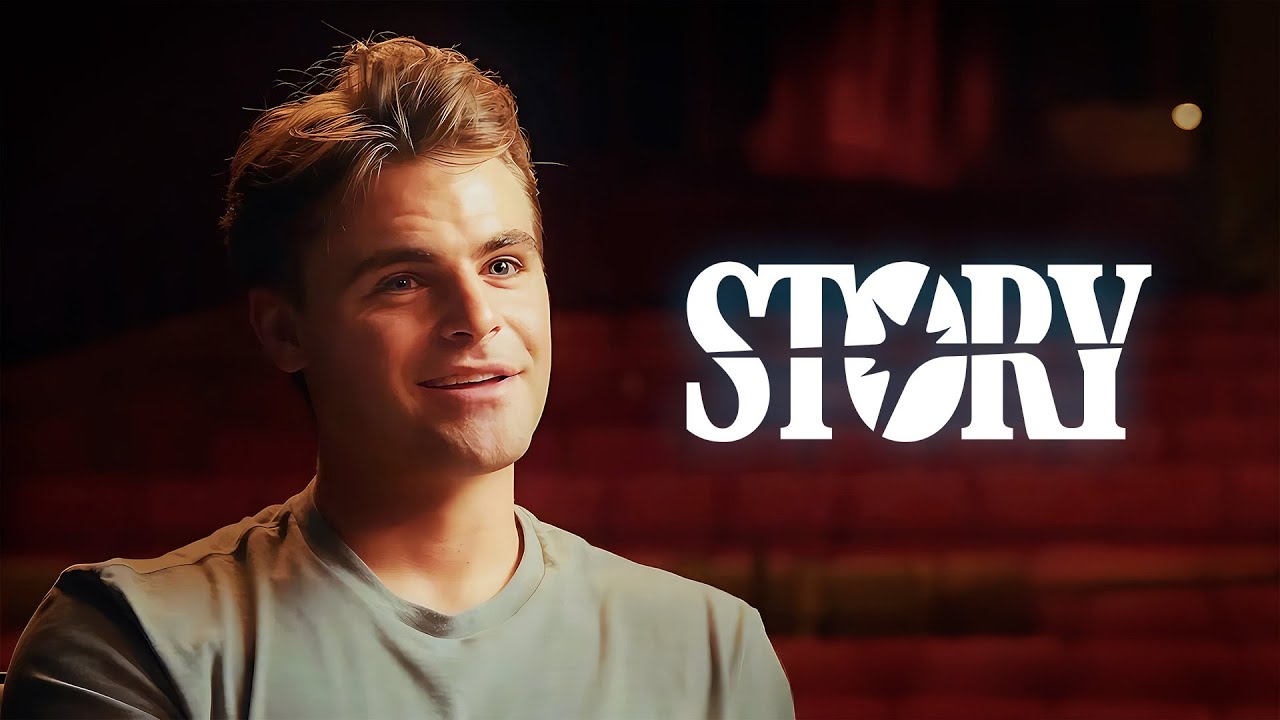
Jason Carman is the 25-year-old founder and CEO of Story, a media company that makes cinematic films about science, engineering, and the future. He just premiered Story’s first short film, Planet, at a sold-out 900-person theater at the Palace of Fine Arts in San Francisco, hours before the final visual effects shot was even exported. The film is about Dr. Evan Khan, a visionary engineer who proposes building an artificial planet with an atmosphere when the government asks him to build an orbital supercomputer. It’s a story about grand, beautiful ambition, born from Jason’s belief that the culture needs more optimistic, aspirational stories about the future.
The origin of Planet
Jason came up with the core idea while filming S3 (his documentary series on deep tech startups) in Montreal. Walking around Old Montreal at night, he was struck by how the moon looked in the sky and imagined how beautiful it would be if there were a second, larger planet next to it.
On the plane ride home, he developed a romantic core story: a young male engineer who loves mega structures and a young woman on an astrobiology mission who loves biology and terraforming. They fall in love despite being opposites. When she dies, he merges their two visions into one: building an artificial planet that combines industrial engineering with atmospheric and biological science.
Jason cried quietly on the plane while writing it. He describes this as the emotional seed of the entire film.
Story’s mission: optimistic stories about the future
Jason believes the stories people are buying into about the future are overwhelmingly negative, dark, and pessimistic. He thinks this is partly because negativity bias makes dark stories easier to enjoy and easier to make.
Story’s mission is to pioneer large cultural stories that are optimistic and aspirational, the kind that make people want to go back to movie theaters to experience them together on a big screen.
He sees movies as one of the last communal cultural experiences where people put their phones away and focus together in a dark room.
The company’s motto is “story inspires science, science makes story real.” The idea is that when society falls in love with a sci-fi vision, it creates the cultural will to make it real.
Planet directly benefited from the year Jason spent filming S3 and interviewing real scientists and engineers. There’s a 20-page engineering document behind the film, and several S3 subjects have cameos in the movie.
Building the Nike for technology
Jason wants Story to become a brand that represents science, engineering, and space exploration the way Nike represents sports. Right now, if you love rockets or engineering, there’s not much cool merchandise you can wear beyond a generic SpaceX shirt.
Story plans to create merchandise that lets people represent their interests in STEM in a cool, identity-forming way.
The company is also developing partnerships for jobs and hiring programs across the United States to encourage more people to work in STEM fields, with the message that you don’t have to be a math prodigy to have a meaningful impact on the future.
The production story of Planet
Jason founded Story in July 2024 with the sole one-year goal of creating Planet. He chose to bootstrap the company through client work, ad revenue, and partnerships rather than raising venture capital.
For the first six months, 95% of his time was spent keeping the company from going bankrupt: signing contracts, onboarding a core team of people he’d been making movies with since middle school, setting up an office, solving supply chain problems for camera equipment.
He had almost no time to write the script. He got a first draft done in November 2024, did a second version, but didn’t show it to anyone (a mistake he later corrected by learning to share scripts with 8 trusted collaborators for feedback).
In late November, he asked his chief of staff and producer, Maxi, whether they could film the movie in three weeks before Christmas. She said absolutely not. A week later, after trying to prep, Jason said they couldn’t do it. Maxi then flipped and said they were doing it.
They filmed the last week of December 2024. Jason was sick the entire time, going through a bottle of Dayquil a day. The lead actor, Steven Miller, got sick on the second-to-last day, making the final scenes extremely difficult.
Jason cast Steven Miller after reviewing roughly 2,000 audition tapes. The second lead, Alex Platt, originally auditioned for the lead role but wasn’t old enough, so he was cast as Greece, the other central character.
Jason hired a dedicated director of photography, Neil, for the first time in his career (he normally DP’d himself). Neil came in four days before filming and handled lighting while Jason focused on directing actors. Jason credits this decision as a major reason the film looks so beautiful.
Post-production struggles and breakthroughs
After filming, Jason got severe editor’s block. He assembled a 47-minute rough cut in a week, but the story wasn’t working. He realized he’d forgotten basic narrative rules after years of not making fiction.
The company was actually broke in January 2025. Major contracts landed that secured the company’s future for a few years, allowing them to return to finishing the film.
Jason hired Clay Welch, who worked at Pixar for 25 years, as concept director. This was a childhood dream for Jason, who had been making CGI films in his bedroom as a teenager.
Jason convinced Andrew, a talented filmmaker on his team, to take over the edit so Jason could focus on story. They initially thought they could fix the film without reshoots, but ultimately did two pickup shoots about six weeks before the premiere.
They shot 70 minutes of footage over a 12-day production period (equivalent to a feature film). The original ending was cut after a rough screening five to six weeks before the premiere, where everyone agreed the film was great except for the ending, which had been a patch fix.
The film was picture-locked about five weeks before the premiere, but the final four weeks were a sprint to complete all 200+ visual effects shots. About a third were relatively easy; the rest required thousands of hours of work.
The final VFX shot was exported literally during this interview, about an hour before the premiere. Jason decided to take a few more days to polish about 20 shots from “8.5 out of 10” to “10 out of 10” before the online release, meaning the version shown at the premiere will never be seen again.
What Jason learned about himself and leadership
Hiring great people: Jason’s biggest personal growth was learning to spend money to hire excellent people rather than trying to do everything himself. He used to bully directors for needing pickup shoots; now he’s done them himself and calls Planet a humbling experience.
Art company vs. deep tech company: Jason spent a year and a half filming S3 and thought he understood how to run a company. He discovered that building an art company is fundamentally different from building a deep tech company. There’s no physics objective truth or spreadsheet of optimization. It’s about creating art that resonates, and the recipe is different for every artist.
Production mode vs. post-production doubt: Jason has been on 700-800 production days in his life. During production, he enters a locked-in “wart time” mode with no doubt. The doubt and depression come in post-production, where you’re confronted with whether the story actually works.
Inspiration is not constant: Jason used to think he’d be an inspiring CEO every day. In reality, when you’re tired, the bank account is low, and the story isn’t working, you can’t fake it. He rates his own inspiration at “2 out of 10” on average.
Transitioning from S3 to Story
Jason loved much of S3, especially the deep conceptual learning and sharing that knowledge through video. But by the end, he was burnt out. S3 had become part of the venture ecosystem in a way he didn’t like, with companies timing releases to fundraising cycles.
He also didn’t enjoy the sit-down interviews as much because he was always exhausted after filming documentary episodes for 4-6 hours and never had time to prep properly.
He’s moving toward creating timeless content rather than content tied to startup fundraising cycles. He wants to capture early founders the way you’d want to document an early George Lucas or Elon Musk, unfiltered and authentic.
He still wants to do one more interview series in his life called Masters of the Cinema, featuring 4-hour uncut interviews with legendary directors, shot cinematically with their films playing on screen. The first episode is planned for next July with a major director.
What’s next: the trilogy
Story’s big announcement at the premiere was that they’re already moving into their next project: a full-length feature film that is actually the first in a trilogy, Story’s first cinematic universe.
Jason has been working on the trilogy for eight months, with art development, 3D models, and extensive writing. He wrote every morning during Planet’s editing hell, immediately applying lessons learned.
The goal is to build a narrative scaffolding that can outlast Jason himself, so future writers and storytellers can continue the universe.
Jason wants to prove to Hollywood financiers that Story can be trusted with a big budget by demonstrating they can produce high-quality, VFX-heavy films at a fraction of traditional costs.
Predictions for the next 12-24 months
12 months: Convincing distributors and financiers to let them complete and release the first trilogy film faster than the typical Hollywood timeline. More realistically, they’ll be in production hell focused on making a great movie. The biggest challenge will also be Jason being a full-time director while Story’s other productions run well, which requires hiring exceptional people who genuinely care about the subject matter.
24 months: Ideally, stressing about how to make the sequel better than the first film. More realistically, the movie will be coming out around then.
Jason feels genuinely optimistic for the first time, with about six months of runway, a strong team, and clarity about what Story is focused on.