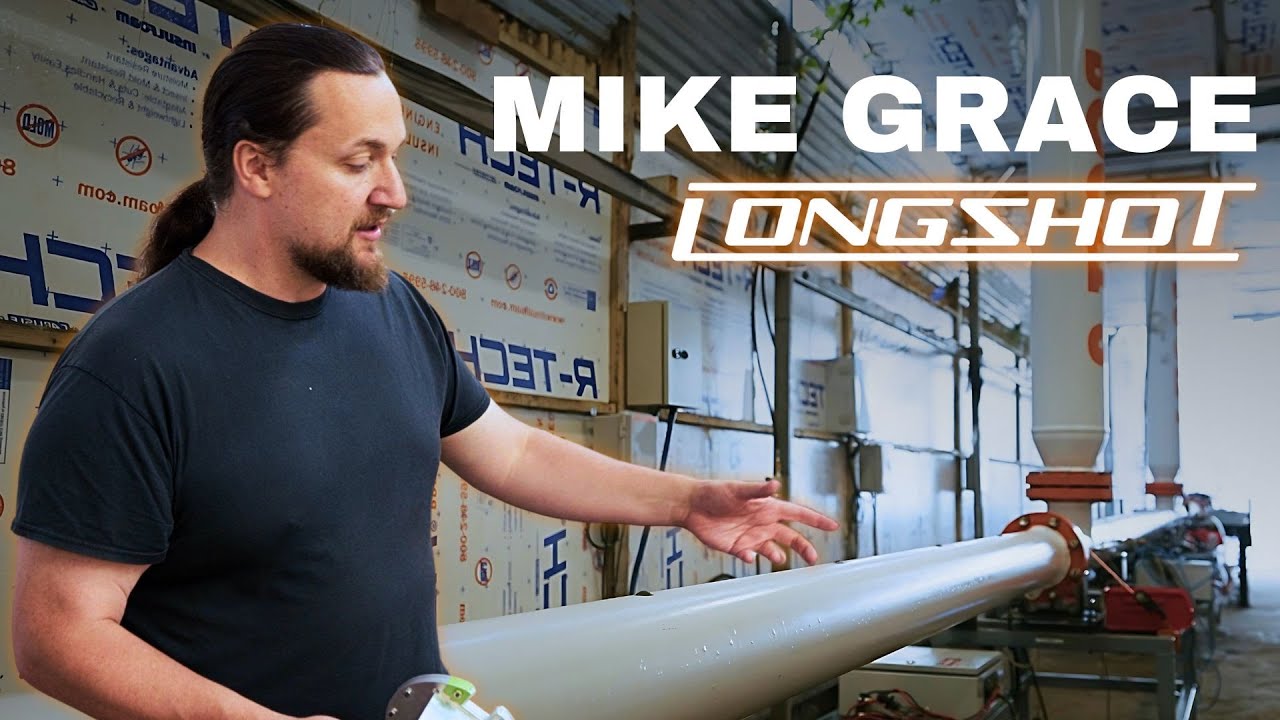
Mike Grace, co-founder and CEO of Longshot, is building massive space cannons in the desert to launch payloads into orbit using kinetic energy instead of rockets. The core idea is that rockets are fundamentally inefficient machines for lifting fuel—only about 1% of a rocket’s total mass ends up as payload—whereas a kinetic launch system keeps all the energy on the ground and only throws the payload itself into space. Grace’s long-term vision is to make the cost of putting mass into orbit effectively zero, opening the solar system to widespread human settlement and industrial activity.
How a space cannon works
The fundamental concept dates back to Jules Verne’s From the Earth to the Moon (1865) and even Isaac Newton’s thought experiments: shoot something fast enough that it reaches orbital velocity. The idea is categorized as “kinetic launch”—all the energy stays on the ground, and only the payload goes to space.
A conventional gun cannot reach orbital velocity because the projectile is limited to the speed of the gas pushing it, and even hot hydrogen gas falls far short of orbital speeds (~Mach 25, or ~7 km/s).
Longshot’s key innovation is a long wedge sticking off the rear of the projectile. Instead of pushing from behind, gas is injected from the sides onto this wedge. Because the wedge is angled, gas impinging one inch sideways forces the projectile forward many inches—the same principle that lets a sailboat travel faster than the wind. This allows the projectile to exceed the speed of the gas driving it.
The design is a “distributed gun” with multiple injection points along its length (like the German V3 cannon of WWII). Every time you double the number of injections, the maximum pressure, temperature, and acceleration force each cut in half. This means the gun can be made extremely long and gentle, using cheap materials like sewer pipe and concrete rather than exotic engineered steel.
The projectile rides on plastic bushings (HDPE or Teflon) pressed against steel rails. Friction instantly turns the plastic into a gas, creating a plasma layer that acts like an air hockey table—preventing metal-on-metal contact even at hypersonic speeds. A heavy leaf spring continuously feeds fresh plastic into the rail as it wears.
Historical lineage: German super guns and Gerald Bull
The V3 cannon (WWII) was an early distributed gun built by the Germans into the side of a hill, bombarding Luxembourg with a prototype. The plan was to build many around Calais to flatten London, but the project was abandoned as the war turned. It was made of sewer pipe—easy to build under bombardment—but was immobile and became a target once the Allies controlled the skies.
After WWII, the US and USSR kidnapped German rocket scientists because rockets, despite terrible marginal costs, were ideal for delivering atomic bombs where cost and reliability didn’t matter. The super gun concept was shelved.
Gerald Bull, a Canadian ballistics engineer, built HARP (High Altitude Research Project) in the 1960s: two WWII battleship cannons end-to-end in Barbados, firing projectiles over 200 km altitude (suborbital). He planned a multi-stage system to put ~1 kg into orbit. The Army bought the program for $6M, passed it to the Air Force, and it was shelved—there was no market for cheap kilogram-level access to space in the 1960s.
Bull later ran guns to South Africa (at the CIA’s behest), went to jail when administrations changed, and then sought Saddam Hussein as a patron to build a super gun in Iraq. He was assassinated in Belgium in 1990, likely by Mossad. Grace’s takeaway: “Don’t build death stars for dictators.”
Why rockets dominate and why they’re the wrong tool for cheap access
The US and USSR have invested roughly $4 trillion in rockets since WWII, driven by defense needs (suborbital nuclear delivery). The ability to reach orbit is a “happy accident” of that investment.
Grace argues Elon Musk went back to the Cold War for his technology choice; Grace went back to WWI. If you care about marginal cost per kilogram to orbit, rockets are fundamentally the wrong answer. They are flying bombs, and even at incredible scale, Grace is skeptical SpaceX can get below ~$250/kg (SpaceX’s aspirational goal is $100/kg).
Rockets have perverse incentive structures in defense aerospace: developing a more efficient system means losing funding. This led to technical stagnation from the 1960s to the 2000s. The Space Shuttle cost ~$72,000/kg to orbit; Falcon 9 brought it to ~$3,000/kg; Starship targets $100-250/kg.
Longshot’s MVP targets $150/kg, and the full-scale “Papa Bear” system targets below $10/kg, with most of the cost being electricity. As solar and nuclear get cheaper, the price could drop further.
The Longshot vehicle family: Baby Bear, Mama Bear, Papa Bear
Baby Bear (current prototype): ~70 cm interior diameter steel pipe, has achieved Mach 4.2 (Mach 4.5 “if you squint”). Bill of materials cost ~$40,000. Per-shot operating cost ~$5,000. Uses helium in urban settings (Oakland) and hydrogen in the desert for higher performance.
Mama Bear: ~1 km long, ~1 m interior diameter, targeting Mach 5–15. Payload ~500 kg (a few LEO telecom satellites). This is the DoD hypersonic test product—offering hypersonic flight tests for ~$150,000 instead of the $15 million the military currently pays for sounding rockets.
Papa Bear: 70+ km long, 7–8 m interior diameter, throwing ~100-ton projectiles (a full Starship as a bullet) to Mach 25. Multi-billion dollar concrete structure. The curvature of the Earth starts to matter; you have to cut the ground to lay it flat.
Atmospheric transit: the real technical challenge
Heating scales with the cube of velocity. At Mach 25 in the lower atmosphere, heating is extreme. The key variable is “ballistic coefficient”—mass and volume (which scale cubed) overcome friction and provide ablation material, while surface area (which scales squared) determines heating.
You cannot throw a small object to orbit through Earth’s atmosphere. A 150 kg projectile at orbital velocity would burn to ash no matter what material it’s made of. You need multi-ton vehicles.
For a ~2-ton vehicle, roughly half the mass is sacrificed to ablation (turned to gas) during atmospheric transit. A 20-ton vehicle is more efficient—only ~2 tons ablates. The Apollo capsule, the fastest object to carry humans, was ~3% heat shield by mass; Longshot’s vehicles need ~50%.
Grace is confident about Mach 15 (warheads have traveled at those speeds in the lower atmosphere since the 1950s-60s). The gap between Mach 15 and Mach 25 involves “legitimately new stuff” and is where the real technical risk lies.
The solution to heat shielding is scale and cheap materials: make the vehicle big and out of wood chips and phenolic resin—overwhelm the problem with mass and brutal Soviet enormity.
Real estate and politics: the harder problem
Grace believes the biggest barrier to building a space gun is not physics but real estate and political economy. You need ~20+ km of flat, remote land with minimal air traffic overhead and a community that wants you there.
The ideal location is somewhere you could detonate an atomic bomb and nobody would notice. Australia’s outback is a leading candidate—twice the land area of Texas with less than 1% the population, no indigenous space access, and a strategic incentive to have one. The US lower 48 is too dense with air traffic for multiple daily launches shutting down corridors.
You must get local community buy-in first, then county, then state, then national government. Grace cites Spin Launch’s disastrous town hall in Hawaii as a cautionary tale. The lobbying has to be bottom-up; congressmen won’t cram a project down a town’s throat.
Tonopah, Nevada (pop. ~1,500, a lithium and gold mining town, equal distance between Reno and Vegas) reached out to Longshot after Grace cold-called municipalities. City council member Joanie Eastley and the town were pro-business, pro-defense, and helped lobby county and state government. They have an old WWII bomber training airbase going unused. This grassroots welcome is why Longshot is building there.
Business strategy: DoD first, space second
Grace initially pitched Longshot as a space launch company for six months and “got kicked in the nuts.” The gap between a garage prototype and a space launch system is too large to finance directly.
The intermediate market is DoD hypersonic testing (Mach 5–15). The military spends $15M per hypersonic flight test using rockets; Longshot can offer it for $150,000—two orders of magnitude cheaper. This is the “thin end of the wedge.”
There are also “spookier” DoD applications (Missile Defense Agency) that Grace won’t discuss publicly.
Once you’ve built the world’s best hypersonic test system, you’re uniquely positioned to solve the Mach 15–25 atmospheric transit problems and bridge the gap to space launch.
The prototype and testing
The current prototype is a ~70 cm diameter steel pipe at a former Navy gun testing facility at Alameda Point (San Francisco Bay Area)—a 300 ft × 20 ft × 20 ft hallway used for testing Phalanx guns, closed since the 1990s. Grace found it through a friend and considers it perfect.
Early iterations were 40-foot PVC potato guns built in Grace’s garage with his CO Brendan (neither are engineers—Grace is an economist and molecular biologist). PVC is dangerous (fails catastrophically, softens in sun), and early pressure vessels did explode. They achieved Mach 1.8 on PVC for ~$13,000.
Current testing focuses on timing precision (orifices must open in tens of microseconds with repeatability), rail alignment, and getting telemetry off the projectile before it slams into a safe with two tons of concrete behind it.
The prototype has gone through roughly three major barrel iterations (same diameter, rebuilt for better rail alignment) and many minor revisions.
Hiring and culture
Grace believes hiring is not a problem because the work is inherently compelling. Aerospace engineers are people who took a 50% pay cut from chemical engineering to work on cool stuff. Give them something inspiring and they’ll break themselves for you.
He criticizes SpaceX for exploiting this passion—treating engineers poorly because they can, given that SpaceX is the only company doing rockets well. He wants Longshot to be the competitive push that makes SpaceX better.
He cannot imagine doing B2B SaaS (“blockchain-supported dating app for Latinx dog walkers”) and considers it soul-crushing compared to building space guns.
Near-bankruptcies and the psychology of hard tech startups
Longshot has nearly gone bankrupt three times. Grace took no salary for the first 1.5 years, his wife paid his rent, he slept at the build site to save gas money, and everyone thought he was crazy.
The first near-death was resolved by an Air Force Direct to Phase 2 SBIR contract when Grace had $4,000 left in the bank.
Before the last fundraise, Grace cut all salaries: himself and the business team went to zero, engineering took 25% cuts, the CTO took a 50% cut. The only people not cut were those on paternity leave.
Grace’s philosophy: “You have to spend money as though you’re going to get more,” which means repeatedly putting yourself in a position of near-desperation. You will have to tell people who moved interstate with their families that you failed to raise money and wasted years of their lives. “You had better be psychologically prepared to do that.”
The bigger vision: cracking the solar system open
Grace has a “solar system mindset” rather than a “planetary mindset.” He questions why you’d spend enormous energy escaping Earth’s gravity well only to put yourself in Mars’s gravity well. The solar system as a whole has the resources to support trillions of people at American consumption levels.
He sees humanity undergoing rapid homogenization (collapsing languages, shared global culture, AI eliminating language barriers within 25 years). Earth has “collapsed to a point”—you’re never more than 24 hours from anywhere. This is good for adopting best practices but creates global failure-mode vulnerabilities.
Future human diversity requires physical separation and different conditions—the same biological principle as allopatric speciation. You can’t get that on Earth anymore. You need weirdos going to new places: conservative Mormon enclaves on Enceladus, Trotskyite communes on asteroids. Lots of experiments, most guaranteed to fail.
Grace wants the price of orbit to asymptote to zero—the same cost as sending airmail to Europe. He doesn’t need to charge for access to space to make money; he can sell fuel in space, beam ads to the moon, or use other business models. “I own the railroad. I don’t need to charge people for access to space.”
Once launch costs drop by orders of magnitude, businesses like space solar power and asteroid mining go from “batshit insane VC plays” to obvious. Heavy industry moves off Earth, and Earth becomes a garden. “Rip apart a dead asteroid—who cares? But ripping apart mountains in the Congo for cadmium and giving people brain damage? That’s not cool.”
He frames this not as existential risk mitigation but as avoiding a boring, claustrophobic future. “I don’t want a boring future for my children. The Earth is getting claustrophobic. There’s not enough elbow room here. We’ve got to go somewhere else.”