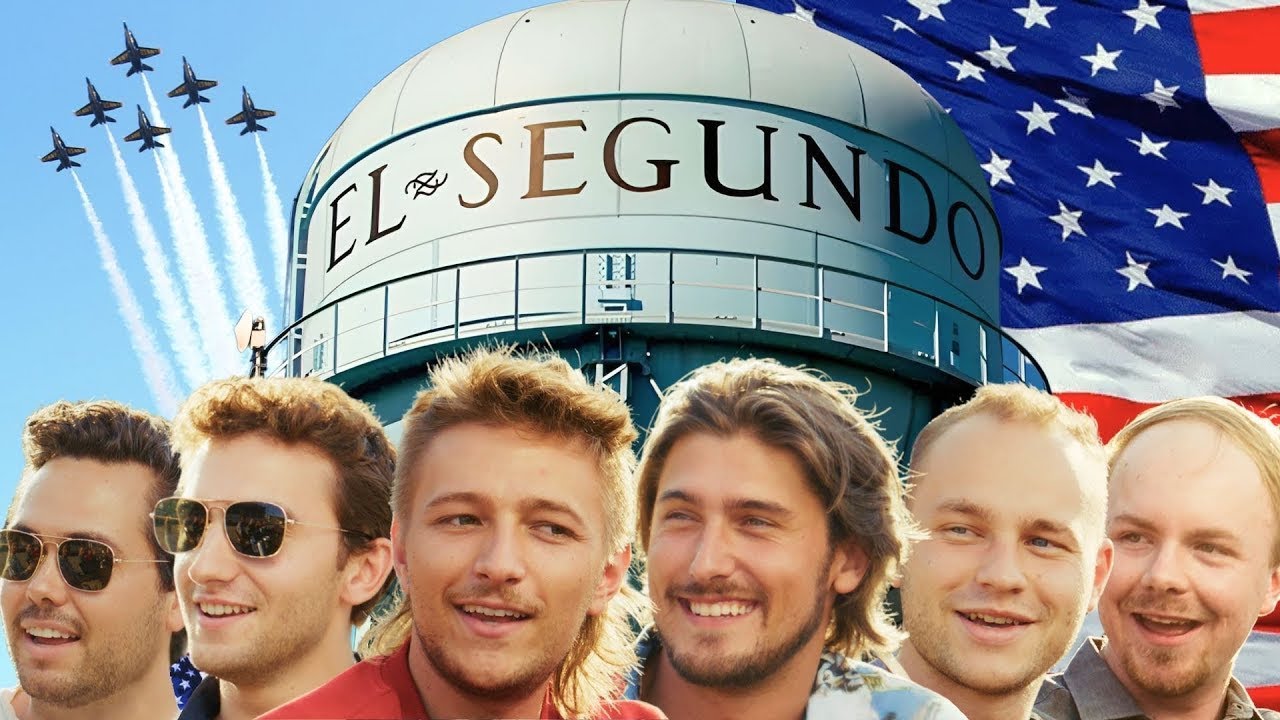
A group of founders based in El Segundo, California—a small coastal neighborhood in Los Angeles—have built a concentrated cluster of hard-tech and defense startups that are now deploying real products in the field, raising serious funding, and attracting talent from across the country. What began as an informal community of ambitious founders meeting at bonfires and on Twitter has evolved into a serious industrial ecosystem spanning drones, nuclear energy, critical minerals, metal casting, and weather modification. The group reflects on how far they’ve come, the existential stakes of their work, why they believe America must re-industrialize, and how their peer-driven community sustains them through extreme pressure.
The El Segundo ecosystem is real and scaling fast
The founders represent companies that are no longer aspirational—they are shipping hardware, generating revenue, and operating at scale:
Rainmaker (Augustus Doricko): Produces ~400 drones per week; conducts cloud seeding operations across the western U.S.
Valar Atomics (Isaiah Taylor): Building nuclear reactors; aims to produce one reactor every 10 months, targeting faster iteration.
Durin (Ted Feldmann): Mining critical minerals in Nevada; developing drilling technology for hard-to-reach deposits.
Rangeview (Cameron Schiller): High-speed metal casting and parts manufacturing; promises 2–4 week delivery but struggles with domestic metal supply chains.
Neuros (Saurin): Deploys FPV and other drones globally, including to Ukraine and undisclosed locations; integrates military systems.
Zane’s company (unnamed): Profitable defense contractor already fielding DoD systems when others were still pre-seed.
Collectively, these companies represent a cross-section of America’s strategic vulnerabilities: energy, minerals, manufacturing, defense hardware, water security, and weather control.
The group jokes—but also half-seriously acknowledges—that if something happened to this table, it would set U.S. national security back decades. They see themselves as a microcosm of the country’s re-industrialization effort.
From visionaries to operators: how the last 18 months changed everything
Two years ago, the group was mostly pre-revenue, pre-product, and spending weekends together at beach bonfires. Now:
Everyone runs real businesses with large teams, active customers, and field deployments.
Companies have moved into operational facilities, relocated staff (e.g., Rainmaker spent six months in Pendleton, Oregon for airspace access), and are solving hard logistics problems weekly.
The community has institutionalized: government agencies now reference “El Segundo” in policy briefs, and new founders continue moving into the area.
Crucially, their core theses have proven correct—not because they were lucky, but because each founder had deep domain expertise and skin in the game. They weren’t just passionate; they were right.
Winning creates its own pressure
As each company hits milestones—drones in combat, reactors going critical, parts shipped, minerals extracted—the bar rises for everyone else.
Success is no longer shared just in person; it shows up in the Wall Street Journal, creating urgency to keep pace.
This competitive dynamic accelerates the entire neighborhood. Founders feel they can’t slow down—not just for their investors or employees, but because the mission demands it.
The ambition level has only increased: Valar aims for trillion-dollar scale; Rainmaker wants to green the American West; Rangeview wants to break China’s grip on specialty alloys.
Why more people don’t build in the physical world—and why that’s changing
For a generation, building hardware was seen as dishonorable or low-status compared to software, finance, or crypto. America outsourced atoms and kept “services.”
That’s reversing because:
Owning the full chain—from raw materials to finished product—is strategically essential.
Young people are choosing electrical engineering over computer science because they want to build weapons, reactors, and machines—not optimize ad clicks.
The financial upside is enormous: SpaceX is the most valuable private company in the world; real-world industries dwarf software in total addressable market.
The founders argue there’s no trade-off between meaning and money: the biggest bags are in the physical world, and doing good is good business.
China’s strategic bet on manufacturing—and America’s wake-up call
While America abstracted into software and financialization, China invested heavily in subsidizing manufacturing, mining, and infrastructure.
Examples of the gap:
China has 30 nuclear reactors under construction; the U.S. has built two new sites in 50 years.
China spends $1.4 billion/year on cloud seeding; the U.S. has no comparable national program.
China dominates specialty metal refining and rare earth processing—making U.S. manufacturers dependent on adversaries.
The El Segundo founders see themselves as countering this imbalance—not alone, but as proof that Americans can still build hard things faster and better.
Talent follows mission
A significant portion of each company’s team relocated from elsewhere in the U.S. (often 33–66%) because the work feels meaningful.
People leave comfortable jobs to live on mountainsides flying drones in snowstorms, drill in remote Nevada, or stand next to a reactor they helped build.
Founders note that in San Francisco, high salaries compensate for meaningless work. In El Segundo, people work 8–10 p.m. shifts because they love what they’re building.
The tangible, material nature of the work—measuring drilling depth, counting drones shipped, watching castings pour—creates deep satisfaction that software rarely offers.
What went wrong: real failures and near-disasters
Despite progress, the last 18 months included serious setbacks:
Rainmaker was falsely blamed for the July 2025 Texas floods after a routine cloud seeding operation. Though scientifically impossible (they produced ~10M gallons max; the flood dumped over a trillion), they received 200+ angry emails daily and faced proposed bans in 32 states.
Rangeview missed customer delivery dates by months due to inability to source specialty metals domestically—highlighting broken U.S. supply chains.
Neuros had a high-profile drone demo fail when a partner’s new European propellers (replacing Chinese ones) catastrophically failed mid-flight—three drones crashed in succession.
Durin struggled with remote test sites in Nevada, now relocating to Tucson for better access.
Augustus suffered severe health issues (eye parasites from stress, kidney problems) that drained his energy for months.
These failures underscore how fragile the re-industrialization effort still is—and how much depends on individual perseverance.
How they keep going: sustainability, self-care, and long-term thinking
Founders have learned (often the hard way) that burning out hurts the company:
Saurin nearly destroyed his health before surgery restored his energy.
Zane realized that diving into technical work slows down smarter team members.
Cameron takes daily 30-minute walks without headphones—where his best strategic insights emerge.
Companies are shifting from chaotic, reactive mode to longer planning horizons (6–12 months), clearer goals, and better delegation.
The key insight: early-stage dynamism doesn’t scale. With 50+ employees, you need process, direction, and stability—even if it feels less “hustle.”
Why community matters
The El Segundo group provides something rare: peers who understand the emotional and operational weight of building hard things in America today.
They share struggles openly—failed demos, supply chain nightmares, public backlash—and learn from each other’s mistakes.
This isn’t just networking; it’s mutual mentorship under shared existential pressure.
The community has grown to over 1,000 people, including quieter but equally serious founders across defense, manufacturing, and materials.
For anyone feeling isolated in their ambition: El Segundo is open, and the movement needs more builders.
Why fight for America?
The founders’ patriotism isn’t abstract—it’s rooted in personal experience and historical awareness:
Cameron grew up in China, admired its speed and scale, but ultimately chose America because of its respect for individual agency and the human spirit. He realized the American Dream isn’t a place—it’s the freedom to become who you want.
Saurin lived abroad for 11 years and saw how the world views America: flawed, but still the place where misfits, outcasts, and builders come to create the future.
Augustus sees America as uniquely capable of outsized outcomes because it rewards risk-taking, tolerates failure, and glorifies greatness—not just comfort.
Teddy emphasizes that America’s government (“the regime”) may be imperfect, but the nation—its land, people, and potential—is worth defending because it exists to enable human greatness.
They believe America is in a temporary decline, not a terminal one. The fundamentals—individual freedom, pioneering spirit, technological ambition—are still there. But revival requires action, not hope.
As Cameron put it: “There is no cavalry. It’s just us.” If this generation doesn’t rebuild American industrial power, no one will.
The stakes extend beyond business
These founders see their success or failure as symbolic:
If they fail, it becomes a data point that “you can’t build real things in America anymore.”
If they succeed, they inspire a generation to pursue meaningful, material work over extractive finance or trivial software.
They feel a responsibility not just to shareholders, but to the country’s future—to prove that a small group of determined people can reignite American industry.
Their ultimate vision: restore the feeling of the 1960s–80s, when America did impossible things (SR-71, Moon landing) and believed in a glorious, abundant future.