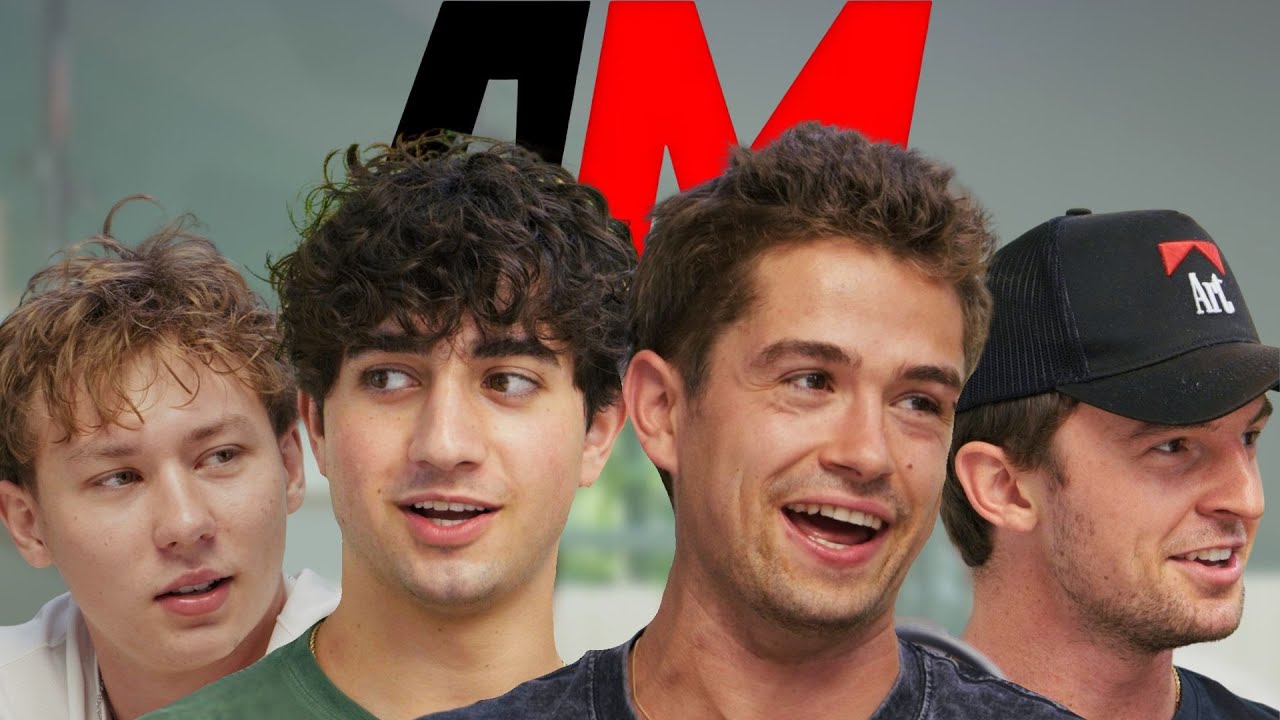
App Mafia is a collective of four young app entrepreneurs — Zach Yadegari (18), Blake Anderson, Alex Slater (19), and Connor McLaren — who have each independently built mobile apps generating millions in monthly revenue, and have now moved into a Miami mansion to build a brand, community, and course together. They describe the group as “fluid,” “omnipotent,” and “all-encompassing,” not defined by a single product but by a lifestyle and movement around making software entrepreneurship cool and accessible.
The members and their apps
Zach Yadegari built Cal AI, an AI calorie-tracking app that uses photo recognition to log food. It does roughly $30M+ in annual revenue (~$100K+ per day) with a team of ~30 people. He started the app at 16 and hit $1M before graduating high school, a goal he set at age 14 in a YouTube video.
Alex Slater co-founded Quittr, an app that helps men quit porn, built with Zach. It scaled to over $1M/month in revenue using influencer marketing and Reddit/X rage-baiting strategies. Alex has never written a line of code.
Connor McLaren is also involved in Quittr and other app ventures. He emphasizes hiring talent and getting out of their way, citing Richard Branson’s philosophy.
Blake Anderson built UMAX, a fitness/body-tracking app, and is involved in multiple ventures. He is older than the others (early 20s) and frames his journey as overcoming years of doubt and failure before breaking through.
Launching a course — and why it’s controversial
App Mafia is launching a course on how to build and scale mobile apps, despite Zach having publicly said ~20 times he would never sell a course.
Their reasoning: for every nine scammy courses, there one that genuinely changes lives. They claim over 30 examples of apps doing $100K+/month built by people who learned from their strategies.
They’re transparent about revenue (all publicly verifiable), which they say differentiates them from typical course sellers.
The course launch is a deliberate strategy to sacrifice social capital for actual capital — they expect backlash but plan to lean into controversy.
Growth strategy: direct response, influencer marketing, and mind share
Their core scaling framework is direct response marketing: every influencer post, paid ad, and UGC piece must be profitable on its own. They scale by increasing volume of profitable posts.
They layer in mind share plays — big, risky bets that don’t pencil out on direct ROI but create second-order effects (credibility, word of mouth, cultural presence).
Example: spending $500K on a MrBeast video for Cal AI. Based on view-to-dollar math, it shouldn’t have worked, but they justified it through brand trust, future deals, and cultural buzz. That $500K represented about 5 days of revenue.
Example: spending $100K on Alex Eubank when Cal AI was at $500K/month. Within months they hit $2M+/month.
Example: a $20K deal with Bryce Crawford (largest Christian short-form creator) to access a competitor’s core audience (a rival app that markets through churches).
They believe controversy and ego-driven content are underleveraged growth levers. They cite Trump, Andrew Tate, Elon Musk, and AOC as examples of people who gained mass influence through being polarizing.
Mind share compounds direct response: when people already know your product, conversion on ads becomes much higher. They describe this as “seeding the algorithm to influence culture.”
Bootstrapping and risk tolerance
All their apps are bootstrapped — no VC money. This gives them optionality and long time horizons but means every dollar spent comes out of pocket.
They are extremely risk-tolerant: they’ll “yolo” everything into a bet if the expected value is positive, because they believe they can rebuild quickly if things fail.
They see bootstrapping as a stepping stone path: start with a profitable app, learn skills, then progressively tackle harder problems. They contrast this with the VC expectation of going for a “decacorn” outcome from day one.
They reject the “indie hacker” solo-founder myth — all of them have teams (Cal AI has ~30 people, half of whom are VAs). Hiring “cracked individuals” and getting out of their way was a major unlock.
Reducing cognitive load and focusing on what matters
They hire away everything that isn’t their highest-leverage work: private chefs, VAs, specialized roles. The ROI on a chef isn’t just time saved — it’s better nutrition leading to more energy and creativity.
They follow the principle of “let little fires burn”: identify the 2-3 things that truly matter for your business (for Cal AI: downloads, conversion, retention) and spend 80% of time there. Everything else — UI bugs, minor issues — can wait.
Zach launched RZGPT with API keys exposed in the frontend, no notifications, and a broken name (“RZGPT-roduction”) — and hit $80K MRR in 3 days. Speed of shipping mattered more than polish at that stage.
As you scale, the calculus shifts: principles you “demonized” as a scrappy startup (process, quality control) become important as the business grows.
Forcing speed and iteration
They force aggressive timelines: when the podcast host said they’d film “tomorrow,” they edited through the night to ship the next day.
They set hard deadlines for themselves after realizing they were getting distracted by the Miami lifestyle.
They kill work that isn’t exceptional regardless of sunk cost: they scrapped a $30K launch video because it wasn’t good enough and immediately started over.
They believe lack of speed usually stems from lack of confidence — over-deliberating, worrying about perception. Their approach: do things, embarrass yourself, build intuition through volume of decisions.
Building App Mafia as a movement
Their thesis: software entrepreneurship is uncool compared to dropshipping, day trading, and meme coins. They want to change that.
They see traditional tech culture as pushing a “nerd in a garage” narrative (reinforced by Silicon Valley the show). They’re deliberately the opposite: young, good-looking, driving supercars, throwing parties, getting girls — while building real businesses.
They believe anyone can build software now thanks to AI, Firebase, Supabase, and no-code/low-code tools. You don’t need a CS degree or millions in funding.
Long-term vision: build a community and movement around app entrepreneurship, potentially with App Mafia houses that incubate young founders.
They want to shift culture around their products — e.g., making “porn is uncool” and “Quittr is cool to be on” the cultural norm, similar to how Whoop became a social signal.
Personal philosophies and overcoming adversity
Alex lied about being a Thiel Fellow when he first met Zach (he had ~$250 in the bank from an unblocked gaming website). He believes some level of delusion is a prerequisite to greatness — “fake it till you make it” worked for him, though he acknowledges it doesn’t work for everyone.
Zach was jumped at a Halloween party, broke his nose, had surgery, and spent two weeks in agony — while simultaneously taking acquisition calls for Cal AI.
Blake spent 22 years with “zero data” to validate his self-belief: no internships, no W-2 jobs, no second-round interviews, just DoorDash and tutoring. He graduated college with nothing to show for it. The hardest thing he overcame was doubt — the gap between internal potential and external validation.
Connor overcame a fear of accountability and pressure in high school sports, which translated into building confidence to pursue entrepreneurship.
They all share perseverance, risk tolerance, and sacrifice as core traits. They believe most people take one or two shots, half-ass them, then retreat to the standard path.
They study complex systems to understand why universal rules don’t exist — two people can take identical actions with vastly different results. They advise leaning into your own attributes rather than copying playbooks.
Future ambitions
Zach: wants to build a Whoop competitor with on-device AI inference, or AR software for when glasses replace phones.
Connor: wants to buy McLaren (the car company) and turn it around.
Blake: wants freedom — the ability to do what he wants, when he wants. He sees App Mafia as a vehicle for that, not the end goal.
Alex: focused on scaling Quittr and building the App Mafia brand.
They all agree they could build a billion-dollar company now but choose to enjoy being young, making content, and living the lifestyle first — then tackle the “really hard problems” in 10-15 years.
They also jokingly debated whether they could build a nuclear warhead in 3 years — half the table was serious, illustrating their “delusional confidence” mindset.