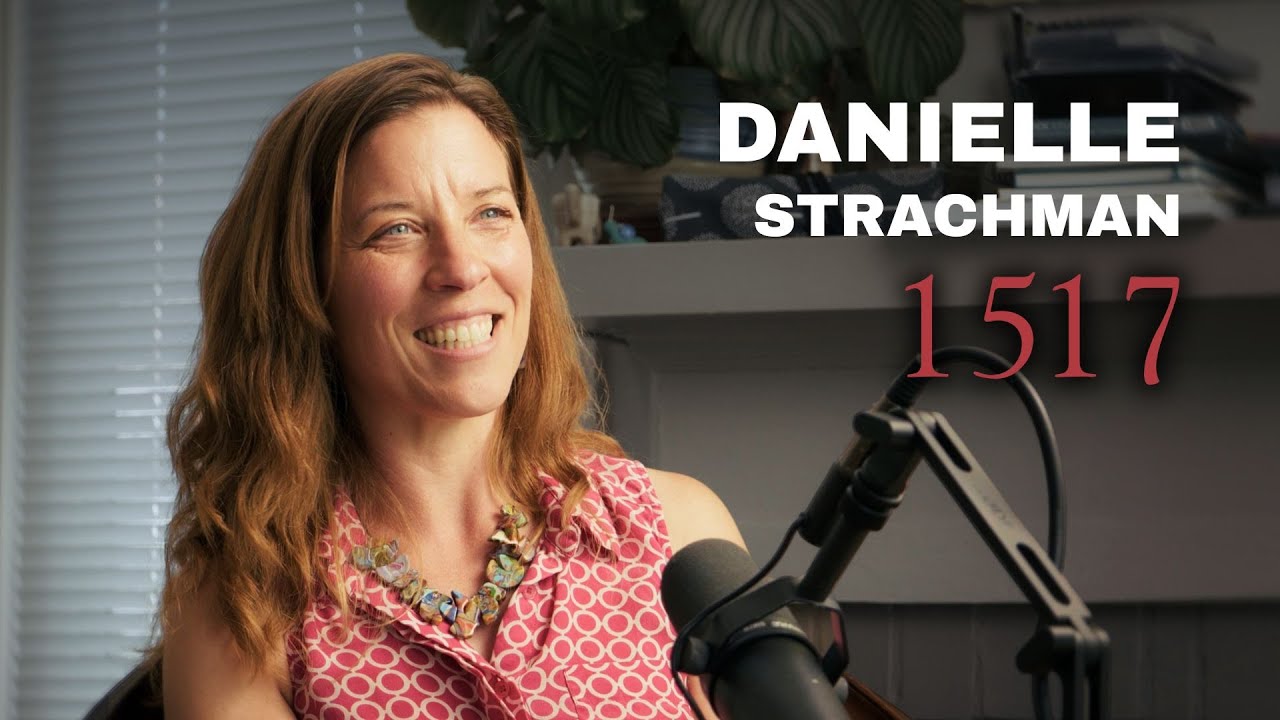
Danielle Strachman is co-founder and general partner at 1517 Fund, a venture fund that backs young founders, often teenagers and college students. Before 1517, she worked on the Thiel Fellowship, where she helped give $100,000 grants to young people to skip or leave college and build something. The episode covers the philosophy behind backing young people early, the origins of 1517’s Medici Project (small $1,000 grants), memorable founder stories, and Danielle’s broader views on education, mentorship, and creative development.
The Medici Project: Small Grants as Belief Capital
The Medici Project gives $1,000 grants to young people to start a project, not necessarily a company. It grew out of Danielle’s experience at the Thiel Foundation, where she and colleague Michael noticed that some people didn’t need $100,000 to get started, a smaller amount could be enough to move forward.
It began informally at a Thiel summit where teens could talk about ideas, and 10 of them received $1,000 each. Around 350–400 young people attended that event.
The grants were originally called “nudge grants” and were given as surprise attacks: Danielle would talk to someone about an idea and spontaneously offer $1,000 via Venmo, often leaving recipients shocked, laughing, or crying.
After about five years, they named it the Medici Project, after the Medici family who patronized young artists and builders during the Renaissance.
The key insight: young people are used to getting money as a prize for something they already made, but rarely get money as a vote of confidence in their potential. The grant is about giving resources, mentorship, and permission to build.
Several Medici grantees have gone on to build significant companies, including Deepgram (now a Series C company) and Mach Industries.
Memorable Founder Encounters
Noah Shuddy (Deepgram): Danielle and co-founder Michael stayed at a fraternity house (the old Shift House at University of Michigan) because they couldn’t afford hotels in 1517’s early days. They met Noah in a strange room with a pair of pants left over from a frat party. He pitched an algorithm he wanted to build. That project became Deepgram, now a Series C company.
Ethan (Mach Industries): Received a Medici grant in high school to work on a novel rifle. 1517 wrote the first check into what became Mach Industries.
Hyperrealistic stuffed animal maker: A 16-year-old reached out saying she makes hyperrealistic stuffed animals. Danielle took the call because she’d never been pitched on that before. The girl had already made 20 hyperrealistic animal heads and approached the craft like an engineer, creating architectural plans before sewing. Danielle sees her as an engineer working in an unusual medium and is connecting her with people in bioprinting, which the girl expressed curiosity about.
Ian (age 11): A grantee interested in ship design who was set up with a field trip to a ship design company in Toronto. He’s now working on a robotic mouse and “bounces when he talks.” Danielle tells him never to lose that energy.
Human (Soulcoa): Started as a grantee at 15–16, extracting rare earth metals more efficiently in his parents’ basement. Received a $100,000 investment check and now has a warehouse facility in San Francisco with a team and is moving into larger production.
Philosophy on Education and Young People
Danielle believes humans are naturally builders and makers, and that systems layered on top of children often suppress this instinct. Much of 1517’s work is about reaching people before those systems take hold.
She is a strong advocate for Montessori philosophy, which she considers deeply philosophical, not just educational. The core is treating young people with reverence, respect, and agency, not just offering classroom choices. Non-coercion and treating children as capable agents are the foundation.
She identifies as an unschooler at heart: child-led, with each child’s path determined individually. She gives examples of her three godchildren, each of whom thrives in a completely different educational environment (structured program, nature outdoor school, and potentially homeschooling at age 10).
She uses the term “young people” in professional contexts (not “kids”) as a form of respect, reserving “kids” for family relationships.
She believes the most important signal of potential is what someone does when no one is watching: “That’s not boredom, that’s motivation.”
The Role of Early Believers and Mentorship
An early believer can be an encourager, a mentor, a funder, or someone who simply says “let’s do it” instead of “that’s crazy.”
The best mentorship is Socratic dialogue: helping someone figure out their own path, connecting them to resources, and jamming on ideas together, rather than dictating what to do.
Danielle is explicit about what hat she’s wearing in conversations (investor, educator, personal) so founders understand the perspective behind her input.
She tells every founder: “You’re the captain of your ship. We’re the navigator.” She’ll warn about rocks ahead, but the founder makes the final call.
She’s learned to be direct when she sees a pattern that consistently fails, like crowdfunding campaigns done before a product is ready. She’s seen founders ignore the warning, smash into the rocks, and spend years dealing with angry backers.
How 1517 Works with Founders
Onboarding call: Begins with celebration (“holy moly, congrats, this is rare”) followed by a grounding reality check: the most likely outcome of any investment is that it goes to zero. 1517 will never ask for the money back. The expectation is to swing for the fences and flame out fast rather than peter out slowly.
Fund performance: Fund 1 (10 years old) returned 4.5x. Fund 3 was $80 million. Fund 4 is targeting $100 million. The goal is to 4x every fund.
Investment philosophy: 1517 is “an ATM machine where the password is traction.” They move fast to write larger checks ($100K, $1M, $2M+) when they see progress. They’ve reserved $2M+ for a single founder, earmarked and waiting for one final experiment to complete.
SPVs (Special Purpose Vehicles): For highest-conviction companies, 1517 “rings the dinner bell” with their limited partners to co-invest. They set up 4 SPVs each for Luminar Technologies (IPO’d December 2020) and Lambda Labs.
Flux program: A program for early-stage scientists who wouldn’t normally think to talk to VCs. 1517 gives $100K investments to scientists working on deep infrastructure-level projects, providing an invitation to try something they wouldn’t otherwise pursue.
Danielle’s key question when evaluating someone: “Would I have wanted to meet this person in the Thiel Fellowship finalist round?” She looks for irrational passion, geekiness, and being an “army of one” with high conviction.
Persistence, Pivoting, and Knowing When to Stop
Danielle tells founders it’s okay to shut down and move on, especially when they’re young. She’s had this conversation repeatedly with one founder who kept going through “nuclear blast after nuclear blast” over nine years, nearly shutting down multiple times, but recently landed a $2 million contract. She’s not sure the suffering was worth it, but the founder was on “a mission from God.”
Steven from Lambda Labs gave a talk advising founders: “Don’t close the C-corp.” Lambda Labs started as a photo-sharing app, pivoted through a Hail Mary moment (selling a deep learning workstation from their apartment for $10,000), and became what it is today.
She contrasts this with the DoorDash origin story: the founders put up a dummy landing page listing nearby restaurant menus, took phone orders while in class at Stanford, and delivered food by car for cash.
Danielle values momentum above all at the project stage. Her advice to the stuffed animal maker and others: keep making, keep building, finish projects. Completing things, even if the completion is shutting down, builds confidence that nothing else can.
Giving Permission and Building the Ecosystem
Danielle believes the most powerful thing for getting more people to start is seeing peers who are like them succeed. When young people see founders like Dylan Field (Figma) who spent their entire 20s building, it gives permission to start at 17, 18, or 19.
She references a phenomenon in sports where once someone breaks a record, others quickly match it, suggesting the barrier was always limited perspective, not limited ability.
She runs Renaissance Reimagined, a program bringing together ~70 fellowship leaders from around the world who support young people through cash, mentorship, and community.
She keeps a list of over 100 fellowship programs for young people. When she started at the Thiel Foundation, there were essentially none for teenagers or undergrads. The prevailing belief was that you had to accomplish things first before anyone would trust you with money.
She sees a dangerous pattern in society: institutions (both for-profit and nonprofit) that say “give us the money, we’re trustworthy, but you can’t trust individuals.” She believes in direct patronage of interesting young people, formalized through programs like the Nautilus program started by Zelda Poem.
If She Had $10 Billion
Danielle’s vision for 1517 at scale: become a massive family office with an investment arm, a fund of funds backing young-founder-focused funds, and nonprofit dollars flowing to fellowship programs across the ecosystem.
She wants to cut checks to every program doing this work well, preserving the niche, caring approach of each rather than centralizing everything. She values the people for whom this work is a calling, not a stepping stone.
She has hunches about extending the Medici model to the arts: driving around the Bay Area, finding painters without MFAs, giving them $1,000 for rent or supplies, and hosting a showcase at the end of the summer to connect them with buyers from the tech community.
Prolificness, Art, and Entrepreneurship
Danielle sees a strong connection between prolific creators and the founders she works with. She references Picasso making art every day from his teens until his death, most of it unknown, but the volume producing the masterpieces.
Many 1517 founders are also makers and artists in other domains. One founder sold art on eBay to make extra money. Another, Marcus from Calave (energy tech), shared beautiful paintings in the founder group chat.
She believes the best founders retained their playfulness and generative energy from childhood. They make a bunch of junk without caring, and eventually land on a masterpiece.
She sees a distinction between artists and entrepreneurs: artists create because they have to, often for themselves; entrepreneurs create but must care about what others think because they need customers. Both are generative, but the motivations differ.
The hardest part for many young founders is finding their tribe: peers who want to talk at the project level rather than asking “what college do you go to?” This is getting better but still a challenge.
Hardest Thing She’s Overcome
Danielle co-founded a charter school called Innovations Academy in 2006, which opened in 2008. She was 28 and didn’t understand macroeconomics. A $250,000 grant from the Walton Foundation that seemed guaranteed fell through because the Waltons disapproved of their approach: co-principals instead of a single leader, first-name basis with students, no homework policy, and a social-emotional curriculum.
With a signed lease, no students, and no state funding (charter schools in California only get paid per student enrolled), she and her co-founder each borrowed $75,000 from family. The recession hit, and it took four years to pay back the loans.
She couldn’t look her friend’s mother (who lent the money) in the eye for years, though the woman, who worked in global macro, understood the situation wasn’t their fault. They repaid with interest.
This experience didn’t directly shape 1517’s policy of never asking for money back (that comes from a philosophical stance about extraordinary returns), but it gave her deep empathy for founders under financial pressure.