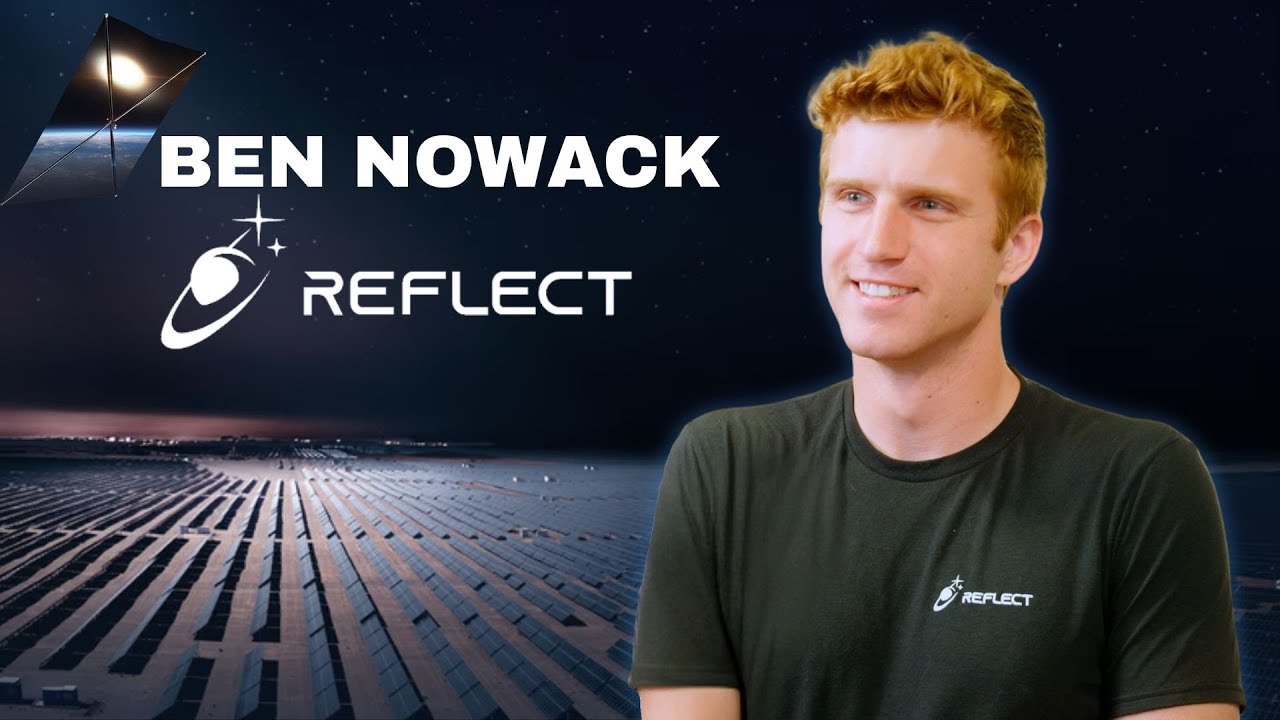
Ben Nowack, CEO and founder of Reflect Orbital, is building a constellation of mirror-equipped satellites that redirect sunlight from space to Earth on demand — effectively extending daylight hours for any location on the planet. The company’s core idea is simple: use mirrors in orbit to move sunlight from where it’s abundant (space, where it’s always daytime) to where it’s needed (the dark side of Earth). This is a small-scale, practical step toward what could eventually become a Dyson swarm — a vast collection of energy-collecting satellites around the Sun. The episode traces Ben’s personal journey from childhood tinkerer to SpaceX intern to startup founder, and explores the technical, commercial, and philosophical dimensions of building a company whose product is literally sunlight on tap.
Ben’s origin story: building hard things as a kid
Ben grew up on Cape Cod, the son of a carpenter, and was using power tools like a table saw by age five. His father encouraged hands-on building, and Ben developed an early pattern: the harder something was to build, the more rewarding it felt.
As a child and teenager, he built increasingly ambitious projects — RC planes, an X-ray machine (which earned him school credit), a Farnsworth fusor that achieved measurable fusion in high school, liquid nitrogen experiments, and a sputter gun. He documented these on a YouTube channel called “Ben and Builds.”
He also built explosives in middle and high school, disassembling model rocket engines with friends. While fun, he eventually recognized this was a dead-end path and shifted toward building things that were useful to society.
His material costs were remarkably low — around $20,000–$30,000 total for all his builds — because he scavenged from a local dump, received donated equipment from teachers, and did contract work (like a reef camera project in Hawaii) that funded further projects.
He never monetized his YouTube channel, earning only about 70 cents total, because he disliked ads and saw them as a form of attention theft.
From YouTube to SpaceX to startup ideas
Ben’s YouTube channel directly led to his first job at SpaceX. Someone at the company watched his videos on their lunch break, sent them to their manager, and after a few phone calls, Ben was hired as an intern during his freshman year of college — despite having been rejected twice before as a high schooler.
At SpaceX, he worked on Dragon 2 propellant tanks and rocket engines, building large automated test fixtures and tooling. The experience gave him enormous ownership over expensive, flight-critical components and confirmed that engineering was the right path.
He had considered dropping out of college to work at SpaceX full-time, but a mentor advised against it, noting it would limit his future employability. Ben finished his mechanical engineering degree, though he found college far less educational and engaging than his self-directed building projects.
After SpaceX, Ben worked at two early-stage startups (including Zipline, the drone delivery company) as an employee #3 or #4. Both companies struggled, which taught him a critical lesson: starting a company commits you to 7–10 years on a single idea, so the idea must be exceptionally good.
He began systematically evaluating startup ideas, eventually considering around 100 different concepts. He ranked them by potential impact and utility, killing most within days. Ideas he seriously considered included antimatter energy storage, drone delivery (before learning Zipline existed), soil sensing for agriculture, flywheel energy storage, and space planes.
The genesis of Reflect Orbital
The core insight came from a simple observation: Africa receives roughly three times more sunlight than Europe. A solar farm that generates $100 million per year in Africa would only generate about $30 million in Germany. That $70 million gap represents an enormous economic opportunity if sunlight could be moved from one place to another.
Ben realized that mirrors are extraordinarily efficient at moving light — LIGO’s mirrors lose only about three photons per million, and even ordinary bathroom mirrors are ~80% efficient, compared to ~20% for solar panels. Light traveling in a vacuum (like from the Sun to Earth) barely loses energy at all over billions of light-years.
The best source of sunlight is in space, where it’s constant (no night, no clouds, no atmosphere). The best destination is the dark side of Earth, where people need light most. A single mirror in orbit can redirect sunlight downward.
He initially explored several technical approaches: vacuum tubes to pipe sunlight across continents, beam expanders to concentrate light onto small areas, and hybrid solar-laser systems. He ultimately settled on a simple architecture: flat, lightweight reflector satellites (similar to solar sails) that redirect sunlight to large areas on the ground.
A key moment came while he was on a run: instead of trying to beat photovoltaic solar (which has become incredibly cheap), what if he simply made existing solar farms more productive by beaming additional sunlight to them at night? This reframing unlocked the business model.
The idea kept getting better over time — every month, new applications and markets emerged. This consistent upward trajectory was the signal that convinced Ben to commit fully.
The technology and architecture
Reflect Orbital’s satellites use a solar sail-like design: four thin booms supporting a tensioned mesh reflector, about 18 meters by 18 meters — slightly smaller than the Russian Znamya mirror experiment from 1992.
Each satellite produces a spot of light roughly 5.5 km in diameter on the ground. While this spreads out the radiance significantly, it’s well-matched to large solar farms and construction sites of similar scale.
The satellites are highly agile, using reaction wheels to reorient quickly. They can begin illuminating a target on Earth within about 30 seconds of receiving a request.
The company’s chief engineer, Charlie Garcia, describes Reflect as “critical path to a Dyson sphere” — starting with a swarm of small, flat satellites around Earth and eventually scaling to millions of units, potentially expanding toward the Sun over decades.
Ben sees this as a practical, incremental approach to the Dyson sphere concept: rather than building a rigid megastructure around the Sun, deploy billions of small, cheap reflectors that collectively approximate the same function.
Market discovery: lighting is bigger than energy
Ben initially focused on energy — using reflected sunlight to boost solar farm output at night. The energy market is enormous (~$3 trillion in solar assets globally, ~8% of global GDP).
But the 264,000 applications for sunlight from 157 countries (submitted after a viral 15-second video got 55 million views) revealed that the lighting market is even larger and more profitable than energy.
Construction alone is ~20% of global GDP — larger than the entire energy sector. Extending the workday by 1–2 hours with free sunlight is enormously valuable for construction crews, mining operations, and emergency response.
Other unexpected applications emerged from the applications: search and rescue (illuminating the ocean when someone falls overboard), night beaches at resorts in the Middle East, drying clothes, growing crops, lighting birthday parties, and helping communities in high-latitude regions like Norway and Alaska that endure long, dark winters.
Lighting is more profitable than energy because it’s a value-added service rather than a commodity. An electron is an electron regardless of source, but sunlight delivered on demand to a specific location has unique value — similar to how email is more valuable than physical mail not because the message is different, but because the infrastructure required is essentially zero.
Launch timeline and scaling plan
Next year (2026): Two satellites launched on separate rockets (April and October), a few months apart. The goal is to be brighter than a full moon, with 5x margin. These are test vehicles, not full commercial deployments.
Year after (2027): Two rings of 18 satellites each (36 total), providing a 2-hour window of illumination anywhere on Earth during evening hours (roughly 7–9 PM local time). This is the first taste of real commercial utility.
Following year (2028): 700 satellites, enabling 24/7 service anywhere on Earth, with overlapping coverage for higher radiance and multiple simultaneous customers.
Long-term: Scaling to thousands and eventually tens of thousands of satellites, with the goal of 100,000 within the decade and millions eventually. This scaling is directly tied to the availability of cheap launch capacity, particularly from SpaceX’s Starship.
The company recently received an Air Force contract (Direct to Phase 2) for both energy and lighting applications, validating the dual-use potential.
The team and hiring philosophy
Ben’s CTO and co-founder is Tristan, whom he met at Zipline. Tristan was a high school prodigy working on hard problems at Zipline and had watched Ben’s YouTube channel for years. He joined Reflect after briefly attending Stanford, recognizing the opportunity was more valuable than finishing his degree.
Ben and Tristan share deep alignment on vision and values, with complementary skills: Ben focuses on the big picture, fundraising, and external communication, while Tristan excels at organizational design, translating complex visions into actionable plans, and ensuring the right people work on the right problems.
Ben’s hiring philosophy crystallized after experiencing what an “A+” player looks like firsthand: one exceptional person can outperform 10–20 average hires in a matter of days. He now evaluates early hires by asking whether they increase the company’s value by more than the equity they receive.
The team includes people like Robert Salazar, an origami expert with 25 years of experience in deployable space structures (starshade, lunar flashlight), who is ideally suited to design the folding reflector mechanisms.
Personal challenges and philosophy
Ben contracted Lyme disease around 2012–2013 (ages 14–15) and was bedridden for about a year. He lost the ability to focus, couldn’t remember things week to week, and dropped all his projects. He described it as a “complete flatline” — he played Minecraft constantly and felt like he was wasting his life.
His recovery (after an unconventional ionic silver treatment from a practitioner in Maine) was a turning point. He realized he never wanted to feel that way again and made a conscious decision to always be building, moving forward, and doing useful things.
He sees a direct line from that experience to his current work ethic: he works long hours not because he has to, but because he genuinely loves doing it. The hardest thing he’s ever done is Reflect Orbital, and he expects it to be a decades-long commitment.
His decision framework for ideas and life choices is to always take the harder path — not for difficulty’s sake, but because the hardest thing to do is usually the most useful, and the most useful thing is where the greatest impact lies.
He’s willing to abandon Reflect immediately if it stops being the best idea. He made a promise to himself that he’ll quit the moment it becomes clear the concept isn’t working — the same discipline that let him kill 99 other ideas quickly.
The Dyson sphere connection
Ben didn’t initially think of Reflect as a Dyson sphere project. His ex-girlfriend pointed out that collecting more solar energy than Earth naturally receives is essentially what a Dyson sphere does — it doesn’t have to be right next to the Sun.
He now thinks of Reflect as a Dyson swarm in its earliest form: thousands of small, flat satellites around Earth that collectively harvest and redirect solar energy. Over decades, the swarm could expand toward the Sun, eventually evolving into the classic Dyson sphere concept.
On galactic scales, Ben argues, light is the only practical way to move energy or information — it’s the fastest thing in the universe and carries energy inherently. Any advanced civilization would eventually become “light-based” in its infrastructure, making Reflect’s core technology (mirrors redirecting light through vacuum) a universal primitive.