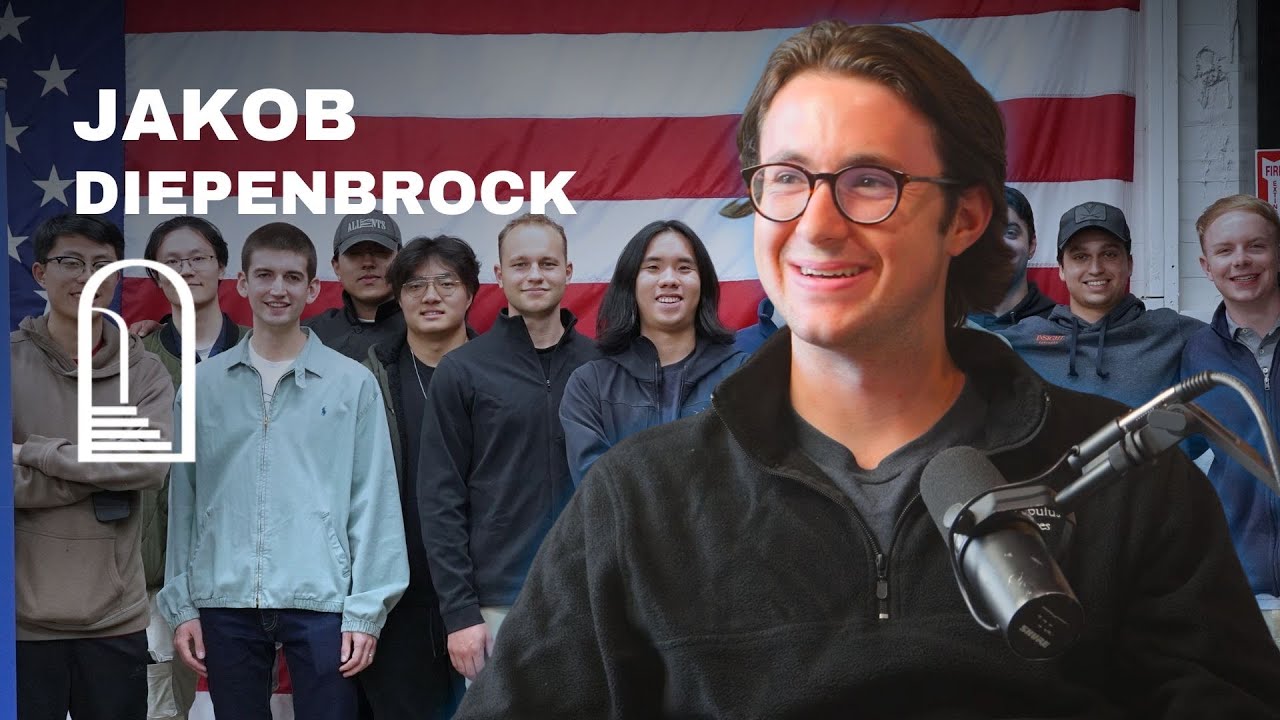
Jakob Diepenbrock is the founder and general partner of Discipulus Ventures, a hard tech residency program based in El Segundo, California. The program brings together young, technically skilled founders building hardware and deep-tech companies for an intensive two-week cohort that plugs them into a powerful network of investors, operators, and advisors in the El Segundo / South Bay ecosystem. What started as scrappy fireside chats and a one-week experiment sleeping in an Airbnb has evolved into a fund that has backed companies raising tens of millions of dollars, with a model that is distinctly different from YC or traditional accelerators.
How Discipulus started
Jakob began by organizing fireside chats at various schools, sponsored by venture funds like 1517 Fund and Contrary, which were interested in hard tech and American reindustrialism deal flow.
These events went well and helped him identify a persona of founder he wanted to work with: young, technical, mission-driven builders.
He considered hosting the first cohort in San Francisco but changed plans after seeing Augustus Dorr’s tweets about the emerging El Segundo tech ecosystem, then reached out directly and got permission to use the space.
The first cohort was run as a nonprofit experiment, funded by a few small checks (around $5K each), because Jakob wanted to prove the concept before committing to the legal and administrative overhead of a full fund.
Doing the first two cohorts in the Rainmaker building
The first cohort was held in the garage/side space of Augustus Dorr’s building (Valor’s space at the time), which was essentially empty.
The second cohort used the upper floor of the same building, which had grown significantly in activity and tenants in under a year.
Jakob described the vibe as scrappy but optimal for a startup’s early days, with founders and Jakob all living and working in close quarters.
Renting an Airbnb for all the founders
For the first cohort, Jakob rented an Airbnb in El Segundo where all the founders stayed together, with people sleeping on cots, bunk beds, and mattresses on the floor.
The arrangement was technically not zoned for business use.
There was no formal application process or structure for the first cohort; founders were simply invited to “come hang out and see what happens.”
The first cohort lasted only one week, which made the informal arrangement manageable.
Everyone enjoyed the experience afterward, and most went on to raise funding, which validated the model.
Why YC didn’t build something similar
Jakob believes YC didn’t attempt this because the model was unproven at the time, and YC’s decision-making process requires more certainty before committing to something new.
He also sees a fundamental mismatch: YC is software-focused, based in SF, and attracts software talent and investors, while Discipulus is hardware-focused and embedded in the El Segundo culture.
He thinks the two models are different enough that combining them wouldn’t work well, and that self-selection by founders plays a role too.
Stories from the first cohort
The cohort did morning runs every day at 6 a.m., which some founders loved and others refused to participate in.
Sleep was minimal, with people working until 1 a.m. and using high-dose nicotine pouches (35mg, Swedish-style) to stay sharp.
The second cohort upgraded the experience with gym sessions, Monster energy drinks, quarter-zips, and higher-quality swag.
Jakob kept the core structure largely the same between cohorts because the first one worked so well: companies from the first batch have raised roughly $60 million in less than a year.
Fundraising for the fund
After the first cohort ended in March, Jakob spent the summer of 2024 talking to GPs and advisors about fund structure.
He considered structuring as an operating company (like Entrepreneur First) but decided against it because of valuation challenges, double taxation, and unclear benefits over a traditional fund.
He officially began fundraising in August 2024 and found it extremely difficult: he was 20 years old, had no track record of running a fund, and had no monetary track record from investing.
Early fundraising was painful: he had a potential LP pull out of a $25K commitment when he had only $100K raised, and a fund-of-funds manager hung up on him and blocked him on LinkedIn after learning the fund size.
He eventually figured out that getting the right people on his side was key: he gave carry to advisors like Josh Diamond, Josh Manchester, and Kevin Harks, who had strong networks among high-net-worth individuals and made introductions.
Putting these advisors’ faces on the fundraising deck also helped build credibility.
Finding early supporters
Jakob’s approach to getting both investors and top founders to engage with Discipulus was to lead with the quality and uniqueness of the cohort: “10 of the best founders in the world at the earliest stages of building important companies.”
He found that people are willing to help when the thing is genuinely unique and the founders are impressive, but won’t engage with something generic.
Early guests like Scott Nolan, Delian, and Chris Power came through advisor introductions and Twitter DMs.
The network advantage for founders
Jakob sees Discipulus’s core value as network access: being in El Segundo means founders can meet investors and operators who wouldn’t fly up to SF for a random meeting but will drive over locally.
For founders like Peter from the first batch who had no prior connections to venture, the program served as an initial network connector into the go-to ecosystem for hard tech.
Post-cohort, the fund helps founders get in front of 100+ investors, dramatically reducing the friction of early fundraising.
Changes for cohort 3
The third cohort will be two weeks long (up from one week for the first cohort), based on feedback that three months is too long for most founders but one week felt short.
The value proposition is intense and quick: plug into the network, get fundraising help, and then optionally stay in the area afterward.
Jakob sees the main value as making founders part of an exclusive group with buy-in from Jakob and, by extension, from the fund’s advisors and network.
The cohort will likely be in September 2024, because summer is dead for fundraising and it takes about two months to prepare after the previous batch.
Scaling Discipulus
Jakob is not interested in scaling to YC size (hundreds of companies per batch); he wants to keep batches in the 10–15 range so he can know every founder personally.
If demand exceeds capacity, he would rather do more batches per year than make a single batch larger.
He has a privileged position as a young person embedded in the ecosystem, sleeping in founders’ offices and knowing the real story behind companies, not just the investor-facing version.
He considered a model like HZ (a larger, longer-term accelerator) but doesn’t think it fits the El Segundo culture and vibe.
Early worries
Jakob’s biggest early worry was whether 20-year-old founders with no experience would actually figure things out or just flop.
Some investors were skeptical of backing such young, unproven teams.
The first cohort didn’t build hardware during the week; it was “vibes maxing” — intense bonding, networking, and working — which turned out to be effective.
From hunting founders to getting inbound
For the first batch, Jakob had to hunt down founders and convince them to come.
The second batch had inbound interest, and by the last batch, he was able to invest in all companies immediately.
Now he is at the point of receiving significant inbound and sees the path forward as repeating a proven process and showing consistency.
Getting in the room
Jakob describes a clear inflection point in his career where he went from being outside the network to inside it.
In high school, he would LinkedIn-message people and get no responses; now those same people respond because they see him as legit.
He recalls Augustus Dorr telling him in El Salvador that he had reached the point where he could talk to anybody he wanted.
The hardest thing he overcame was getting people to see him as legitimate rather than just an outsider.
Early businesses
Age 13: Started a Wix store to drop-ship luxury watches without knowing what drop shipping was. Made zero sales on the free Wix plan.
Age 14: Learned what drop shipping was and started selling back braces, making around $1,000 in sales.
Age 14–15: Sold computer stands (standing desk accessories) sourced cheaply from China, selling them for $100 each at a cost of about $5. Spent roughly $30 total on Facebook and Instagram ads. Sold through the entire stock and couldn’t fulfill remaining orders, leading to refunds and the end of his drop-shipping career.
Age 15–16 (sophomore year of high school): Grew a TikTok account posting financial content, getting decent views and recognition at school, but was eventually shadow-banned (likely for posting financial numbers and promises).
Age 15–18 (sophomore to senior year): Founded The Young Investor Network, a community for young people in the Seattle area interested in investment careers, offering events, internship connections, and chapters (including one in London). This is where he met Ben (who spoke at one of his events) and first learned about venture capital, which ultimately led him to the Balmer Group and the path to founding Discipulus.
Willingness to reach out and fail
Jakob attributes much of his trajectory to a high willingness to fail and reach out to people, starting with mass LinkedIn messaging in high school.
He learned to always offer value when reaching out (e.g., inviting people to speak at events for publicity or access to interns) rather than asking for things with nothing in return.
Even with this approach, raising the fund was still extremely difficult, underscoring how hard it is to break into venture without an existing track record.