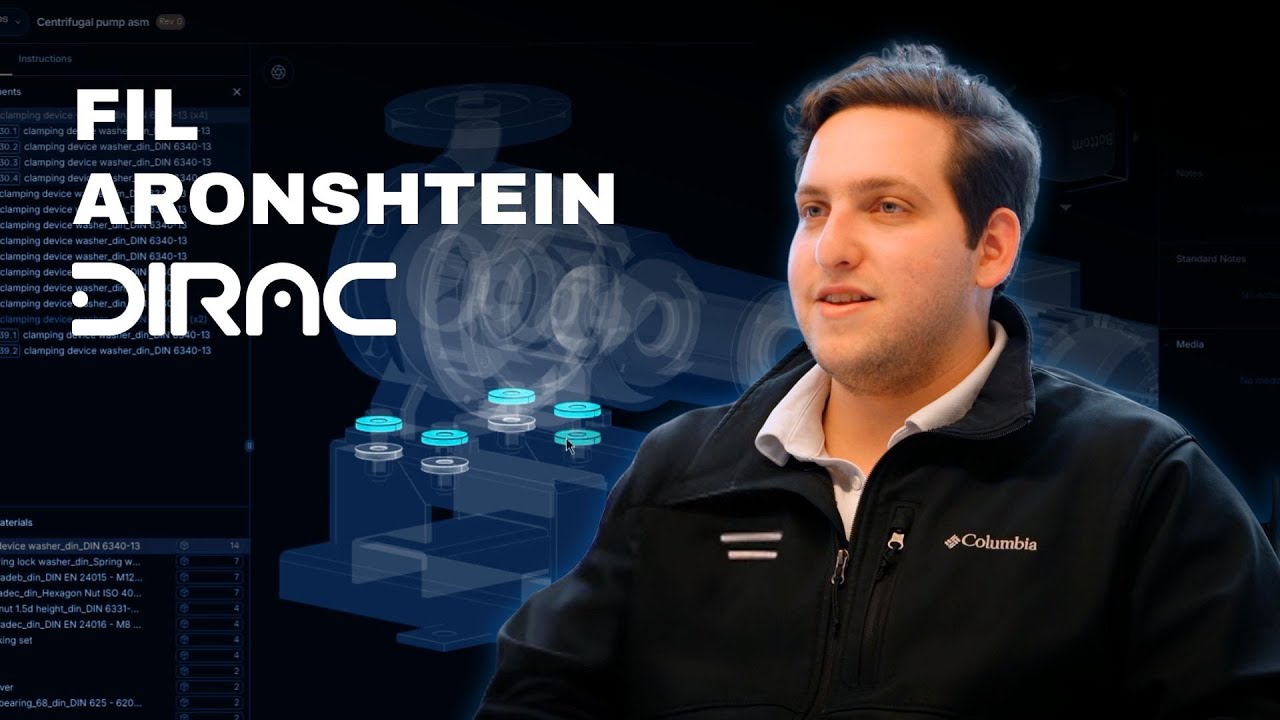
Fil Aronshtein is the co-founder and CEO of Dirac, a company building BuildOS, the first automated work instruction platform for manufacturing engineers. Since their last conversation, Dirac has completely rebuilt its product from scratch, moved its headquarters from El Segundo (“the Gundo”) to the Empire State Building in New York City, and launched BuildOS V1 in April 2025 — an ITAR-compliant, enterprise-grade, GovCloud-ready platform. The company is now pipeline-constrained, hiring aggressively, and evolving from a point solution into a broader context-aware production planning platform that connects design, production, and sustainment across manufacturing facilities.
Rebuilding the product from scratch
In August 2024, Dirac realized the legacy version of BuildOS had fundamental architectural problems that made it unsustainable at scale.
The original app had two separate 20,000-line data structures (one for parts, one for steps) that were 95% similar but had to be manually synced, creating a maintenance nightmare.
A clunky “pre-draft → simulate → drafting” workflow forced users to go back and forth between modes whenever they wanted to reorder steps, making the experience painful.
The architecture couldn’t support ITAR compliance or GovCloud integration, which a major aerospace customer required.
Rather than patching incrementally, the team decided to start a new repo and rebuild entirely from October 2024 through March 2025.
Expected timeline: 3 months. Actual timeline: 6 months.
The result is a completely re-architected, scalable application with a new tech stack that can handle massive CAD files and competes with the most sophisticated cloud-based CAD tools.
Key new capability: dynamic, synchronous animation generation — when a user reorders steps, new animations update on the fly rather than requiring a batch simulation pass.
During the rebuild, morale was “bleak” — the team was burning revenue, couldn’t sell the new product yet, and had to sell the legacy app while building relationships for the replacement.
Fil called an all-hands in September, declared “wartime,” and rallied the team to execute.
The legacy app served as an effective beta that helped the team understand the shape of what the real product should be.
BuildOS: what it does and why it matters
BuildOS automates the creation of work instructions — the step-by-step guides that tell factory workers how to assemble complex mechanical products.
Today, 99.9% of manufacturers use paper-based or PowerPoint/Word-based work instructions: hundreds of screenshots compiled into massive documents over weeks or months, printed into white binders, and rarely updated even when designs change.
BuildOS takes a CAD file, automatically determines the assembly sequence, and generates 3D animated, interactive work instructions that show parts coming together step by step.
Fil’s analogy: “What CAD did for mechanical engineers, we’ve done for manufacturing engineers.”
The value proposition is simple and immediately understood by manufacturing engineers: work instructions, automated.
Instructions are faster to draft, easier to follow, and dramatically reduce error rates and scrap.
Animated, model-based instructions radically reduce the skill level required to perform assembly tasks, enabling companies to hire less experienced or younger workers — a critical advantage amid labor shortages.
On the shop floor, operators use Operator Plus (recently announced) to execute work instructions, automatically trigger time studies, and give feedback on improvements, error codes, and non-conformances.
This is a new concept: most manufacturing software treats operators as “cogs in a machine.” Dirac calls their approach “power to the operators.”
All operator feedback gets associated with specific components, creating cross-analytic visibility.
From point solution to platform: context-aware production planning
Fil’s long-term vision is to evolve BuildOS from a work instruction tool into a full production planning platform using what he calls the “three blind men and an elephant” framework.
A manufacturing engineer sees the micro-level work instruction perspective (bottoms-up).
An industrial engineer sees the macro-level factory layout perspective (top-down).
Maintenance and repair personnel see yet another angle.
Today, these roles work in silos. Dirac aims to be the central source of truth that connects all of them.
The key insight: every piece of information in a manufacturing facility is connected to every other piece.
Example: an industrial engineer consolidates 15 bolts across 20 stations into 2 stations during line layout. That change should automatically propagate to the work instruction, which should then notify a mechanical engineer doing DFM (Design for Manufacturability) analysis.
This automatic propagation of context across roles is what Fil means by “context-aware production planning.”
Planned modules and capabilities on the roadmap:
Factory layout planning (inspired by the game Factorio — Fil played 30 hours straight to study material flow mechanics and quality-of-life UX patterns).
DFM (Design for Manufacturability) feedback from production back to design.
Automated MRO (Maintenance, Repair, Overhaul) instructions — Fil notes that changing six lines of code in assembly instructions can generate disassembly instructions.
Commander Console / Commander Overlord Seat: a management dashboard for COOs and VPs of manufacturing that aggregates shop-floor context (error-prone parts, fastest operators, most-executed work instructions) into a unified analytical view — “what Ramp is for a CFO.”
Complex enterprise integrations with PLM systems like Teamcenter, Windchill, and 3D Experience.
Moving from El Segundo to the Empire State Building
Dirac previously maintained two offices simultaneously — El Segundo and New York — but made the difficult decision to consolidate entirely in New York.
The lesson: if you have two in-person offices with strong in-person culture, you effectively have two remote offices. Communication breaks down, context gets lost, and decisions get made without full information.
The company restructured the engineering team, parted ways with the LA team, and moved into the Empire State Building all on January 30, 2025.
Fil still frequently visits El Segundo for customers and friends — “once a Gundo company, always a Gundo company.”
The Empire State Building move was a deliberate signal of seriousness and longevity.
Tenants include LinkedIn (10 floors), the FBI, and the SEC — not typical startup territory.
Customers, especially enterprises, want to know Dirac will be around. The building communicates permanence.
Fil describes a conscious personal transformation: shedding the “silly, goofy” early-stage founder persona and becoming a more serious leader. “You don’t build a startup in the Empire State Building. You build a company.”
“They don’t want you to fuck around. We’re helping people make submarines.”
Customer traction and market tailwinds
Since launching BuildOS V1 in April 2025, the pipeline has “been blowing up” — Fil and Trevor (who runs partnerships) are double-booked on calls and having to schedule customer onboarding weeks out.
Customer types: Dirac focuses on companies doing complex mechanical assembly — aerospace and defense, automotive, agriculture and construction machinery, maritime. They work with OEMs and tier 1–3 suppliers.
Ancra is a highlighted customer: tier 1 supplier to Airbus, Boeing, and Gulfstream, making 60% of all cargo loading mechanisms in planes worldwide. Dirac is live on their lines.
Employee #1, Keenan, was a manufacturing engineer at Boeing — his coworkers applauded on his last day, treating his departure to join Dirac as a “hero’s journey.”
Reshoring trend: Dirac has a unique vantage point because they work across entire supply chains (OEM through tier 3), and they’re seeing a wave of reshoring activity.
Customers are constantly revising work instructions because they’re swapping subassemblies sourced from new domestic vendors.
Companies are bringing production back from abroad and need to train new, less-skilled labor — Dirac’s animated instructions make this feasible.
Data center boom: A major growth area. Companies building cooling systems, heat exchangers, and other infrastructure for AI data centers are standardizing production across hundreds of global facilities with high product variance.
Dirac acts as a “rubber band around variance” by automating model-based work instructions that handle many product variants consistently.
Shipbuilding: After partnering with Fairlead (a major shipbuilder at Norfolk Shipyards), Dirac saw a surge of inbound interest from other shipbuilders.
Selling into manufacturing: the bottoms-up challenge
Selling to manufacturing has a unique difficulty: the end user (manufacturing engineer) immediately sees the value, but management often doesn’t.
Manufacturing engineers try to advocate upward, but if management doesn’t immediately see the ROI, the sale stalls.
This is why Dirac is building the Commander Console — to give executives the aggregated context they need to justify the purchase.
Meeting customers where they are: Many customers initially use BuildOS to draft instructions and then export to PDF for paper printouts on the shop floor.
This is common and expected. But most quickly transition to using the live operator viewer once they realize how easy it is.
Fil’s philosophy: “You have to be willing to be a thousand times faster to done” — even if the customer’s starting point is a PDF export.
Listening to what customers aren’t saying: Fil references the “faster horses” problem — customers ask for incremental improvements because they can’t imagine the car. He cites the Paul Graham (“call your customer”) vs. Peter Thiel (“call your shot”) dichotomy and believes the answer is combining both: deeply understand the customer’s underlying problem, then solve it in a way they didn’t know was possible.
Co-founder dynamics and personal growth
Fil’s co-founder and CTO Peter is “the smartest man I’ve ever met” — an execution machine who did all four final project options in their freshman EE class instead of picking one.
Peter is an “engineer’s engineer” who earned the highest GPA in their EE department, tutored friends at MIT and Hopkins for fun, and initially refused to stop tutoring calls even after Dirac was founded because he loves teaching.
Over the past year, Peter has grown from a brilliant but somewhat shy engineer into a genuine leader of men — now leading a 10-person engineering team and widely respected as the youngest member.
Fil’s own evolution as a leader over the past 12 months:
Realized he could no longer be “one of the guys” — his team looks to him as an example. If he’s late, they’re late. If he’s sloppy, they’re sloppy.
Made a conscious decision to become more serious, present, and disciplined. “I’ve had to kill a little bit of that silly version of myself in order to win.”
Hasn’t played video games in a year (except one 30-hour Factorio session for product research).
When things are difficult, Fil leans on fellow founders Augustus, Josh Steinman, and Isaiah Taylor — mission-aligned peers who understand the founder journey.
Design philosophy: making production planning enjoyable
Fil is inspired by video game design principles — not to gamify work instructions literally, but to make production planning pleasant and engaging.
Video games excel at making repetitive tasks enjoyable over long periods. Dirac applies similar UX thinking: reducing clicks, adding intuitive macros, making the interface responsive and clean.
A head of manufacturing at a German conglomerate (in his 50s) told Fil he uses BuildOS on weekends because “it’s actually fun.”
A lead manufacturing engineer told Fil: “I don’t want to make work instructions any other way.”
The contrast: traditional work instruction software is essentially PowerPoint or Word with extra buttons. Nobody likes making or following them. Dirac has created something entirely new.
Ambitions and the Boeing question
When asked about a dream company to work with, Fil’s answer is Boeing — but it’s complicated.
Boeing has well-documented quality and work instruction problems, but suffers from “not made here syndrome” and management that doesn’t listen to manufacturing engineers.
Fil has empathy: “I want them to win. I’d like to be proud to take a Boeing [plane].”
Boeing’s near-peer competitors are already working with Dirac, and there is significant internal interest from various groups within Boeing.
Fil is confident they’ll work together eventually: “It just takes time for people to realize that just because you didn’t build it internally doesn’t mean it’s not game-changing.”
Fil notes that every industry has one or two stubborn incumbent giants with this mentality — Boeing is just the most visible example in aerospace.