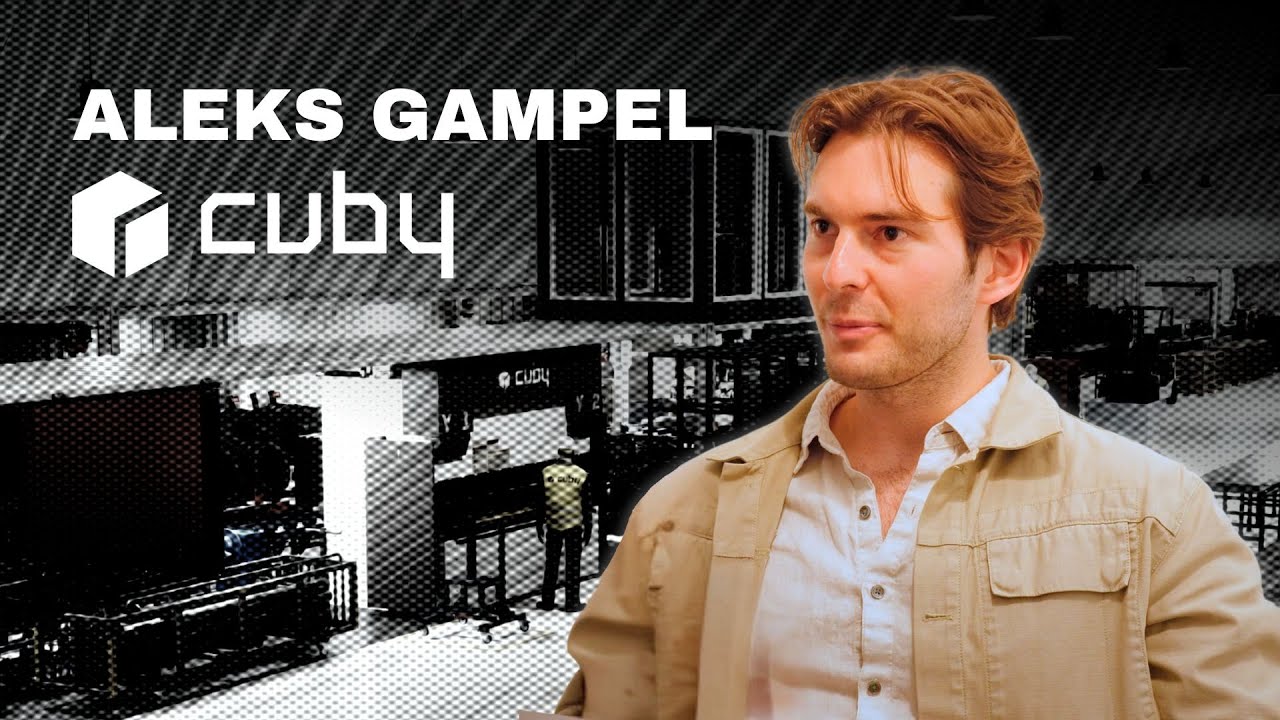
Cuby is a construction technology company building mobile microfactories that produce homes on-site using unskilled labor and digitalized instructions. Co-founder Aleks Gampel discusses the company’s progress since his last interview: scaling to over 200 employees, reaching nearly 700,000 engineering hours, and preparing for its first commercial deployment in Nevada. The core thesis is that the biggest bottleneck in housing isn’t the factory — it’s the chaos of the construction site, and Cuby has built an end-to-end system (combining general contractor, 22 subcontractors, and manufacturing) to solve that.
The housing crisis is global and structural
The US still faces a shortage of roughly 6.5 million homes, a figure that hasn’t meaningfully improved in a decade.
The root cause is demographic: 40% of the construction workforce will retire in the next 10 years, with a replacement ratio of 7 retirees for every 1 new worker.
This is not just a US problem — it’s acute in Australia, Canada, and the Middle East.
Australia has a massive affordability crisis where incomes can’t keep up with housing costs.
Saudi Arabia alone needs 5 million units — nearly the entire US shortage — and imports cheap but unskilled labor from Pakistan and Bangladesh.
The new US administration has been a tailwind because Cuby’s model hits two priorities: domestic manufacturing/industrialization and housing supply.
The crisis is twofold: bureaucratic (permitting, zoning) and labor-related (skilled worker shortage). Cuby addresses the labor piece; the regulatory piece is a systemic problem requiring standardization — there are 26,000 different zoning codes in the US alone.
How Cuby’s system works
Cuby’s product has three components:
Software — digitalized, dynamically changing instructions for building homes (tied to hardware iteration cycles).
The mobile microfactory — the core IP, a container-based factory that can be deployed anywhere.
On-site hardware and kit of parts — what the factory produces, assembled on-site by unskilled labor following binary (done/not done) instructions.
Co-founder Oleg has broken homebuilding into roughly 10,000 binary steps across three dozen stages, eliminating any task requiring subjective judgment (e.g., painting a wall) from the on-site process.
The factory iterates quickly because the R&D center is physically attached to where hardware is built — design, build, test, discard, repeat.
Cuby looks deceptively like traditional construction and has no regulatory risk by design. It actually uses its factory structure to bypass certain regulations.
Business model: four-phase master plan
The plan has remained unchanged over 4.5 years and envisions a $50–100 billion outcome over 10–20 years.
Phase 1: Be the “AWS for homebuilding” — deploy factories globally using McDonald’s-style SOPs for repeatable, capital-efficient launches.
Phase 2: Supply all ~550 SKUs of bill of materials to own factories (several billion in revenue at ~30% margin).
Phase 3: Become the homebuilder — consume 20–30% of each factory’s output using Cuby’s own supply.
Phase 4: Expand to other asset classes with adapted versions of the technology.
The goal is 200 factories, each producing ~200 homes per year at scale.
Capital efficiency and the “cockroach” approach
Cuby measures itself by technical de-risking per dollar — nearly 700,000 engineering hours completed with relatively little capital.
R&D is based in Eastern Europe (45,000+ sq ft of space), which is the most capital-efficient location. This choice would be 5–10x more expensive in the US.
The company has been intentionally underraised relative to what it’s built, following a “sources equals uses” philosophy from private equity/real estate: raise only what’s needed for the next milestone.
This forces resource-constrained innovation but makes fundraising harder because venture capital rewards vision and unlimited upside, not de-risking.
Most investors haven’t visited the Eastern European facility; customers launching factories are more likely to visit than investors.
The company believes it will raise at ~4x its B1 round once the Nevada facility is operational and tourable.
The Papa Factory and China strategy
Cuby is building a “Papa Factory” — a stationary facility that manufactures the mobile microfactories.
It will ramp to 3 factories/year, then 8, then 20.
It’s more capital efficient than the mobile microfactories themselves.
The Papa Factory is being built in China (Tinda), not Eastern Europe.
China was chosen over India, Mexico, and the US because Cuby makes specialized OEM machines — not the kind of product China copies at scale (they want billion-unit opportunities).
Custom CNC machines and components can be sourced in China at up to 12x cost reduction compared to elsewhere, even accounting for tariffs.
Containers (which make up the factories) are overwhelmingly made in China anyway, so it’s more efficient to manufacture and package there.
Long-term, Cuby envisions extreme vertical integration — potentially leasing entire cargo ships, similar to BYD’s recently built car transport vessel.
Nevada commercial deployment
Cuby acquired 6 acres of land in Nevada within four weeks of starting the search, leveraging Aleks’s real estate background.
The facility is moving forward with public sector support, but the pace is deliberately calibrated:
Oleg uses the time to test and iterate on the first-of-a-kind facility in Eastern Europe so mistakes aren’t made at commercial scale.
The company is also sequencing the unlocking of project finance (asset-level backing) correctly.
The main timeline constraint: it takes ~10 months to build a factory (potentially reducible to ~6 with the Papa Factory in China).
Multiple factories will be built in parallel — scaling is a function of SOPs, modeled on McDonald’s regional launch playbook.
Co-founder dynamics and company culture
Aleks and Oleg operate in very separate lanes and stay out of each other’s way.
Oleg is described as someone who makes decisions extremely fast (51% correct, 49% incorrect) and iterates quickly — a trait Aleks considers ideal for a startup with limited time and resources.
The company hired a chief of staff (Danny) — an exceptional engineer who no longer wanted to be an engineer, speaks Russian, and is New York-based — a rare combination sourced through an investor.
Hiring for the Nevada facility begins 12 months before launch, with 400+ page SOPs already written for factory deployment.
Fundraising philosophy and investor alignment
Cuby has been underraised relative to its progress, which is unusual in deep tech where companies often raise large rounds on renderings and vision.
The company is adamant about sources = uses — raising only what’s needed for the next milestone, not raising for the sake of raising.
This is a “scary way to run a business” but forces efficiency.
Overfunding can be a detriment: it leads to excessive dilution, and first-time founders who end up with 1% after multiple rounds may lose motivation over the 7+ year journey.
Cuby’s investors tend to be highly technical — with manufacturing or deep tech backgrounds — and appreciate the massive moat the company has built.
The company believes it will eventually reach a point where revenues equal burn and it won’t need venture capital at all. After the first mobile microfactory is launched and cash-flowing, subsequent factories will be funded through project finance (cheaper, asset-level debt).
What keeps Aleks up at night
Every task is filtered through two questions:
Does it reduce burn by monetizing the existing first-of-a-kind facility (building model units, syndicating parts globally)?
Does it move the needle on launching the Nevada facility faster?
The most painful experience: being told “no” by investors for reasons that aren’t underwritable — they simply don’t understand the business.
Venture capital’s model doesn’t work well for deeply vertically integrated companies where the iceberg is massive and requires deep diligence most investors won’t do.
Cuby believes it should have invested more in media and narrative building (like Jason Calacanis’s S3 or AI startups do) because deep tech is often “show vs. tell,” and many deep tech investors aren’t deeply technical themselves.
The overarching pressure: the responsibility of overselling and overdelivering — launching something that has never existed before, with no dependency on anyone else.