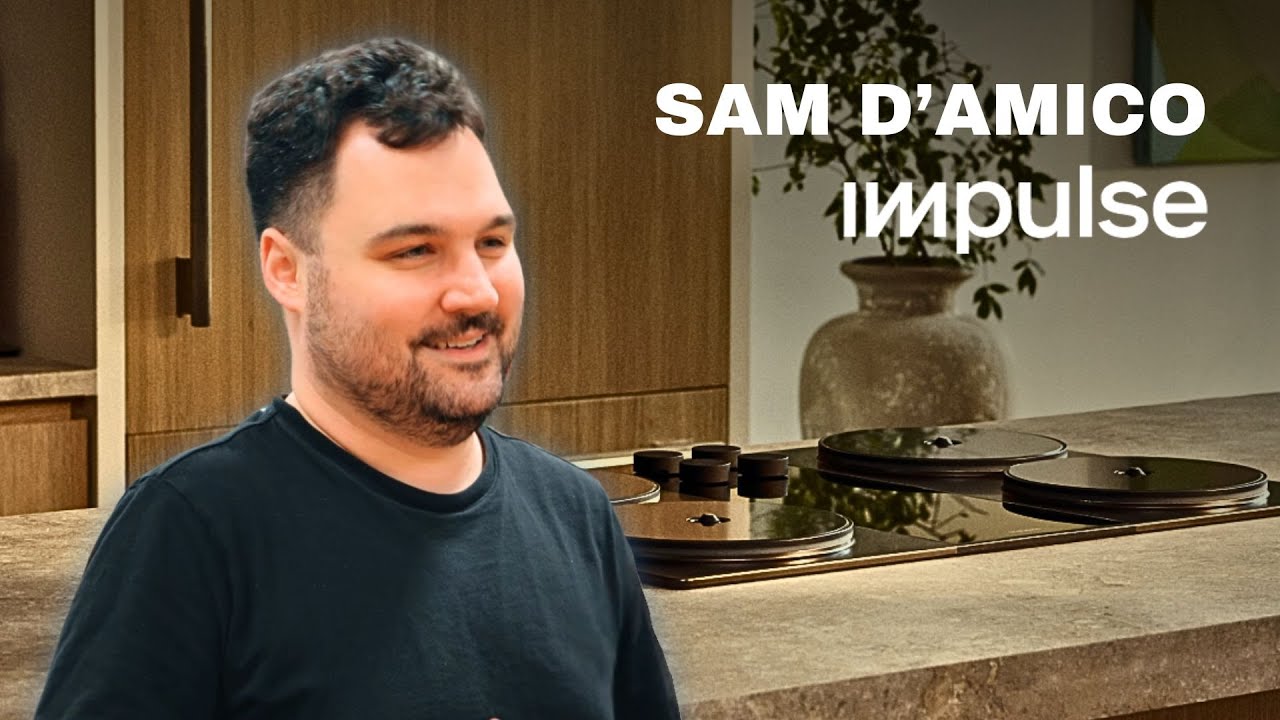
Sam D’Amico, founder and CEO of Impulse Labs, has spent four years building a high-performance induction cooktop with an integrated battery that can boil a liter of cold water in under 40 seconds — roughly three times faster than a typical induction stove. But the stove is really a Trojan horse: the real play is to embed batteries and power electronics into every major home appliance, creating a distributed energy storage network at the edge of the grid. The company’s strategy mirrors Tesla’s original master plan — build a premium product to prove the platform, then license the underlying technology to established appliance brands for massive distribution.
Why a stove
Sam’s path to stoves started with a pizza oven problem: he wanted a tabletop electric oven that could cook a pizza in a minute, like a brick oven, but realized a standard 120V plug couldn’t deliver enough power. His solution was to add a battery that trickles charge from the wall and dumps high power on demand.
He generalized this insight: residential electrical infrastructure is essentially frozen in amber — houses were built for a low-energy era, and upgrading service panels, transformers, and wiring is slow and expensive. A battery embedded in an appliance sidesteps all of that because it draws power slowly from existing wiring and delivers it at high burst when needed.
The stove was the obvious first product because the fuel source is the user experience — gas stoves are beloved for their responsiveness, and no electric stove had ever matched that feel. If you could make an induction stove dramatically faster and more precise, you’d have a product people actively want.
The battery also means the stove doesn’t need a 240V outlet — it plugs into a standard wall socket, avoiding the single biggest barrier to induction adoption.
The technology
Power: The Impulse cooktop can deliver 10,000 watts to a single burner by combining wall power with battery discharge. A typical induction stove tops out around 3,000–3,600 watts in boost mode. This is what enables the 40-second water boil.
Temperature control: Existing induction stoves use open-loop power settings (levels 1–10) with no idea what the pan is actually doing. Some products tried infrared sensors through the glass, but glass blocks IR below ~300°F, making sous vide impossible. Others required special Bluetooth-enabled pans. Sam rejected both approaches — he wanted any pan to work.
Custom sensor: Impulse spent nearly a year (2021–2022) developing a new sensor type that measures temperature inside the pan, not the bottom surface. The team went through extensive prototyping with an external consulting firm, eventually arriving at a solution involving custom ceramic components and a spring-loaded contact mechanism. The engineering challenges included ensuring the spring wasn’t magnetic (so it wouldn’t melt from induction heating), selecting plastic resins rated for high temperatures, and designing for manufacturability.
Battery: The unit contains roughly a 3 kWh battery pack (LFP chemistry) capable of ~15 kW output. It charges slowly from a standard outlet and discharges rapidly during cooking.
Inverter: The stove includes a bidirectional inverter that can feed power back into the house. This enables backup power during outages, demand response, and grid services — turning every installed unit into a distributed energy asset. Developing a UL-compliant, stove-sized inverter that could handle grid-frequency regulation was a major program in itself.
Magnetic knobs: The control knobs are fully magnetic and removable — no electronics in the knob itself, just a magnetic angle sensor under the glass. This was inspired by the Nest thermostat and solves the cleaning problem of shafts penetrating the cooktop surface.
Prototyping and manufacturing
Sam ran the development like a consumer electronics program (his background is Oculus, Facebook, Google Glass) rather than the typical appliance industry approach of iterating on showroom-ready units.
P0 (mid-2022): A server-rack-sized prototype with four burners, magnetic knobs, battery, and screen. Proved the core concept worked.
P1 (August 2023): First prototype built at the contract manufacturer using their supply chain. Missing inverter hardware. Required a full construction review with compliance experts who redlined the design.
EVT (April 2024): Engineering verification — fixed major issues from P1, redesigned battery pack shape, completely new temperature sensor molded parts, new software architecture. The software was refactored from a single microcontroller (which created long, failure-prone sensor wiring runs) to a distributed architecture where each burner controls itself.
DVT/PVT: Production-verification units that are essentially identical to shipping product. Sam notes the total development involved hundreds of prototype units, each costing tens of thousands of dollars.
The factory itself had to be treated as a product — Impulse was the first company to integrate a large battery, inverter, and induction system into a single appliance, so the production line was a “special snowflake” with no playbook.
COVID complicated early prototyping because Sam couldn’t travel to China. His advice to other hardware founders: get on a plane and prototype with production parts at the factory as early as possible — don’t waste time on lab-only prototypes using non-production components.
Regulatory and compliance
Appliances sold in the US must be listed by a Nationally Recognized Test Lab (NRTL) like UL or CSA. This is a private, privatized system — not a government agency, but OSHA-approved labs that enforce standards referenced in building codes.
Impulse brought compliance experts in for a formal construction review as soon as they had a working prototype, getting redlined early rather than discovering issues later.
The stove required UL certification for the appliance itself, FCC Part 15/18 for electromagnetic emissions (challenging at 10,000 watts — Sam hints at proprietary solutions still being patented), and UL 6730 for functional safety of the firmware and control system.
The bidirectional inverter added another layer of complexity: it must detect grid frequency deviations and respond appropriately, requiring sophisticated algorithms validated to utility standards.
Prototypes can be given to VIPs and influencers with a “sample not for sale” sticker without full certification, but any consumer sale requires complete compliance.
The business model and distribution strategy
Direct-to-consumer: Impulse sells its own cooktop as a premium product. It’s a high-end purchase (comparable to a car decision, not an impulse buy), targeting people doing kitchen remodels or who want the best cooking experience. Sam believes they can sell tens of thousands of units DTC.
The platform play: The real scale comes from licensing Impulse’s technology — battery modules, inverter hardware, power electronics, temperature control systems, and software — to major appliance OEMs. Sam compares this to Tesla’s original plan of supplying powertrains to Daimler and Toyota, or to BYD’s model of building the “electrification stack” that other brands use.
Impulse has announced partnerships with major appliance brands. The vision is “Powered by Impulse” branding — like “Intel Inside” — where existing brands offer Impulse-equipped products in their showrooms. This gives Impulse access to thousands of showrooms and millions of annual appliance installations without having to build its own distribution.
Energy services: Once batteries are deployed in homes, Impulse can monetize them through grid services, demand response, and backup power — creating recurring revenue from every unit in the field. This also flips the appliance industry’s broken service model: instead of profiting from repairs, Impulse and its brand partners are incentivized to keep every unit running perfectly because the battery is a revenue-generating grid asset.
The appliance market sees ~55 million installations per year in the US alone — roughly one in three homes gets a new appliance annually. Sam contrasts this with Tesla Powerwall installations, which cost ~$6,000 for the install alone. An Impulse-equipped appliance installs for ~$50 using existing appliance delivery infrastructure.
Fundraising and the hard-tech challenge
Sam raised a seed round in September 2021 (co-led by Locky Broom, who also received one of the first stoves) and a Series A in summer 2022.
Fundraising for consumer hardware in San Francisco has been difficult. The Kickstarter-era hardware bust left a stigma, and during the zero-interest-rate era (2021), VCs preferred crypto and SaaS plays that offered faster liquidity. Sam argues that hard tech is actually better positioned in a higher-rate environment because the capital efficiency of software-only plays has diminished.
Sam’s core challenge wasn’t technical — he’s confident in the team’s ability to build. The hardest thing was crafting a coherent narrative that connects a premium stove to a distributed energy platform, convincing investors that the distribution angle works through OEM partnerships rather than just DTC sales.
He studied BYD closely as a model: a company that builds its own products but also supplies its electrification stack to others, manufacturing everything from phones to buses to transit systems. Impulse aims to be the BYD of home appliances — a power electronics platform company that happens to make a great stove first.
Sam’s background
Sam grew up around cooking — both parents cooked, his uncle owned a restaurant, and a cousin is a professional chef. He developed a passion for replicating street food at home, especially after spending extensive time in China, Japan, South Korea, and Southeast Asia for work.
He spent roughly a quarter of 2015–2016 in China while working at Facebook on next-generation VR controllers, eventually getting a residence permit. He previously worked on Google Glass camera modules at Google.
At Oculus (post-Facebook acquisition), he built factory test and computer vision inspection systems for the Rift headset, which required him to live in China for extended periods. This gave him deep experience in supply chain management, manufacturing relationships, and the principle of “prototyping with production parts” — lessons he directly applied at Impulse.
He’s a self-described gadget nerd who owned a Breville Control Freak (a temperature-controlled induction burner) and studied every approach to precision cooking before deciding Impulse needed to invent something fundamentally new.