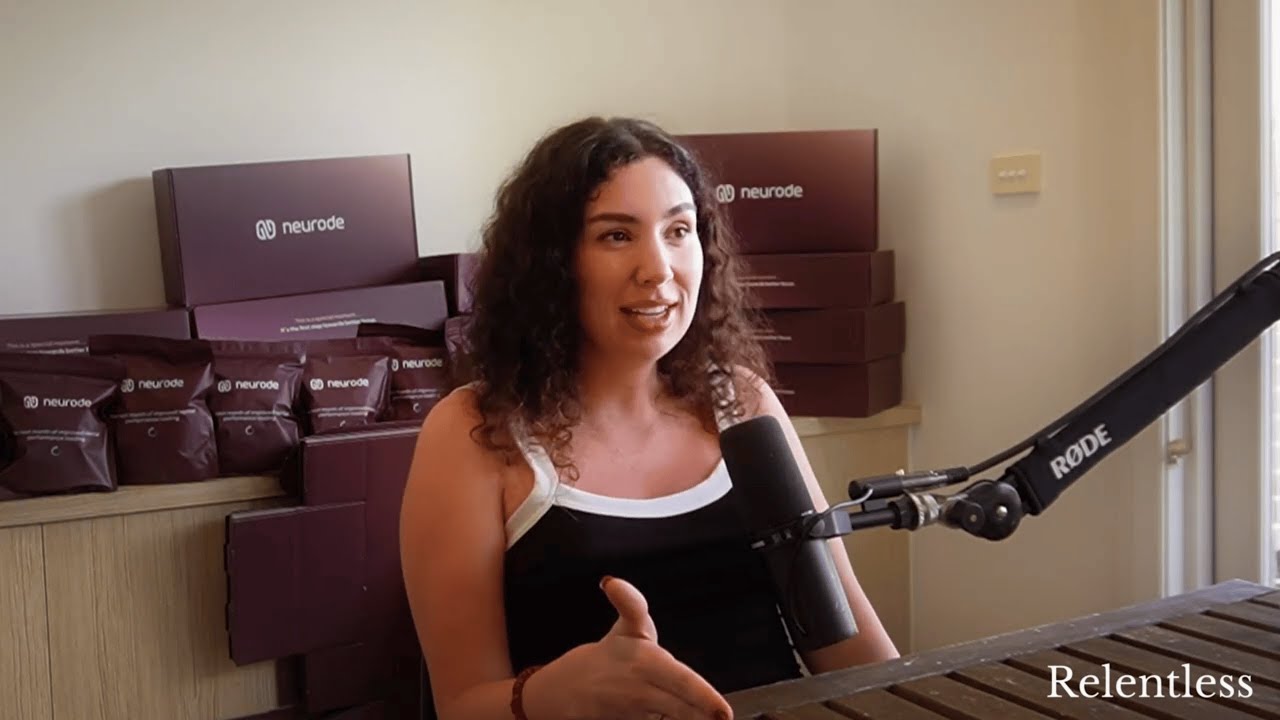
Neurode is a startup building a wearable headband that treats and tracks ADHD without drugs, using non-invasive brain stimulation to improve focus, memory, and impulsivity, and functional near-infrared spectroscopy (fNIRS) to measure brain activity in real time. Co-founded by Nathalie Gouailhardou (a neuroscientist with ADHD) and Damian (a hardware and signal processing expert), the company aims to make brain measurement and treatment accessible at home while building the world’s largest brain dataset to eventually address many brain-based conditions.
Nathalie’s Personal ADHD Journey
Nathalie was diagnosed with ADHD at age 5 after her teachers suspected she was deaf or blind because she was so absorbed in her internal world she wouldn’t respond when called.
Her internal world was as loud and salient to her as the external one, a trait that persists into adulthood during hyperfocus.
Her parents tried medication for her, but she felt sick on every one she tried (roughly 7–8 different medications across childhood and high school).
She tried again in high school ahead of final exams, including Ritalin and dexamphetamine (an amphetamine), but felt wired and didn’t want to stand out socially, so she stopped again.
She was briefly placed in special education but moved to accelerated classes within two weeks once it became clear she needed challenge, not remediation.
She coasted through school without doing homework, relying on being smart enough to get by, which later caught up with her at university.
How Nathalie and Damian Met
They met at the University of Sydney through the Latin dance society, where Nathalie went to have fun after becoming serious about studying for the first time.
Nathalie was ranting to a dance partner about the intersection of neuroscience and technology when Damian overheard and jumped in.
They switched dance partners and spent the rest of the evening talking about neuroscience, hardware, and digital signal processing.
Within two weeks they agreed to a skill swap: Damian taught her hardware and signal processing; she taught him neuroscience and data interpretation.
They immediately ordered electronics from China and started building EEGs, EMGs, and heart rate sensors together, coming up with creative (if impractical) use cases like mapping partygoers’ heart rates as digital art.
Why They Didn’t Start a Company in College
Both were deeply immersed in lab work throughout their degrees, often unpaid, bugging professors to let them participate in research.
Damian worked on a fall-detection sensor for blind people and quantum computing projects.
Nathalie did rodent brain surgery experiments and neural activity measurements.
They were more obsessed with learning than with starting a business at that stage.
The Inception of Neurode
Nathalie’s first job out of university was at a bionics company building predictive models of implant success using a half-million-dollar fNIRS machine to study neuroplasticity.
The models worked well but couldn’t translate to the real world because the equipment was too expensive and inconvenient for patients.
She realized that if the same data quality could be achieved with a smaller, cheaper device, they could collect 100x more data and actually help people.
She called Damian and asked whether physics fundamentally prevented miniaturization; after two weeks of analysis, he couldn’t find a reason why it couldn’t be done.
They started building while Damian finished his PhD thesis (which won best thesis award), and within a few months achieved a 100x reduction in cost and size with no loss in data quality.
This is significant because even MRIs, the gold standard for brain imaging, are so expensive that most people get at most one in their lifetime, leaving daily brain fluctuations largely unknown.
From Brain Measurement to ADHD Treatment
Initially the project was purely about measuring the brain in the real world, not about treating any condition.
They realized people wouldn’t wear a brain-measuring device daily without getting immediate personal value from it, even if the long-term mission was building a massive brain dataset.
Nathalie had been researching drug-free ADHD treatments and found non-invasive brain stimulation (specifically a new waveform used in research and clinics for depression) that showed promise for ADHD.
The clinical version cost $30,000 for 30 sessions ($1,000 each) and was limited in availability.
A key bottleneck to personalizing this therapy was the inability to measure the brain in real world settings, which Neurode’s device solved.
The collision of their scientific mission (brain data) with Nathalie’s personal need (drug-free ADHD treatment) defined Neurode’s product direction.
First Iterations and Becoming a Company
They are currently on version 6.4 of the hardware.
Early versions were bulky and looked like VR headsets; they’ve since refined the form factor, comfort, and ability to fit ~95% of head sizes.
The decision to incorporate came after their first lab validation, about 3–4 months in.
They brought their device to a university lab (professors they’d befriended during their studies) and compared its readouts against the half-million-dollar machine; the data matched almost exactly.
That moment of validation convinced them the technology was real and impactful enough to become a company.
First Beta Test
Their first beta cohort was 20 people, intentionally small to provide a high-touch experience.
They flew to China to source parts, then quality-tested and assembled everything locally.
The biggest surprise was that users were most excited about the brain stimulation (which they call “stem”), not the brain measurement that Nathalie and Damian found most exciting.
Users wanted more sessions than the planned 15–20 minutes per day, asking how they could do more within the first week or two.
Current research supports up to an hour per day as safe; Neurode is considering two daily sessions or a 40-minute session.
Building a Company in Sydney
Advantages:
Australia offers R&D tax incentives returning 43 cents per dollar spent on R&D, which extended their runway significantly during the nearly four years they were purely in R&D.
Sydney has strong talent, and there are fewer exciting startups competing for that talent, making it easier to assemble an exceptional team.
Disadvantages:
Fundraising is much harder in Sydney than in San Francisco.
The founder community is smaller and more spread out (across Sydney, Melbourne, Queensland), making the experience lonelier.
Nathalie finds San Francisco affirming because everyone is ambitious and high-agency, making her feel less like an outlier.
She now splits her time 50/50 between Sydney and San Francisco.
Hiring and Core Values
Nathalie is transparent in interviews about the difficulty and intensity of working at Neurode, filtering out people who want a 9-to-5.
She tests for intellectual honesty and integrity by overstating a candidate’s accomplishments and seeing if they correct the record or let the exaggeration stand.
The team has identified behavioral “tells” for strong engineers, such as great electronics engineers editing themselves mid-sentence to find the most precise word, zooming into extreme specificity.
Co-Founders
Nathalie considers Damian essential; they’ve been best friends for over seven years and have complementary personalities and skill sets.
They bring different perspectives to every decision, usually finding a middle ground or deferring to whoever knows more about the topic.
Sharing the emotional burden of the startup journey, the stress and the highs, has been critical to their resilience and mental health over four-plus years.
Fundraising Challenges
Their first proper VC fundraise involved meeting about 60 investors, most of whom said no, often with the classic “it’s too early.”
A few VCs were generous enough to book calls explaining their reasons, which included skepticism about ADHD as a large enough market.
The core issue was fundamentally that investors didn’t believe in the team or the vision.
Nathalie had a particularly low moment at a healthcare conference in Las Vegas, opening her laptop to five rejection emails in a row just hours before she had to pitch on stage.
She cried in a Starbucks, called her parents and Damian for support, then pulled herself together and pitched.
She realized that trying to convince someone whose worldview differs from yours is nearly impossible; the key is finding investors who already see the future you’re trying to create and simply showing them your plan to get there.
They ultimately found that alignment with Crystal Adventures, who believed in them immediately after seeing the product demo.
During a particularly brutal fundraise where many founder peers dropped out month after month, Nathalie and Damian made “cockroach plans” for surviving to the next milestone with their existing funds, never entertaining the possibility of quitting.
Helping Other Founders
When a founder friend called saying he wanted to give up, Nathalie staged what she describes as an intervention, telling him to discard the victim mindset and recognize his company’s potential.
She introduced him to every VC she knew, and an Australian investor she connected him with ended up investing; he has since submitted to the FDA.
Resilience and Self-Belief
Nathalie’s conviction was tested early when university professors she deeply respected told her not to start Neurode, saying the science wasn’t strong enough.
She pushed back, arguing that science and innovation require trying novel things even when consensus says they won’t work.
After their clinical trial returned exciting results, one of those same professors called two years later asking for advice on starting a startup to commercialize his own research.
She builds and maintains self-belief through several practices:
Relying on Damian, who sees her as more capable than she sees herself, to re-anchor her in first-principles logic when she doubts herself.
Reminding herself that she has overcome every difficult thing she’s faced so far.
Questioning everything, including her own logic, and re-deriving her ideas from first principles to either strengthen or update her conviction.
Listening to pump-up songs before high-stakes moments.
Practicing “optimistic nihilism”: the idea that she is insignificant in the grand scheme of the universe, which is freeing because it removes fear of embarrassment, public failure, and caring what others think.
Future Milestones
Over the next 24 months, Neurode is focused on:
Expanding their beta to interact with more users, gather feedback, and iterate on the product.
Improving daily usage and retention, since more frequent use correlates with better outcomes.
In their first beta cohort month, 85–87% of users saw meaningful improvements, with those who used it most frequently seeing the best results.
Pursuing FDA submission, building on already completed clinical trial results.
Beyond ADHD, they are interested in age-related cognitive decline, anxiety, and depression, all addressable with the same hardware by targeting the prefrontal cortex.
The long-term vision is improving focus, memory, and impulse control for everyone, not just those with diagnosed conditions.