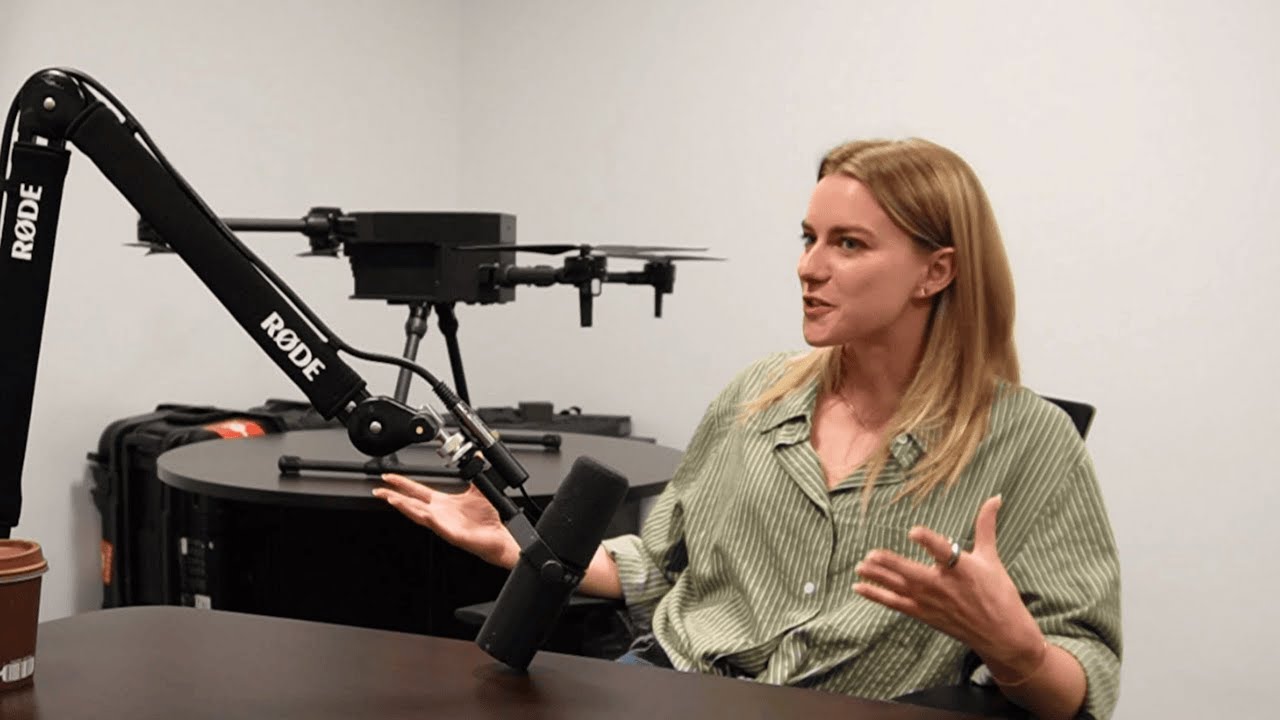
Cat Orman is co-founder of Flyby Robotics, a Los Angeles–based drone startup building American-made, modular drones designed as open platforms for machine learning—filling a gap left by DJI’s dominance and subsequent ban over cybersecurity concerns.
DJI controls roughly 90% of the market in key drone segments, but U.S. government restrictions (similar to the TikTok and Huawei bans) are pushing defense, industrial, and public safety users toward domestic alternatives.
Flyby was founded in early 2023 after Cat and co-founder Jason (whom she met through a Yale startup incubator) realized no existing drone offered modular payloads, open architecture, onboard compute, or a real SDK—so they posted a spec sheet on a developer forum and immediately got inbound interest from builders in security, mining, GPS-denied navigation, and hyperspectral sensing.
Their first major partnership came via Twitter: Palantir’s CTO saw a demo tweet, DM’t them, and within weeks they were collaborating on a GPS-denied navigation capability—because Palantir already believed deeply in tactical ISR (intelligence, surveillance, reconnaissance) and recognized Flyby’s hardware wasn’t vaporware.
Why Cat Became a Founder
Cat was drawn to adventure and autonomy from a young age:
In high school (2016), she interned at a proptech fund in Austin where her boss introduced her to Bitcoin; she invested her entire internship salary.
By senior year (2017–2018), Bitcoin had surged—she withdrew her gains, told her parents she was going to the library, drove 100 miles to Lexington, Texas, and went skydiving—eventually earning her AFF certification (Accelerated Freefall, which clears you to jump solo without an instructor).
The summer before college, she lived on the Greek island of Lesbos, volunteering with an organization that lifeguards refugee crossings from Turkey—rescuing people from overcrowded, duct-taped boats with fake life jackets that absorb water.
These experiences reflect a consistent drive: seek high-stakes, real-world impact—not just build apps.
Flyby’s Strategy: Hardware First, Software Later
Flyby is pursuing two long-term plays:
Capture DJI’s market share now by being obsessively focused on hardware quality—something Cat compares to Steve Jobs–level design discipline, which she sees as DJI’s core advantage.
Become a software platform later: once the hardware is in the hands of developers and partners like Palantir, the real value will come from what others build on top (e.g., autonomous navigation, AI-powered surveillance, mineral prospecting).
They are not trying to be a delivery operator—Cat argues quadcopters are poorly suited for delivery due to range limitations and safety risks (e.g., if shot down over people); fixed-wing designs like Google Wing or Zipline are better for that use case.
Building Hardware Is Harder Than Software
The biggest operational challenge is supply chain resilience:
Unlike software (where bugs are caught instantly), hardware flaws may only surface weeks after parts arrive—making iteration slow and unforgiving.
Hiring is also harder: you can’t assess fine motor skills or assembly ability from a GitHub profile; top manufacturing talent in the U.S. has atrophied, and the culture around hardware builders differs from software engineers.
Despite this, Flyby prioritizes in-person customer onboarding—even flying out alone to remote locations—because hands-on feedback in real weather and mission conditions reveals issues no spec sheet or Zoom call can.
A Wild Customer Ride-Along
During an onboarding trip to a friendly island (likely in the Caribbean), Cat trained a public safety agency that combats human, arms, and drug trafficking.
After the session, the team invited her on a 3 a.m. raid of a gang leader’s compound.
She wore a bulletproof vest, rode in an armored van formerly used against the IRA, and was officially listed as “Air Support Unit Cat Orman” during roll call.
She held the radio for the pilot as he flew the drone live, calling out suspect movements (“this person has a gun”)—didn’t get home until 8 a.m., then powered through investor calls the next day.
On Being a Happy, Ambitious Founder
Cat pushes back against the myth that great founders must be perpetually unhappy or driven by a chip on their shoulder.
She’s writing an essay arguing that ambition and self-actualization aren’t mutually exclusive—that you can pursue hard things without sacrificing well-being.
This reflects her broader ethos: seek adventure, stay grounded, and build something real—not just for glory, but because it matters.