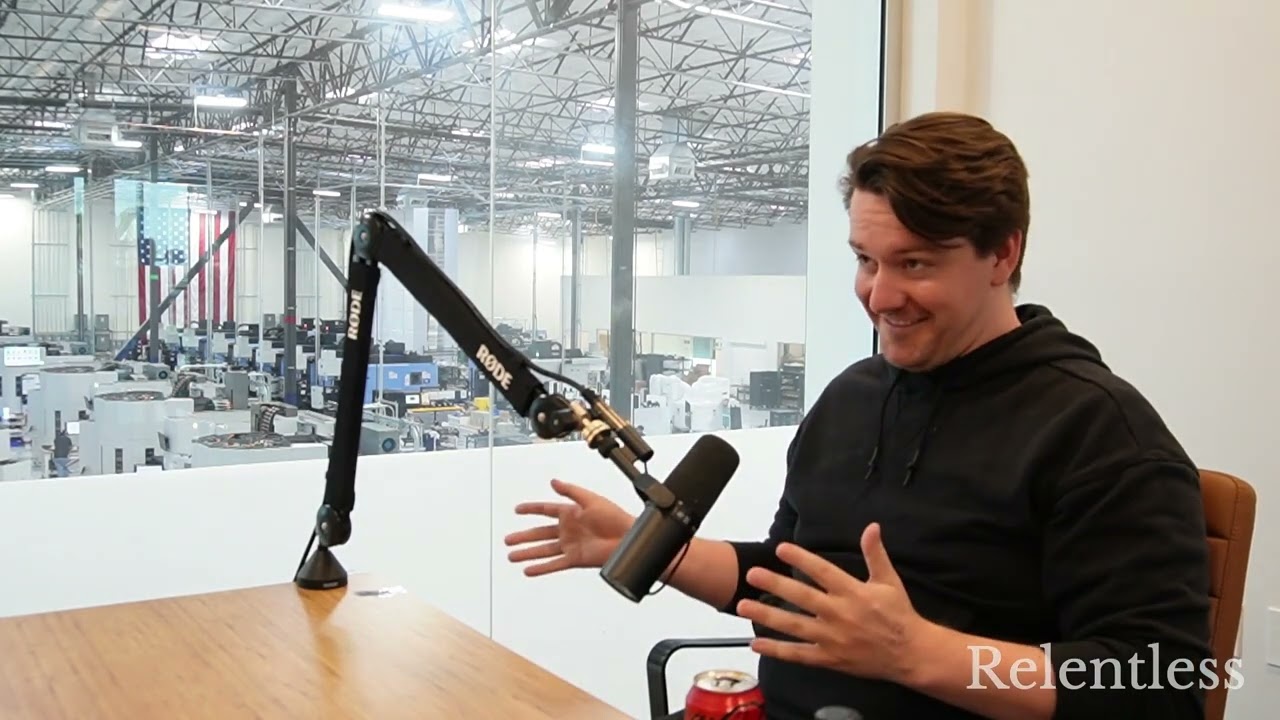
Chris Power is the CEO and founder of Hadrian, a company building highly automated precision component factories to serve Space & Defense manufacturers, with the goal of delivering parts 10x faster than traditional methods. His path to founding Hadrian was shaped by a macro-historical worldview, a belief that American manufacturing decline is both a civilizational and cultural crisis, and a conviction that reversing it is essential to maintaining U.S. global leadership—especially in competition with China.
Early Life and the Spark of Ambition
Chris grew up in Australia as a self-described “weird shut-in” kid, trained in music from age two by his grandmother, a French Conservatory–trained pianist. He played video games, worked at Blockbuster, and kept a low profile through school.
He chose accounting and commerce not out of passion but as a strategic calculation: Australia’s university entrance system weighted subjects by difficulty, and he gamed his course selection to hit the exact score needed for the best university without taking subjects he disliked, like chemistry.
In college, he was mostly bored—only about 12 hours a week of class—so he spent his time as treasurer of the Commerce Society throwing parties. He started failing classes, then took a full-time retail job without telling anyone, working 9-to-5 and studying at night just to get through.
The real turning point came in 2012 when Facebook went public. Chris Googled “what is an IPO” because he had no idea how markets worked, then realized the CEO was 26. That moment shattered his assumptions about what was possible and ignited his ambition.
From Retail to E-Commerce to the U.S.
While working at a small independent video game retail store in Melbourne (the last of its kind in Australia), Chris tripled sales in months just by engaging with customers and writing email copy. The owners noticed that 90% of their revenue was already coming from e-commerce and asked him to help run that side of the business.
That experience opened his eyes to entrepreneurship. He later joined Catch of the Day (an Australian daily deals platform) after being a supplier there, helping launch a digital downloads business for music, books, and games—pre-Shopify, early iTunes era. It worked but couldn’t scale in Australia’s small market.
He then ran a software company in Australia focused on scheduling and product implementation inside factories and distribution centers. He got good at building software for manufacturing operations but grew frustrated selling $500K/year SaaS contracts to companies where his work saved $20M/year—and he wanted to be the company being optimized, not the tool vendor.
At 26, he decided to move to the U.S. His logic was blunt: if he didn’t leave Australia now, he never would. He also recognized that Australia’s tiny population meant almost zero early adopters for any B2B product—maybe 0.1% of the early adopter segment that exists in the U.S.
The Macro Thesis Behind Hadrian
Chris is deeply influenced by macroeconomic and civilizational cycle theory, especially The Fourth Turning, which describes roughly 120-year cycles of civilizational growth and collapse. He believes the U.S. is in a late-stage decline phase—decadent culture, inflationary pressures, degraded core industry—while China is rising.
He sees the competition as existential: the U.S. must maintain dominance because there are no more “fractals” (continents) for humans to experiment with new coordination systems. America was the last great experiment, and with AI and climate change converging, whichever system wins the world government will shape the future of the solar system.
The Moon is the critical beachhead because its resources (hydrogen, oxygen, sunlight) allow production of rocket fuel, solving the delta-V problem for deep space. Whoever monopolizes the Moon first replicates outward. If the CCP wins space, Chris believes, the consequences are permanent.
He considered moving to China to ride the rising power’s wave but rejected it because he views the CCP as “pure evil”—citing forced sterilization of Uyghur women, infiltration of U.S. nonprofits, the fentanyl crisis as revenge for the British opium wars, and thousand-year strategic thinking that outmatches America’s 40-year election cycles.
His conclusion: it’s more believable that the U.S. can stave off decline for 30–40 years (buying time until China’s own demographics collapse due to the one-child policy) than that China can reverse its population decline. The question became: what’s broken in American culture, and how do you fix it?
Manufacturing as Cultural Fix
Chris argues that what wins wars isn’t the fanciest weapon—it’s raw production output and iteration speed, as demonstrated in World War II. The U.S. has decimated its industrial base through over-financialization and outsourcing, much like a startup that starts reading spreadsheets instead of building product.
He identifies three mechanisms that historically transmit values across generations and prevent civilizational decay: military service (elites’ sons fight on the front lines and become wise leaders), religion (long-term storytelling that bakes in values), and core industry (manufacturing, where reality slaps you in the face daily and you can’t lie to yourself about whether something works).
The U.S. broke all three in the 1970s: ended the draft, legalized abortion, removed the gold standard. Manufacturing was particularly important because it produces “serious people”—those adjacent to reality who can’t pretend the roads get paved if they don’t build them. Software engineers building abstract stuff and financiers operating in a post-gold-standard world where “the rules no longer apply but it still somehow works” are symptoms of lost seriousness.
The correct reading of the Apollo-Dionysus dichotomy isn’t work versus play—it’s serious unserious: intentional cycles of rest and celebration (like winter solstice) that keep society coherent. America’s problem is that it’s no longer a serious country because success removed all consequences.
Hadrian’s mission, in Chris’s framing, is not just a business—it’s an effort to reverse the Fourth Turning cycle so the CCP doesn’t end up owning world government.
Why Software in Manufacturing—and Why Hadrian’s Approach Is Different
Chris’s core thesis: no one has ever successfully applied software to manufacturing because you can’t bolt software onto a broken physical operation. You have to vertically integrate—control both the software and the hardware—to build the right software. Competitors running on spreadsheets are no match for a company with a laser gun.
He studied every automation company that had tried and failed in manufacturing and identified three failure modes:
Not building full-stack: trying to automate without controlling the entire operation.
Starting in low-margin markets hoping to move upmarket—you get stuck because you learn the wrong product-market fit.
The “50 PhDs” problem: elite software teams that look down on machinists, refuse to hire from the industry, and automate the wrong things based on wrong assumptions. The automation doesn’t work in the real world, and they spend three years convincing themselves it will.
Hadrian does the opposite: they hire people with industry context (mechanical engineers who switched to software, engineers from companies like Stitch Fix who built complex systems), and they standardize the hardware first so the software problem becomes dramatically simpler. If a factory has 40 machines with n-of-one each running different code, software complexity explodes. Standardize the physical world, and computer vision and robotics become an order of magnitude easier.
Building in Parallel: Narrative and Reality
Chris’s model for scaling Hadrian rejects two common approaches: (1) perfect the technology in a lab before launching (you run out of time and never build the growth muscle) or (2) blitzscale subsidized operations and hope the technology catches up (software and operations teams drift apart and the tech never integrates).
Hadrian operates in the middle: building and testing simultaneously, continually upgrading operations while scaling. The core competency is change management—establishing a rhythm of continuous process improvement while the ship is flying.
He pre-sold nothing. They built and beta-tested the first factory while the building was still under construction, running out of money before the Series A. Everything was done in parallel.
His thesis on what separates small businesses from companies worth $10B+: there are two curves—narrative and reality. Small businesses keep them separate. Great companies (he cites Elon Musk) make them converge and diverge over time, with the narrative pulling reality forward and reality grounding the narrative. The trick is being competent enough to actually pull it off—otherwise you become Icarus.
Hiring and Culture
For software engineers, Chris looks for people who can handle complexity, have high clock speed, are internally artistic but care about the customer, and are willing to operate the factory themselves enough to understand it.
The best hires are often mechanical engineers who switched to software—they’re not great mechanical engineers, but they have enough context to know what matters, and they’re great software engineers.
He also hires engineers from companies like Stitch Fix who built large, complex systems, even if they’re not deep-tech automation experts, because they bring systems-thinking and operational rigor.
Storytelling and Personal Growth
Chris is a natural introvert who was forced to become a strong communicator and recruiter because Australia’s extroverted culture and the demands of startup leadership left no choice. He learned by doing—“just recruit, just do it”—and by studying failure modes in other companies rather than emulating specific people.
He sees storytelling as essential to his role: aligning customers, investors, and employees around a narrative that pulls reality forward.
The Hardest Thing
The hardest thing Chris has overcome is rebuilding his entire life—friends, community, support system—while simultaneously operating a complex startup in a new country where he knew no one. Most people barely survive startups; doing it without any safety net is exponentially harder.
His answer for how he got through it: high pain tolerance. When pressed on whether that’s learned or innate, he shrugs: “Who knows.”