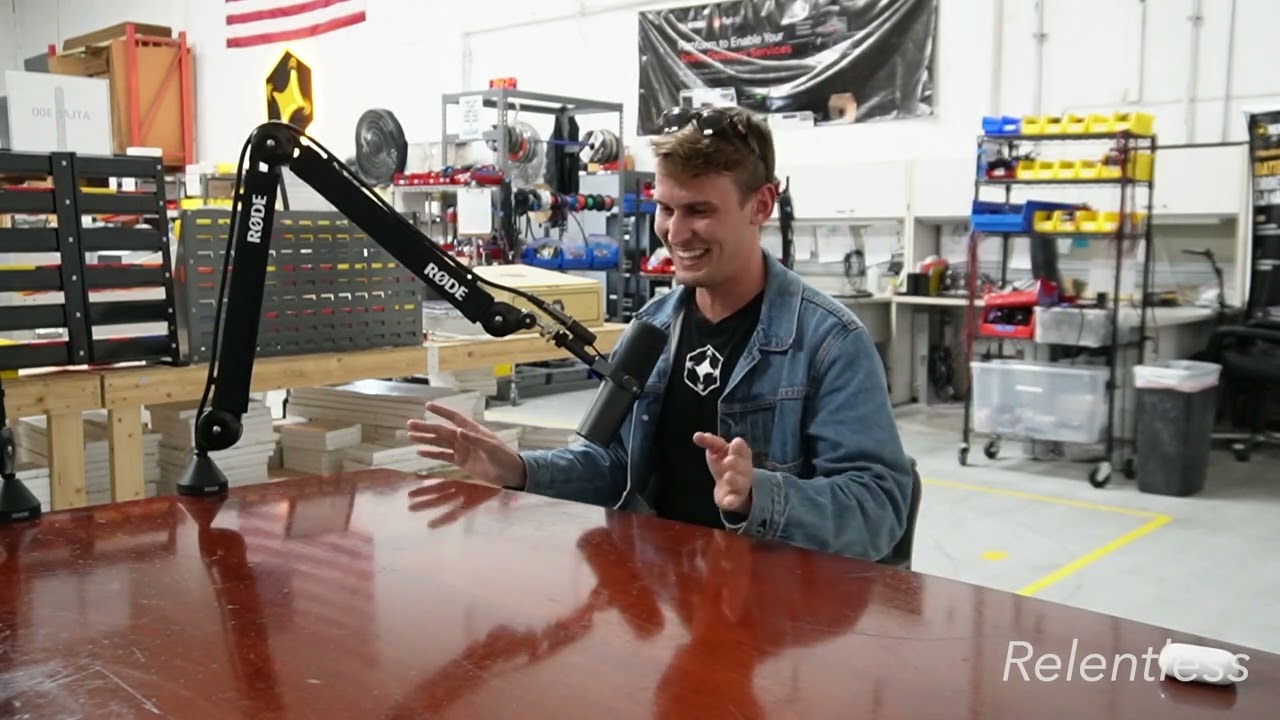
- Curt Lary is the founder and CEO of Hextronics, a company that builds automated drone stations—physical infrastructure that enables drones to fly, land, swap batteries, and relaunch without human intervention. The company is bootstrapped, born out of a garage in Miami, and has sold systems to customers across the globe including governments in Ghana and Saudi Arabia. This conversation traces Curt’s path from childhood tinkerer to hardware entrepreneur, covering his early inventions, the origin of Hextronics, the realities of bootstrapping a deep-tech company, and his long-term vision for a building called Helix Tower.
Early Inventions and the Builder Mentality
-
As a kid, Curt was obsessed with Rube Goldberg machines and chain-reaction contraptions.
- His first creation was a bedroom booby trap to protect his Hot Wheels collection: a switch by his bed would roll a golf ball, knock over an object, turn on a fan with a blade attached, cut a string, and drop a bag of rocks on any intruder.
- He spent countless hours in Minecraft building elaborate redstone contraptions and always tried to create the most impressive physical setups for friends—projectors, monitor arrays, snack stations—whenever people came over.
-
In high school, Curt joined a social entrepreneurship program called Agents of Change.
- The program sent him into wilderness environments—the mountains of North Carolina, the Everglades, the jungles of Ecuador, the Galápagos—while challenging him to build something that helped society.
- To afford the program, he worked a summer on a farm shoveling horse manure and planting.
- He ended up building a bike share program for the City of Palmetto Bay, Miami, fixing up old bikes and working with the police department and mayor to install stations in local parks. The city later expanded it to other parks. This was before Citi Bike became ubiquitous.
-
At Georgia Tech, Curt studied mechanical engineering, drawn by the school’s Invention Studio—one of the best-equipped maker spaces in the country at the time.
- His first project was a pencil with a retractable blade inspired by Assassin’s Creed. People thought it was goofy and impractical, which he took as a compliment.
- He then converted the design into a hidden smoke sleeve—a wrist-worn bracelet that held a Juul and reeled it back in like a badge holder. It became popular in his fraternity and orders poured in from across the country and even Thailand.
- The company sent a cease and desist letter, which Curt framed and kept. He saw it as a sign he’d built something real and used it as a natural stopping point.
The Shower Moment
- Curt describes a pivotal moment in a Georgia Tech communal shower late at night.
- He had a realization: he could either be somebody or not, and if he was going to be somebody, it had to be “freaking crazy.”
- This flipped a mental switch. He stopped thinking of himself as just a student cycling between classes and video games and started asking: if he were a great inventor, what would he build?
W8R: The Ceiling Food Delivery Robot
-
Curt’s first major project at Georgia Tech was W8R, an automated food delivery system.
- The original concept was underground tubes carrying plates from kitchen to table, but customers immediately flagged the cleaning problem.
- He pivoted to an overhead rail system—a robot driving on ceiling-mounted train tracks, carrying food from the kitchen to the table.
- He built the first prototype in his parents’ garage in Miami, then installed a full track system in his Atlanta apartment, drilling into the ceiling.
- He pitched it to Aramark, the company running Georgia Tech’s food service. They were skeptical but gave him a shot at installing it in Tech Tower, the school’s most iconic building.
- To get approval, he had to obtain sign-offs from a structural engineer, a professional electrical engineer, the fire marshal, and the school’s board. He pulled 1940s blueprints from Georgia Tech’s archives to prove his mounting screws wouldn’t compromise the building’s beams.
- He and a fraternity brother named Clay Wilson installed the entire system in about a week, sleeping in the cafeteria. At peak, it was doing around 70 automated deliveries a day.
-
Curt applied to Y Combinator with W8R and was rejected, which he expected—he was young, had no business plan, and was essentially a kid with a prototype. He was accepted into Startup School, where his story of actually building and deploying a real system stood out among people who were still searching for ideas.
-
He also competed in Georgia Tech’s Inventure Prize, a televised entrepreneurship competition for students. He made it to the final five as a solo competitor, showing up to presentations on two hours of sleep. The exposure was valuable, but the very next day—March 12 or 13, 2020—Georgia Tech shut down campus due to COVID-19.
- The pandemic killed the W8R concept: people were afraid of shared surfaces, and restaurants were closing. Curt finished his remaining credits that summer and graduated.
The Pivot to Drones
- Curt decided he didn’t want to build a company that could be shut down by a pandemic.
- His reasoning: “They can’t shut down the sky.” He wanted to get into drones.
- He didn’t initially understand the regulatory complexity of the FAA. He learned the hard way that autonomous, beyond-visual-line-of-sight drone operations require extensive approvals, documentation, version control, and reporting to operate legally in the national airspace.
- During an early demo for FAA officials, he was flying a drone and was mid-flight when they asked what airspace he was in. He said Class D. They informed him he was within range of an Air Force base and hadn’t checked NOTAMs (Notices to Airmen). They roasted him on the spot but let the demo continue.
Starting Hextronics
-
Hextronics began as an idea in Curt’s Atlanta apartment right after graduation.
- His W8R capstone project had been funded by prize money from the Inventure competition. The team wanted to build a fully automatic drone delivery system that swapped batteries autonomously.
- The first prototype was a monstrous device made of plywood, 2x4s, linear actuators, and a gripper mechanism. It didn’t work at all.
- Curt would carry 2x4s and sheets of plywood on a Bird scooter through Metro Atlanta to get parts from Home Depot—a process he admits he “should have died” doing.
- After graduating, his teammates took high-paying jobs elsewhere. Curt went solo.
-
He cold-called drone service providers and software developers and discovered a common pain point: everyone used commercial drones that required manual battery swaps, breaking the autonomy loop.
- Multiple providers told him: if you can build a machine that swaps the battery automatically, we’ll buy one.
- This was the first time anyone had committed to buying something from him beyond the Juul sleeves.
-
He moved back to Miami because prototyping costs were dramatically lower—roughly five times cheaper than Atlanta—thanks to a place called Hialeah, where fabricators with water jet cutters and other industrial tools competed on price. A job quoted at $6,000 elsewhere was done for $300.
- He built the first real prototypes in the garage he grew up in.
-
The company name Hextronics combines three ideas: hexagons as the strongest structural shape and molecular building block, “hex” as in a spell or magic, and “tronics” as the electronics that make magic real.
-
The first product was the Hextronics Global, named because it attracted attention from day one from South Africa, Saudi Arabia, India, Malaysia, and beyond.
- The original design used a robot arm with computer vision to swap batteries—extremely over-engineered.
- Curt redesigned it into a compact box roughly 3 feet × 3 feet × 1 foot, using a gripper mechanism similar to a 3D printer. The drone slides in, the battery gets swapped, and it slides out—like a pizza oven.
Customer Stories
-
Agricultural pollination: A group wanted to use drones to artificially pollinate crops by flying low and blowing wind to stir up pollen. The idea didn’t close because the drones didn’t produce enough downdraft, but it illustrated the unexpected use cases people bring.
-
Ghana government: A flight software partner connected Hextronics with the government of Ghana, which wanted to use drone-in-a-box systems to protect critical infrastructure. Curt didn’t expect Ghana to be an early adopter, but they shipped a unit there, navigated customs, and got it running. He described them as a great group to work with.
-
Saudi Arabia construction monitoring: One of Hextronics’ first customers was a Saudi group using drones for construction monitoring. They invited Curt for a demo.
- Saudi temperatures required a complete redesign to handle 120°F+ conditions. Hextronics built one of the smallest compressor-based refrigerator units ever and integrated it into the station, achieving a 50-degree temperature differential between the outside air and the internal electronics.
- During shipping, TSA agents in the U.S. stepped on the unit and popped a hydraulic tube. Curt found HVAC technicians in a small hut in Saudi who repaired it in 30 minutes—and it performed better than before.
-
Curt describes the sales process as deeply relational. Customers don’t just buy a product; they buy into the team, the vision, and what the product says about them. He’s brought prospects to Sugar, a bar on the 40th floor of Brickell City Center in Miami, to talk about the bigger picture of what autonomous drones make possible.
Bootstrapping and the Financial Tightrope
- Curt tried the VC route—pitch competitions, cold calls to venture firms—and was rejected over 100 times. He was young, building hardware (which investors dismissed as “ew”), and had no pedigree.
- He made a conscious decision to fundraise from customers by selling product. This became the company’s financial model.
- There were multiple occasions, especially in the first and second years, where Hextronics did not have enough money to make payroll. Curt would pull all-nighters—one to two nights a week—to build and ship product in time to close a deal that would cover the next period.
- The company has been bootstrapped from day one, operating out of a garage and then a small, “beaten up” facility.
Iteration and Reliability
- Early on, Curt iterated by building something cool and seeing what happened. Over time, the process became more disciplined—grounded in solid engineering requirements.
- The key insight: a product has to work not once, but a million times. Components that seem bulletproof (like motors) can fail at cycle 401 after working perfectly for 400 cycles.
- Hextronics started deploying products in the field early, close to home, and put real cycle counts on them in actual operating environments to tighten the feedback loop.
- One unit, nicknamed Sheeran after a Malaysian sprinter, was approaching 20,000 consecutive cycles without failure at the time of the recording.
- The team now tries to predict what will fail first—bearings, motors, belts, circuit boards—and designs accordingly.
Hiring
- Curt hired when deals were closed and there was no way to fulfill orders alone.
- He personally built every system until 2 a.m. the night before shipping, then ran it through test cycles to verify it worked.
- As volume grew, he brought on technicians—some of the best in the world, in his words—to handle assembly and production.
- The hiring model is deal-driven: close a deal, hire to fulfill it, close the next deal to sustain the team. It requires constant momentum in sales.
Selling to Governments
- Governments are only beginning to understand how to use autonomous drone infrastructure.
- Curt sees Drone as First Responder programs as the beachhead for government adoption—drones that launch automatically to scan emergency scenes, providing critical information at a fraction of the cost of a helicopter.
- The challenge is that government stakeholders are highly specialized but siloed: the parks director doesn’t know what the water department is doing, and neither has access to the other’s funding. Getting adoption requires buy-in from leadership who can see across all the departments that would benefit from a shared aerial data platform.
Learning and Mentors
- Curt is largely self-taught through YouTube and online resources—channels like Real Engineering and various engineering science channels, plus YC interviews for startup thinking.
- From YC, Michael Seibel was the most impactful mentor—direct, no-BS, always pushing Curt to focus on the main problem and not get distracted by side quests.
- In high school, teachers like Dr. Gas and Ms. Marin challenged him even when he was already a straight-A student doing everyone’s homework, pushing him into uncomfortable territory.
- At Georgia Tech, Rahul Saxena was a critical mentor during the hardest phases of building W8R and beyond.
- Ben, a fellow Georgia Tech student Curt met in the electrical engineering lab, taught him about battery management systems and spot welding, and still helps build circuit boards for Hextronics.
- Nick Maia, who works at Hextronics, is Curt’s design partner for reliability and detailed engineering—his “Superman bro.”
- Curt’s father was one of his greatest teachers, though Curt often tells him: “Let me cook.”
Cold Calling a Billionaire
- Curt cold-called a billionaire’s office, guessing the man might need drone security for his multiple properties.
- The billionaire said yes to a demo. Curt told the team they had to make the station “extra fresh” because they were demoing for a billionaire.
- The deal was still in progress at the time of the recording but looked like it could grow significantly.
Turning Down $15 Million
- At some point, someone offered to buy Hextronics for $15 million (the offer may have been verbal).
- Curt turned it down. He knew he wasn’t done and that no number at that stage would satisfy him.
- He saw it as validation and a confidence boost but told the buyer to “hold on to that” while he kept building. He believed the industry had enormous growth ahead and that he’d only build the best products if he stayed motivated by the mission, not by an exit.
Helix Tower
- Curt’s long-term vision is a building called Helix Tower (or possibly just Helix)—a roughly 70-80 story skyscraper in Miami with a cascading, spiraling hexagonal design.
- Estimated construction cost: around $600 million (not including land), with a target budget under $1 billion.
- The concept is a “startup in a tower”: mixed-use with residential, business, maker spaces, retail, and themed restaurants (one requiring Viking costumes, another with a Peaky Blinders 1920s dress code).
- The rooftop would feature a bar on the exterior with glass walls for sunset dining, and at the very top, a central island bar with a full 360-degree panoramic view of the city.
- Curt sees it as a model: if they build one in Miami, every city will need one.
The Hardest Thing He’s Overcome
- Curt is an endurance athlete—he’s run marathons and completed a half Iron Man.
- His hardest experience was training for a marathon after never having run more than about 5 miles. He signed up roughly 2-3 months before the race.
- During a 19-mile training run, around mile 11 or 12, he blacked out from exhaustion and dehydration. He was wobbling, grabbed a fence, and has no memory of telling his running partner Ron that he “invented this crazy thing” before fainting.
- Ron called an Uber, but the driver couldn’t move Curt and went to get Gatorade. The Uber canceled, triggering a chain of four more Ubers, all of whom went to get Gatorade. They all returned at the same time as the ambulance. Curt regained consciousness, vomited in the bushes, and snapped back.
- He later ran a 20-mile training run where his calves cramped so badly at mile 15 he thought they’d snap. At mile 18, he was in what he describes as “the pit of Hell.” With a quarter mile left, he had a vivid mental vision of all his ancestors and family members and where they got distracted in life and didn’t reach their potential. He finished and passed out on the ground at 2 p.m. on a Thursday in the middle of campus.
- The actual marathon was somehow easier—he never stopped and got a good time.
- He also holds a black belt in Jiu-Jitsu (his primary discipline) along with Taekwondo and kickboxing, training in mixed martial arts for 10 years starting at age 6.