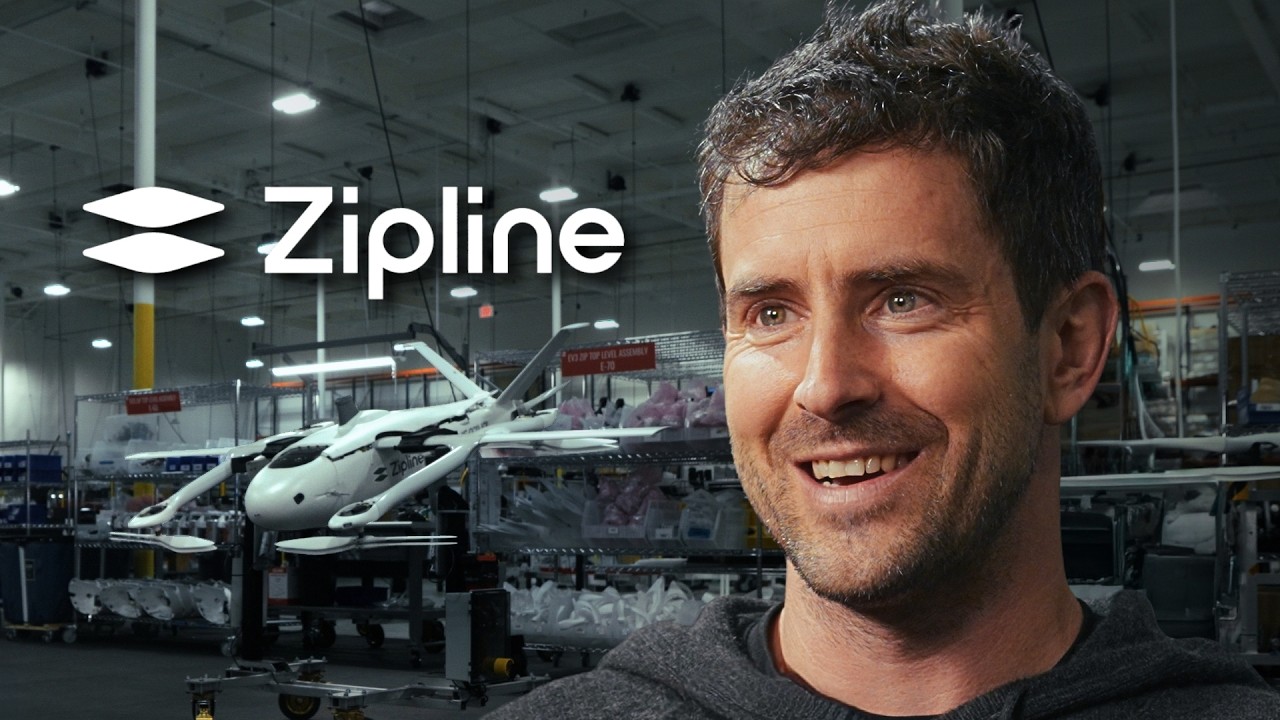
This episode features Keller Clifton, co-founder and CEO of Zipline, the world’s largest drone delivery startup, which has completed ~2.8 million deliveries to date and just announced a partnership with Uber to reach 1 million deliveries per day within 2.5 years — a target that now requires 5–10× more manufacturing capacity than originally planned.
Scaling to 1 million deliveries a day
Zipline’s growth exploded after receiving unprecedented FAA approval to operate at scale in the US; the system grew 10–15% week-over-week in flight volume and revenue for over a year.
The original operating plan for 1 million deliveries/day was built around Zipline’s full capacity; when Uber’s CEO Dara Khosrowshahi visited the factory four weeks ago, he committed to taking all of that capacity, forcing Zipline to scrap the plan and aim far higher.
The market is far larger than it appears: US instant delivery is ~5.5 billion orders/year today, but extrapolating Zipline’s observed customer behavior (daily ordering vs. monthly) suggests a 55 billion order market — a 10× expansion driven by a service that is 10× faster, cheaper, safer, and more reliable.
Clifton compares this to Uber’s early days: observers predicted Uber would capture 50% of the taxi market, but Uber grew to 10× the taxi market by changing behavior (e.g., daily commuting by rideshare); Zipline sees the same pattern — customers order multiple times a day, from rooftop pools to backyard birthday parties.
Creating a magical customer experience
The product is inherently viral: in mature neighborhoods, >50% of homes order from Zipline within 6–8 months; people see deliveries at soccer practice, pool parties, or rooftops, download the app, and get their first delivery that night.
Deliveries land directly in backyards or on seventh-floor rooftop decks; the visual spectacle stops people in their tracks and creates a strong emotional pull to try the service.
An 80-year-old grandmother ordered 350 times in a year; a dad with five kids orders multiple times a day; these are new behaviors unlocked by instant, reliable, low-cost delivery.
The Fermi Paradox for hardware companies
Hardware companies face a “Fermi paradox” — many start, few survive — because they require 30+ disciplines (avionics, firmware, powertrain, mechanical, aerodynamics, GNC, detect-and-avoid, comms, customer apps, operations, logistics, manufacturing, supply chain) all working perfectly; one weak link makes the company a zero.
At hyperscale, commitments are massive: hundreds of millions in supply chain, expensive factories that must run at extreme scale for unit economics, and timelines that compress from years to hundreds of days.
Clifton describes a constant state of “existential crisis of the month”: launching Platform 2, shaking out integration bugs, scaling aircraft utilization, fixing the customer app, navigating tariff-driven supply chain disruptions, manufacturing bottlenecks, then fleet maintenance crises (fleet health went from worst-ever to best-ever in a month).
The only way to survive: ruthless focus on the current bottleneck, humility to listen to the team, and shamelessness to reverse bad decisions quickly without ego.
Staying ahead of the company
Clifton aims to learn faster than the company grows; each year he feels like “Neo seeing the matrix” by December, only for the company to double and render him unprepared again.
Key practices: stay low-ego, listen to people who call out mistakes, admit errors fast, and pivot the whole company in the opposite direction when needed — without looking backward.
What won’t change as Zipline scales
Culture remains: hire hungry, low-ego, mission-driven, fast-learning practical problem solvers; organize as small “special forces” teams with high autonomy and CEO-level ownership; avoid middle management (information flows directly via Slack/email/AI tools).
As complexity grows, discipline increases: clear goals across teams that add up to a unified vision, especially for cross-program requirements like safety and reliability.
Safety infrastructure investment has leveled up: component and aircraft testing in environmental chambers (rain, snow, heat, humidity), plus three 24/7/365 real-world test sites to validate increasingly rare failure modes (1 in 10K → 1 in 10M flights).
Finding people who will tolerate a bad customer experience
Hardware companies lack software’s luxury of iteration; each major platform (every ~3–4 years for 10–15 years) is an existential bet — if Model S or Model 3 failed, Tesla would have died.
Strategy: find a beachhead use case where customers tolerate imperfection because the value is existential. For Zipline, that was blood delivery in Rwanda (4–5 years): every flight saved a life, so hospitals partnered through regulatory firsts and reliability gaps.
Success there (5,000 hospitals, 17,000 lives saved/year) convinced Walmart, Chipotle, Cleveland Clinic, etc., that automated instant delivery could be fundamental US infrastructure — but Platform 2 still had to work or the company would die.
Strangest challenges: nesting, hail, solar weather
Real-world weirdness: animals nesting in infrastructure (bugs, raccoons, birds); extreme weather (hail, lightning, dust, -20°C to 40°C) — customers expect 24/7/365 service, not “only when sunny.”
Solar weather: sunspot cycles cause electromagnetic interference that disrupts dual-band RTK differential GPS (military-grade, recently commercialized); Zipline must harden against this and also plan for GPS denial (jamming/spoofing).
Human behavior: people try to hack the system, defeat safety sensors, or film failures; but backyard delivery creates accountability — the recipient is known, the aircraft stays 100m up, and interference means Zipline shows up at their door in 5 minutes.
Selling drones vs selling delivery
The vehicle is only ~15% of the solution; the rest is software integration, maintenance, inventory management, unmanned traffic management, customer portals — all made reliable.
Customers don’t want to buy drones; they want “teleportation” — instant, cheap, delightful delivery from any building to any home. They pay for A→B transport; ideally they never know a drone was involved.
This lets Zipline iterate hardware freely behind the curtain; investors often ask why big tech spent billions on drone delivery with little to show — the answer: the problem is vastly harder than “duct-taping a Snickers to a quadcopter.”
Limiting customer growth
Zipline artificially constrains sign-ups because demand exceeds capacity by an order of magnitude; charging sites run 6am–11pm (moving to 24/7) at max utilization every hour.
The app shows “demand is really high, try again in 15 minutes” — a “fail whale” moment Clifton worries will drive users to competitors if it persists.
Uber’s Khosrowshahi noted demand for instant delivery is “insatiable”; Zipline is deploying capacity as fast as possible (factory doubling in 30 days) but still can’t keep up.
Attacking the biggest constraint
The bottleneck is capacity, not demand; expanding a Zip’s service radius doesn’t help when current zones are 100% utilized.
Zipline adds homes off the waitlist weekly, but prioritizes avoiding the “70% of the time we can’t serve you” failure mode.
The current factory (designed for 20–40K aircraft/year) is being disassembled and expanded; 5× that capacity is needed, requiring new US manufacturing sites.
Future platform improvements and exponential gains
Clifton showed the team a 1994 Amazon.com screenshot (blue hyperlinks, book categories) to illustrate: today’s Platform 2 will look equally primitive in retrospect.
Thousands of improvements are visible daily: double efficiency here, change maintenance model, dynamic capacity assignment, 3× denser ground infrastructure, new site types beyond parking-lot “superchargers.”
The team prioritizes 15–20 improvements per quarter; gains compound exponentially (like iPhone 1 → iPhone 16), and humans consistently underestimate exponential curves.
Giving the Earth back to humans
Clifton argues winning technologies must return space to humans: reduce traffic, pollution, noise, sidewalk congestion. Scooters and sidewalk robots fail this test; Zipline operates high, quiet, and unobtrusive.
Data centers to space is a parallel; logistics should move to a “different plane” so cities become more magical and human-centric.
NPS is ~85–90 (vs. negative for DoorDash/Uber Eats); communities want this, governors should welcome it. The vision: abundance for humanity, 100 billion people on an Earth that feels like a nature preserve.