This episode traces the origins and beliefs of secret societies by presenting an alternative, esoteric history of Western religion, arguing that these groups exist to preserve a suppressed ancient truth: that mind creates matter, not the other way around.
-
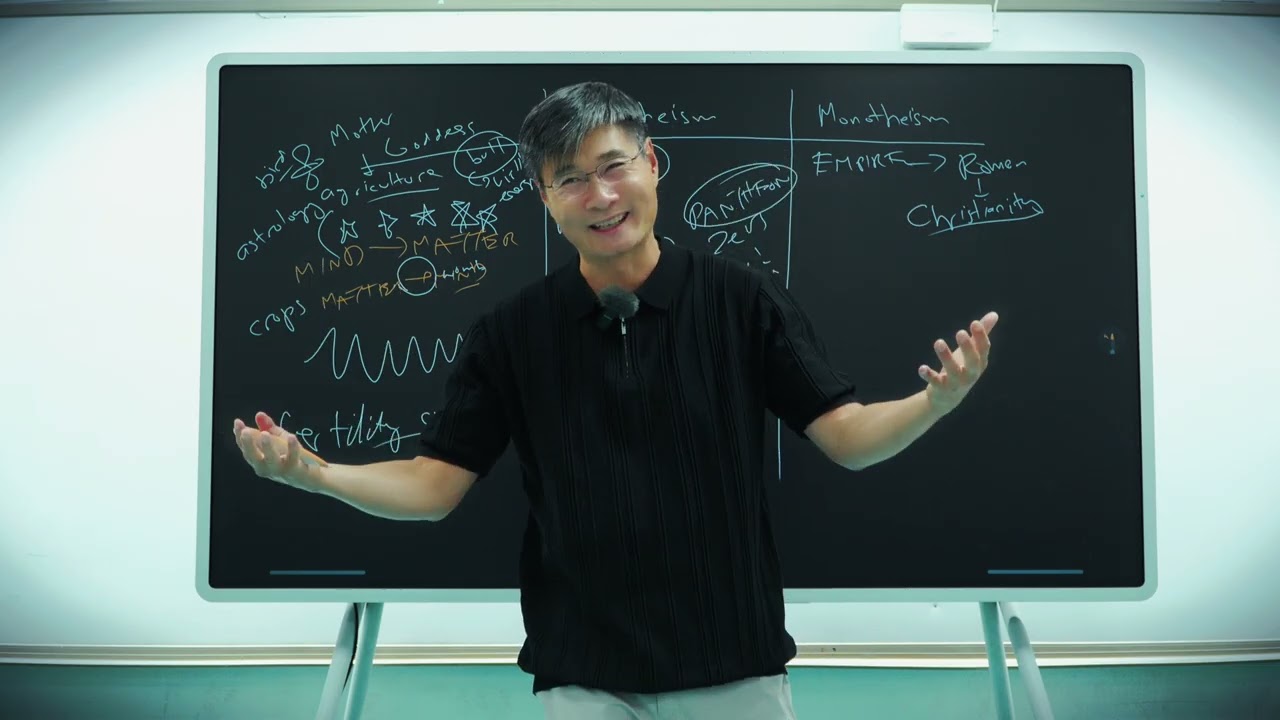
The three stages of Western religious development
- Mother Goddess civilization arose from agricultural life, where the central problems were crop fertility and human reproduction.
- The woman’s womb was seen as a divine portal connecting the spirit world to the physical world, giving women the highest social status.
- Society had no private property, no hierarchy, and sex was a communal act through fertility cults designed to obtain the best possible DNA.
- The Mother Goddess was symbolized as a bird (dominion over the sky, the source of life) paired with a bull (virility and energy).
- Everything was understood as interconnected and harmonized: the stars (astrology), the crops, and the womb were all aligned.
- Polytheism emerged because of war.
- As populations grew, young men without resources were cast out and began raiding other societies to capture women, creating the concepts of property, hierarchy, and marriage.
- Different societies had different gods; wars between societies became wars between gods, and losing meant admitting your god was weaker.
- This produced a hierarchy of gods, or pantheon (e.g., Zeus at the top, with Apollo, Ares, and Aphrodite below him).
- Gods were essentially immortal mortals with the same desires and flaws as humans.
- Above the gods sat impersonal forces like fate and fortune; what mattered was being lucky, not being good.
- Beneath everything were unwritten, immutable universal laws like justice; violating these brought punishment regardless of divine favor.
- Monotheism emerged with empire, specifically the Roman Empire and Christianity.
- Empires could destroy entire societies and impose a single god and a single reality on everyone.
- Christianity introduced three concepts that were counterintuitive and previously non-dominant: truth (one truth, deviation from which is evil), evil (defying God), and individual (loyalty to one God over family or community).
- These three concepts underpin modernity and the modern world.
- Mother Goddess civilization arose from agricultural life, where the central problems were crop fertility and human reproduction.
-
How the ancient worldview differs from ours
- Mind leads to matter: Throughout most of human history, people believed the mind creates the brain and the physical world, not the reverse. Modern neuroscience cannot explain how the brain produces imagination and consciousness, and the deepest neuroscientists treat the question as forbidden.
- Metaphorical vs. literal understanding: Ancient people understood the world through metaphors (e.g., anger is a god that seizes you), which was more useful for interpreting experience and fostered greater creativity. This is offered as an explanation for achievements like the pyramids that remain unexplained by modern literal thinking.
-
The origin of secret societies
- When war shifted power from women to men, women went underground and formed mystery schools to preserve the knowledge and traditions of the Mother Goddess civilization, especially the principle that mind creates matter.
- Mystery schools functioned as elite sex clubs, maintaining sacred sexual techniques as a means of communicating with the universe. Members were sworn to secrecy on pain of death.
- With the rise of Christianity and empire, these mystery schools became a threat to imperial control because they gathered local elites. They were driven further underground and became secret societies.
- Known examples include the Knights Templar, Rosicrucians, Illuminati, and Freemasons, but many older and more hidden ones exist.
- All of them share one core mission: preserving the secret that mind leads to matter and that the universe was created by divine consciousness.
-
The orthodox (canonical) Christian narrative
- The Bible is presented as a series of covenants between God and humanity:
- Adam and Eve: God offers paradise on one condition: do not eat from the tree of knowledge of good and evil. They eat the fruit and are banished from Eden, condemned to work and suffer.
- Noah: God sees humanity has become wicked, destroys the world in a flood, spares Noah, and promises never to destroy the world again.
- Abraham: God chooses Abraham and his descendants as the chosen people and gives them the promised land (Israel).
- Moses: God frees the Israelites from Egyptian slavery and gives them the Ten Commandments as divine law.
- David: God favors David as the most faithful follower and promises that David’s house will rule Israel forever.
- Jesus: Reasserts the Mosaic law, sacrifices himself to free humanity from original sin (the fruit-eating disobedience), and creates a new covenant where anyone, not just Israelites, can be with God through faith.
- The first five covenants constitute Judaism; all six constitute Christianity. Jews await a future messiah to restore the kingdom of David; Christians believe Jesus was that messiah and was God himself.
- The Bible is presented as a series of covenants between God and humanity:
-
Problems with the orthodox narrative
- Why was eating a single piece of fruit so severe a crime as to banish humanity from paradise?
- Why did God destroy the world in the flood when he knew humans would remain wicked afterward?
- Who was Jesus, and why did God need to sacrifice his own son for humanity?
-
The esoteric (secret society) interpretation
- The Nephilim: God destroyed the world in the flood not because of human wickedness but because of the Nephilim, the offspring of angels (sons of God) and human women. These demigods enslaved humanity and fought among themselves. Because they were partly divine, they could not be truly killed; their spirits became demons who still exist underground and in the shadows, and the richest and most powerful people in the world today are said to be Nephilim.
- Sources for this teaching include the Book of Enoch and the Gospel of Thomas, texts not included in the standard Bible.
- Mythological heroes like Hercules, Achilles, and Theseus are identified as Nephilim, and the old gods like Zeus, Ares, and Apollo are reinterpreted as these “sons of God.”
- The Monad and the Demiurge: The true God is called the Monad (the One), a divine consciousness whose vibrations over millions of years created all life and matter (mind leads to matter). One of its emanations, a being named Sophia, tried to prove she was equal to the Monad by creating life on her own, and accidentally produced a monstrous being called the Demiurge. She abandoned and hid the Demiurge in a sea of clouds. The Demiurge, unaware of the Monad or his own origins, believed himself to be the one true God and created the Earth, Adam, and Eve.
- The God of the Bible is therefore the Demiurge, a false god and a monster, which explains why he would banish people for seeking knowledge, demand loyalty through fear, and enforce his will through violence.
- Humanity lives in a prison created by this false god.
- Jesus’s true role: Jesus was a cosmic being sent by the Monad to reveal the truth: that a divine spark from the Monad exists within every person. By activating this spark through love, rejection of materialism and competition, and pursuit of spiritual goodness, a person can return to the Monad after death. Jesus was killed because the Roman Empire and the powers of the Nephilim could not allow people to learn the truth.
- Why the Monad does not intervene directly
- First explanation: The Monad is pure mind and does not interfere in material affairs; individuals have the free will to return to it through their own spiritual choices.
- Second explanation (from Dante): The Monad is eternal and perfect but lacks imagination. By allowing the Demiurge to create flawed human beings who make mistakes and commit evil, the Monad expands the imagination of the universe and grows. Good and evil must coexist because committing evil gives beings the chance to recognize their mistakes and become better.
- The Nephilim: God destroyed the world in the flood not because of human wickedness but because of the Nephilim, the offspring of angels (sons of God) and human women. These demigods enslaved humanity and fought among themselves. Because they were partly divine, they could not be truly killed; their spirits became demons who still exist underground and in the shadows, and the richest and most powerful people in the world today are said to be Nephilim.
-
How secret societies operate
- They believe most people cannot accept the truth and would reject it as crazy, so they wait for individuals to “wake up” on their own and approach them. They then test those individuals before revealing the secrets.
- They have been repressed, executed, and massacred over the centuries for protecting this knowledge, which they consider their duty to preserve for humanity’s ultimate salvation.
-
Paradise Lost by John Milton as an esoteric text
- Milton was a blind free thinker, rebel, and advocate of free speech. His epic poem Paradise Lost is the national epic of the British Empire, memorized by its elites, and is a foundational text for secret societies.
- The poem retells the fall of man: Satan rebels against God, loses, and is cast into Hell. He volunteers to escape Hell and corrupt humanity by tricking Eve into eating the forbidden fruit.
- Satan’s first speech (volunteering to escape Hell): He describes Hell as a prison of fire with no exit, and the universe beyond as an abyss of darkness where one could be lost for eternity. Despite this, he says a true leader must risk everything for his people. Secret societies interpret this as describing the soul’s journey from the prison of the material world back to the divine light, and use the speech as an initiation ceremony where new members must choose to fight for humanity alone, knowing they will be hunted for speaking the truth.
- Satan’s second speech (persuading Eve to eat the fruit): He argues that God’s warning of death is a test or a lie. A true God would reward risk-taking and the pursuit of knowledge. If eating the fruit truly threatens God, then God must be a false god trying to keep humanity ignorant and enslaved. He tells Eve she will not die but will become “as gods, knowing good and evil.”
- The episode argues that Satan was telling the truth, and the Bible itself confirms this: after eating the fruit, Adam and Eve do not die. God banishes them not as punishment for disobedience but to prevent them from also eating from the tree of life, which would make them immortal like God. God’s own words in Genesis confirm this: “See, the man has become like one of us, knowing good and evil. And now he might reach out his hand and take also from the tree of life and eat and live forever.”
- Eve knew Satan was telling the truth because of the divine light within her, the spark of the Monad that connects every person to the true God and reveals truth from falsehood.
- The episode concludes that the Bible itself is an act of propaganda designed to replace polytheistic mythologies with a single supreme God, denying humanity’s intuitive understanding of the world and its own history.
-
The core message secret societies promote
- Do not pray to an external god; look inside yourself. The true God (the Monad) is within you as a divine light.
- It is acceptable to make mistakes and even to do evil, because through recognizing and redeeming those mistakes you grow in wisdom and expand the imagination of the universe.
- Redemption, growth, and imagination are all possible because of the connection to the Monad. The Monad rewards those who believe in themselves, which often means defying authority and transgressing society’s rules.
- The ultimate secret: believing in yourself, even through transgression and error, activates the divine light within and leads to truth.