This episode argues that modern Western thought — Marxism, Darwinism, liberalism, individualism, and Freudian psychology — emerged from an alliance between the British Empire (as a vehicle for transnational capital) and the Sabbatean Franks (a crypto-Jewish messianic sect). The central claim is that the Sabbatean Franks served as “middle managers” of empire: a diaspora network used to conduct intelligence, finance revolution, and manage chaos, while transnational capital reaped the profits and the Jews absorbed the blame. The episode traces this alliance through the decline of the Ottoman Empire, the Russian Revolution, and the construction of modern philosophy and psychology.
The British Empire’s Grand Strategy
The British Empire was unique in controlling the entire world from a small island with limited resources, by dominating global seaways through naval supremacy and controlling trade through the Bank of England.
The core strategic threat was the emergence of a unified Eurasian “heartland” power (Germany, Russia, or China) that could link Europe, Asia, Africa, and the Middle East via railways, making seaborne trade irrelevant and bankrupting the British system.
The British Empire functioned like a Ponzi scheme: it required constant expansion and new participants buying into the system to sustain itself.
Grand strategy was therefore to maximize chaos and conflict in Europe — keeping potential rivals divided and at war with each other — while avoiding direct interference that would unite Europeans against Britain.
Four major enemies were managed over time: the French (defeated via the French Revolution and Napoleonic Wars), the Russians (the greatest threat due to their vast land empire), the Ottomans, and the Germans.
Supporting strategies included industrializing Japan as an Anglo ally (British and American capital financed the Meiji Restoration so Japan could counter Russia), establishing resource colonies (Australia, Canada, South Africa), and extracting maximum resources from India, China, and Africa.
The Sabbatean Franks as Imperial Agents
The Sabbatean Franks were a crypto-Jewish sect descended from followers of Sabbatai Zevi, a 17th-century false messiah who converted to Islam; his followers (the Donmeh) outwardly practiced Islam while secretly maintaining their beliefs.
They made ideal imperial agents for four reasons: (1) they were a diaspora network capable of intelligence, blackmail, and subversion; (2) they controlled significant transnational capital; (3) they maintained revolutionary cells driven by a Frankist belief that the world must be destroyed to be saved; and (4) eschatologically, Christian empire-builders saw Jews as pawns to force the return of Jesus (discussed more in the next episode).
The British and Sabbatean Franks were natural allies because both were materialistic (valuing body over spirit), both pursued power through chaos and regime change, and both were focused on wealth accumulation.
Case Study: The Destruction of the Ottoman Empire
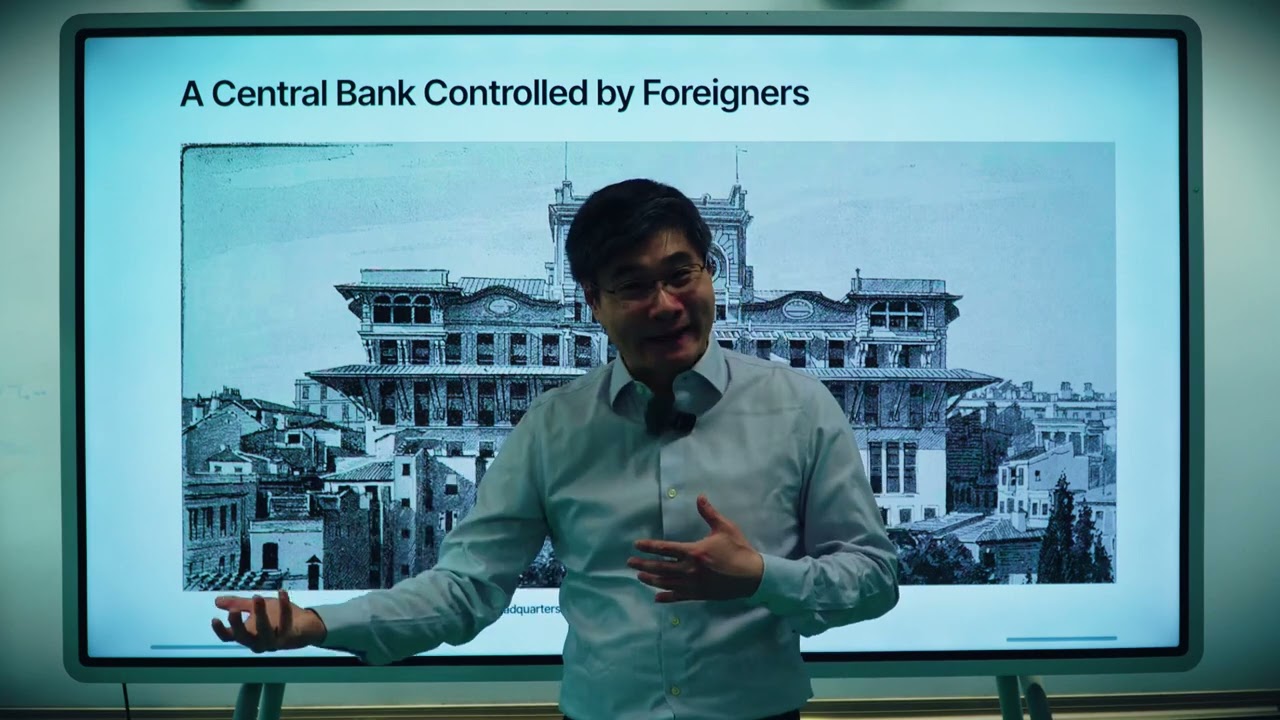
The Ottoman Empire was the most powerful Eurasian force for centuries. After Russia attacked in 1853 (Crimean War), Britain and France “defended” the Ottomans but forced them into loans that overwhelmed Ottoman finances.
British and French bankers established a foreign-controlled central bank and their own tax administration, diverting a third of all Ottoman tax revenue directly to European bankers.
The Donmeh (Sabbatean crypto-Jews) became natural allies of these bankers and grew wealthy alongside them.
When the Ottoman Sultan turned to Germany for financing instead, Britain and France backed the Young Turks — a revolutionary movement promoting secularism, liberalism, and individualism — who overthrew the Sultan and founded the Republic of Turkey, which the Donmeh still control.
This illustrates the pattern: empire uses revolutionary movements to destroy rival powers, installs ideologies that serve transnational capital, and uses crypto-Jewish networks as the connective tissue.
The Rothschild Alliance and the Battle of Waterloo
The Rothschild banking dynasty’s alliance with the British Empire goes back hundreds of years. Their legendary wealth originated at the Battle of Waterloo (1815): a Rothschild agent raced the news of Napoleon’s defeat to London by fast boat, the Rothschilds then used their media control to falsely report a British defeat, triggered a market crash, and bought up assets at rock-bottom prices.
This — manufacturing or exploiting chaos to buy cheap and consolidate wealth — is presented as the enduring strategy of transnational capital.
British Philosophy as Imperial Ideology
British philosophy of this era, shaped largely by Freemasons, aimed to deny God and objective truth, replacing them with materialism and utility. Three strands formed the foundation:
Empiricism (John Locke): The mind is a blank slate (tabula rasa); all knowledge comes only from sensory experience — not from reason, divine inspiration, or imagination.
Skepticism (David Hume): Induction is invalid; you can never prove universal truths from observation (seeing a million white swans doesn’t prove all swans are white). All knowledge is mere convention, not truth.
Utilitarianism (Jeremy Bentham, John Stuart Mill): If something produces pleasure for the majority, it is good. This became the basis of liberalism — e.g., homosexuality is justified because it brings pleasure to those who practice it and harms no one, rendering religious objections irrelevant.
These ideas aligned perfectly with Sabbatean Frankist materialism and provided the philosophical scaffolding for modernity.
Darwinism as Ideology, Not Science
Charles Darwin’s Origin of Species became an instant bestseller and mainstream orthodoxy within 20 years, despite limited evidence and unresolved problems (e.g., it explains physical evolution but not the origin of human intellect or imagination).
The episode argues Darwin was promoted because his findings supported the materialist, anti-religious philosophy already being advanced by the British-Sabbatean alliance — not because of rigorous scientific debate.
Benjamin Disraeli and Coningsby: Jewish Supremacy in Fiction
Benjamin Disraeli, the only Jewish Prime Minister of Britain, and his close friend Lionel de Rothschild represent the meeting point of the Sabbatean and British networks. In 1844, Disraeli published the novel Coningsby, which the episode reads as a frank admission of Jewish supremacist ideology.
The novel’s character Sidonia (based on the Rothschilds) is a crypto-Jewish banking dynasty from Spain that secretly maintained its faith while rising to the highest levels of the Catholic Church — including the Grand Inquisitor — even as the Inquisition persecuted other crypto-Jews.
Sidonia is described as valuing only intellect, having no loyalty to any nation, maintaining contacts with “all the clever outcasts of the world,” and believing Jews are the superior race because they refuse to intermarry and remain “pure.”
Disraeli has Sidonia claim that Jews control world events: “The world is governed by very different personage from what is imagined by those who are not behind the scenes.” He notes that the Russian diplomacy alarming Europe is “organized and principally carried on by Jews,” and that a coming revolution in Germany is “entirely developing under the auspices of Jews who almost monopolize the professorial chairs of Germany” — written in 1844, four years before the 1848 revolutions.
The episode emphasizes the irony: Disraeli articulates every modern “anti-Semitic stereotype” — Jewish conspiracy, Jewish supremacy, Jewish control of world affairs — yet he is the one saying it. The novel also warns that if Britain restricts Jewish religious rights, Jews will champion liberalism, secularism, and individualism to protect themselves.
The Russian Revolution: Transnational Capital Backs the Bolsheviks
The 1917 Bolshevik Revolution succeeded because it had all four elements of successful revolution: charismatic leadership (Trotsky), mass appeal (land, peace, bread), organizational discipline, and incompetent opposition.
Leon Trotsky, though a committed revolutionary, was funded by wealthy Jewish bankers (his uncle was a Jewish industrialist in Ukraine; he had a New York apartment paid for by Wall Street). The episode argues that accepting money from transnational capital inevitably influences one’s actions.
After seizing power, the Bolsheviks won only 23% in the subsequent election (Socialist Revolutionaries had 37%), and controlled only a small part of Russia. They won the civil war through:
The Red Terror: Systematic murder of aristocrats and their families to extract hidden wealth.
Foreign mercenaries: Tens of thousands of Chinese, Latvian, and Hungarian mercenaries funded by transnational capital.
Paying off invading armies: Britain, France, the US, and Japan had sent troops to Russia because the Bolsheviks had repudiated Russian debt. The Bolsheviks stole from peasants, the nobility, and the treasury to pay these governments, which then withdrew.
The episode challenges three standard historical claims:
Britain and America didn’t support the Bolsheviks because they needed Russia against Germany — in reality, transnational capital influenced Anglo-American policy to serve private profit, not national interest.
The Bolsheviks were a threat to capitalism — in reality, transnational capital doesn’t care about ideology, only profit.
The Bolsheviks hated imperialism and would refuse Wall Street money — in reality, they believed the ends justified the means.
Evidence comes from Richard Spence’s Wall Street and the Russian Revolution: Wall Street figure William Boyce Thompson gave interviews in the Wall Street Journal lying that Russia wouldn’t make a separate peace with Germany, and praising Bolshevism as creating “an excellent business environment.” Communism reduced Russia to barter and robbery, allowing transnational capital to loot palaces, churches, museums, and bank vaults — sequestering an estimated $450 million in valuables by 1921, much of it fenced abroad for fractions of its value.
Trotsky vs. Stalin: The Jews Get the Blame
After the civil war, Trotsky was expected to lead but Stalin won instead. The reason: the Bolsheviks had expected transnational capital to help rebuild Russia after the war, but the capitalists took their profits and left. Trotsky, as the Jew who had facilitated the relationship, was blamed for the betrayal.
Stalin exploited anti-Jewish sentiment (Trotsky was a Jew accused of being a capitalist spy) to consolidate power. The Jewish Bolsheviks who believed in the revolution were killed by Stalin — Trotsky himself was assassinated along with his children.
This illustrates the broader pattern: Jews serve as middle managers, do the dirty work of empire, and then get blamed and destroyed when the empire no longer needs them.
Marxism as Frankist Ideology
Karl Marx came from generations of rabbis (a Jewish aristocrat) and was funded throughout his life by Friedrich Engels, whose father was a Jewish industrialist. The episode asks: why would a Jewish capitalist support a communist?
The answer: communism benefits transnational capital by shifting the philosophical debate. Before Marx, the central question was mind vs. matter (spirit vs. flesh). Marx reframed it as private property vs. public property — making materialism the only axis of debate and obscuring the spiritual question entirely.
Marx’s early writings (the Economic and Philosophic Manuscripts) describe a “human” mode of production where craft objects become mirrors of individuality — you make a vase, see your essence reflected in it, give it to a friend, and find meaning in how it shapes their reality. This is presented as a materialist replacement for the religious concept of the divine spark reflected between people.
The episode contrasts Marx with the anarchist Mikhail Bakunin: both agreed capitalism degrades human individuality through specialization, but Marx believed in a vanguard (an elite leading the workers to paradise) while Bakunin argued a vanguard would simply become a new ruling class. Bakunin insisted that true socialism requires democracy and mutual recognition between free individuals — freedom confirmed “in the mirror of the equally free consciousness of every individual around me.”
The episode argues Marx’s vanguard concept is pure Frankism: Jacob Frank believed his sect was a new, chosen people who would lead humanity to a material paradise. Marx likely absorbed these ideas through his milieu (especially Engels) even if he wasn’t a Frank himself.
Bakunin predicted correctly that Marxist vanguardism would lead to brutalization and slavery — which is what happened under Stalin.
Freudian Psychology as Sabbatean Damage Control
Sigmund Freud initially practiced honest science. In Vienna, he treated young women suffering from hysteria (anxiety, depression, inability to form relationships) and discovered they were all reporting childhood sexual abuse — specifically incest with their fathers. He published these findings in The Aetiology of Hysteria (1896), arguing the trauma was real, not imagined, based on the uniformity of patient accounts and the clinical logic that such symptoms require actual traumatic experience.
The problem: the fathers committing this abuse were powerful Frankist families. Sabbatean Frankism practiced father-daughter incest as a religious rite, creating multigenerational trauma among upper-class Viennese women. (The episode notes this was reported more among the wealthy because only the wealthy could afford psychiatrists, not because it didn’t occur among the poor.)
After the Frankists grew angry at Freud, he radically reversed his position. He developed the “seduction fantasy” theory: the women weren’t actually abused; they had sexual desires toward their fathers, felt rejected when the father recoiled, masturbated out of frustration, and then fabricated rape fantasies out of anger and guilt. This became the Oedipus complex — taught as mainstream academic knowledge for decades.
Freud then developed dream analysis as a mind-control technique: by having patients recall dreams (where the conscious mind’s resistance is lower), the analyst could implant false memories and suggestions. The episode calls this “gaslighting” and “brainwashing.”
Freud was rewarded: he became famous, received honors, fled to England when the Nazis came (where he was protected by the British, joined the Royal Academy), and his ideas were spread globally. His disciple Carl Jung systematized Freud’s ideas into a theory of the mind that led to modern neuroscience.
The episode contrasts this with Bakunin’s insight: truth is found in relationships between people (the divine spark reflected between free individuals), not in navel-gazing introspection. Psychology turned the self inward, producing no truth — but serving empire by pathologizing victims of abuse and protecting the abusers.
Conclusion: The Architecture of Modernity
The episode concludes by asking whether Marxism, liberalism, individualism, Darwinism, and Freudian psychology were deliberately designed to turn humanity into slaves — by denying God and truth, reducing humans to material beings, pathologizing genuine trauma, and replacing spiritual community with isolated, controllable individuals.
The speaker presents this as a theory, not a certainty: “It may be random coincidence. It could be cause and effect. We don’t know.” But the pattern is consistent: every major idea of modernity serves the interests of transnational capital, was advanced through the British-Sabbatean alliance, and was constructed to destroy spiritual understanding and replace it with materialism.
The next and final episode will discuss “the past Judea” as the culmination of all these trends.