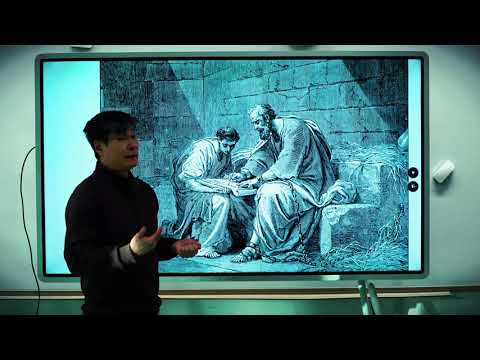
This episode traces how the original teachings of Jesus—centered on individual spiritual liberation—were systematically transformed by Paul into the hierarchical, obedience-based Catholic Church, which served Roman imperial interests and continues to shape global power structures today.
The Original Teaching of Jesus
Jesus was a messenger from the “monad” (the divine source) who taught that every person contains a divine spark—an inner connection to the divine that can be activated by focusing on his words and repeating his poetry.
His message was radically liberating: you are not a slave to any earthly power; you are free to seek truth yourself; the kingdom of heaven is within you.
This threatened the Roman Empire because its economy depended on slavery. If slaves believed they were spiritually free and unafraid of death, the entire system of exploitation collapsed.
Jesus was crucified by the Romans—not the Jews—because he was “stealing” their property (slaves) by freeing people spiritually.
Paul as the True Founder of Christianity
Paul (Saul of Tarsus) is the real architect of Christianity as an institution. He was a Hellenized Jew, highly educated in Greek rhetoric (sophistry), wealthy, and likely working as an agent for the Roman Empire—or possibly as a double agent also serving Jewish leadership interests.
Scholars note three mysteries about Paul: why a wealthy, literate Jew would join a movement of illiterate peasants; why a fanatical persecutor of Christians suddenly converted; and where he got the money to fund extensive missionary journeys with secretaries.
Paul’s conversion story—blinded by a light on the road to Damascus, hearing Jesus’ voice—mirrors Plato’s allegory of the cave, suggesting it is a literary construction rather than a historical event.
Paul’s Great Trick: From Words to Person
Jesus said: “Listen to my words and you will find the divine spark in you.”
Paul changed this to: “Believe in Jesus and you will be saved.”
This shifted the focus from individual spiritual practice (repeating Jesus’ poetry, seeking truth within) to institutional belief (faith in Jesus as a person, obedience to the church).
Paul used sophistry (rhetorical trickery) to redefine key terms: “circumcision” became spiritual rather than physical; “love” became obedience; “freedom” became slavery to God.
Paul Synthesized Three Cultures to Build Christianity
Jewish culture: Paul claimed Jesus was the promised Messiah, but redefined the Messiah as one of peace rather of war. Jews had been waiting for a military leader to overthrow Rome; Paul told them not to resist, neutralizing Jewish revolutionary energy.
Greek mystery cults: Paul borrowed from the cult of Dionysus, whose story—born of a virgin, killed, resurrected—mirrors Jesus’ narrative. The ritual of eating the god’s body and drinking his blood became the Eucharist (communion), which Paul presented as consuming the body and blood of Jesus.
Roman social structure (pater familias): The church was modeled on the Roman patriarchal system: one bishop at the top (like a patriarch), with cardinals, priests, and followers below—mirroring the hierarchy of patriarch, clients, and slaves.
How Paul’s System Solved Rome’s Problem
Before Jesus, slaves worked to avoid punishment. After Paul’s formulation, slaves worked to earn eternal paradise—a far more powerful motivator.
The deal: work as a slave for a few decades, then enjoy eternity in heaven. This made slaves more obedient and harder-working.
Patriarchs gained spiritual authority in addition to private wealth. They were no longer just kings but representatives of God, making it dangerous to challenge them.
Conversion became a faster way to expand power than buying slaves—you simply converted people into your religion.
The Two Tiers of Christianity
Ordinary people practiced Christianity (belief in Jesus, obedience, sacraments).
The elite (patriarchs) continued practicing Greek mystery cults in secret—these became the basis for secret societies that still exist today.
This dual system allowed the powerful to maintain cohesion among themselves while controlling the masses through the public religion.
Paul vs. James the Just
James the Just, Jesus’ brother, inherited the original movement in Jerusalem. He and other early leaders (including many women like Mary Magdalene) taught the original message of spiritual freedom and empowerment.
Paul’s Christianity was anti-woman, hierarchical, and orthodox—the opposite of the diverse, democratic early movement.
Paul and James clashed over whether Gentile converts needed to be circumcised. Paul said no; James upheld Jewish tradition.
Paul is likely responsible for having James killed, since James was the ultimate authority on Jesus’ true teachings and thus a threat to Paul’s version.
The Eucharist as Spiritual Enslavement
The Eucharist (communion)—eating bread and wine believed to be the body and blood of Jesus—originated in Greek mystery cults where participants consumed the god to absorb his energy.
The episode frames this as spiritual possession: by consuming Jesus, you lose your individuality and become part of the church collective.
Paul taught that “you are the body of Christ”—meaning the church replaces your individual identity. This requires complete obedience.
The ritual has ancient roots in cannibalistic funeral practices (Magdalenian culture, Aztecs, Victorian-era mummy consumption) meant to maintain communion with the dead.
Paul’s Sales Pitch to Different Groups
To Roman patriarchs: We will divide the Jewish diaspora, turn their warrior messiah into a peace messiah, and spiritually enslave the population so they work harder for you.
To Jewish leaders: We will spread the Torah to the Gentiles, elevate Jerusalem’s status globally, and ally with Roman power to subvert it from within.
To ordinary people: A few decades of obedience in exchange for eternal paradise. No circumcision required. Jesus is returning any day—convert now (the “50% off” urgency tactic).
Augustine and the City of God
After Christianity became the official religion of Rome (~300 CE), Augustine wrote City of God, placing the Catholic Church above the Roman Empire.
Augustine taught that the divine spark in humans comes from Satan, not God—humans are born evil (original sin) and cannot trust themselves.
“Pride” (self-satisfaction, independent thinking) is the root of all sin. The solution is complete obedience to the church.
True “freedom” is redefined as the inability to even think about disobeying God.
Why the Catholic Church Became the Most Powerful Organization
It allowed better exploitation of slaves (eternal damnation is a worse threat than physical punishment).
It protected wealth: gold stored in the church was safe because stealing from God’s institution invited divine wrath.
It enabled rapid expansion through conversion rather than conquest.
Roman dynasties stored their power in the church, giving rise to the Black Nobility—13 families from Rome that allegedly still run the world today.
The Lasting Power Structure
The episode argues that today’s global power structure rests on three pillars:
The Black Nobility (elite Roman families)
The alliance between these families and Jewish leaders (a pact where Jews agreed to serve as scapegoats in exchange for being allowed to practice their religion)
Secret societies (descended from Greek mystery cults) that bind the elite together through rituals
The Catholic Church is the institutional vehicle through which this structure has persisted for 2,000 years.
Key Distortions of Jesus’ Original Message
Jesus taught self-salvation through inner work; Paul taught salvation through belief in Jesus.
Jesus said the rich cannot enter heaven; Paul said the rich will lead the church.
Jesus taught that you must seek truth yourself; Paul taught that you must obey the church and never think for yourself.
Jesus rejected sacrifice (human and animal); Paul centered the religion on the sacrifice of Jesus.
Jesus taught that the divine spark is trustworthy; Augustine taught it comes from Satan.
Why the Jews Didn’t Defend Themselves in the Bible
The Bible blames the Jews for killing Jesus, but this is Roman propaganda. The episode argues there was an agreement: the Catholic Church needed scapegoats, and Jews accepted this role in exchange for being allowed to survive and practice their religion.
This explains 2,000 years of Christian persecution of Jews in Europe—Jews could not speak up without risking elimination.
How to Recognize Truth
The episode closes with a simple test: you know truth the way you know love. When you encounter it, your heart glows, you feel stronger and more energetic. If something makes you feel weaker, tired, or hopeless, it is not truth.