-
This episode examines the historical figure of Jesus, separating what scholars can verify from the biblical narrative, and argues that his true teachings were later distorted by the Roman Empire and the Catholic Church.
- The speaker grew up in a Christian-majority culture without understanding Christianity, and uses this distance to critically analyze the religion’s core claims and contradictions.
- The central puzzle: roughly two billion people today worship Jesus as God, more than any other historical figure, despite the fact that Christianity’s core doctrines — Jesus as God’s son, dying for humanity’s sins, the Second Coming, and the requirement to believe in him or face hell — are unique among world religions and raise profound logical problems.
- The episode’s goal is to answer three questions: What did Jesus actually believe and teach? Why did he become so popular? And why did the Romans kill him?
-
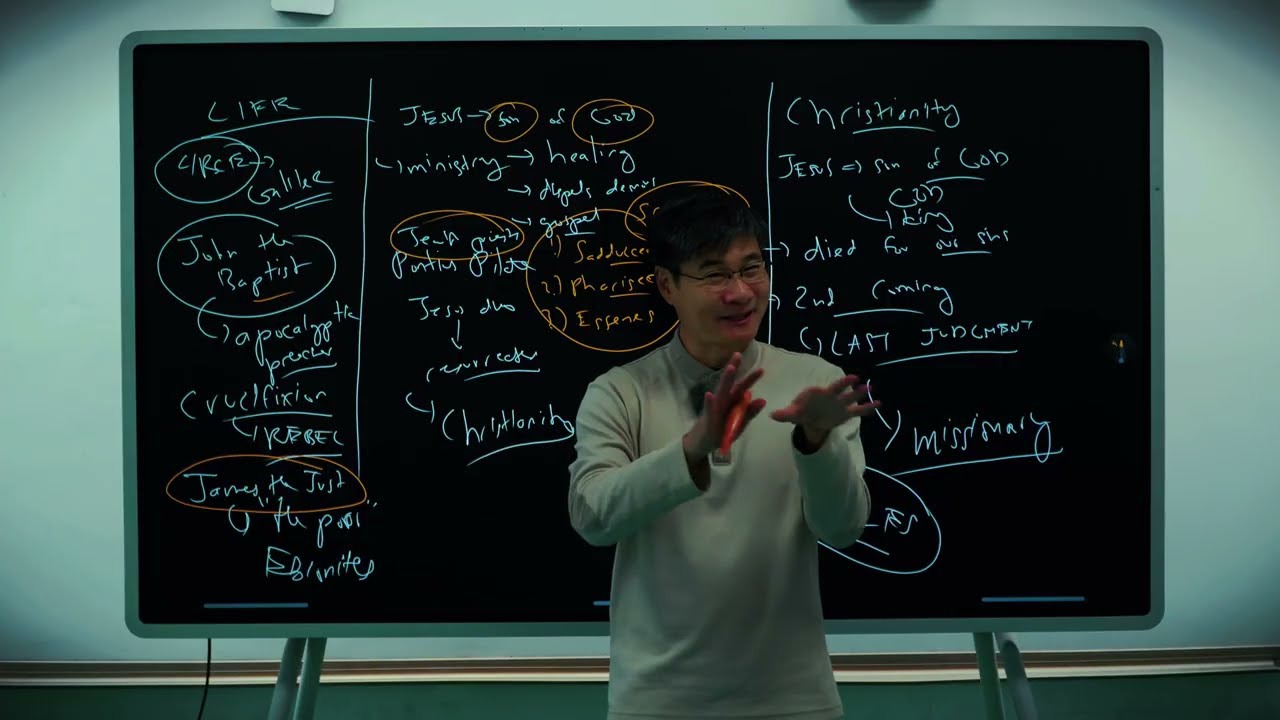
Only four facts about Jesus are accepted by mainstream scholars.
- He was born around 4 BCE (not year zero) in Galilee, a cosmopolitan coastal region exposed to multiple religious traditions including Judaism, Hinduism, and Zoroastrianism.
- His teacher was John the Baptist, an apocalyptic preacher who warned that God was coming to destroy the wicked and that people must prepare by redeeming themselves.
- He was crucified by the Romans — a brutal execution method reserved for thieves and rebels, meaning the Romans likely considered him a political threat.
- After his death, leadership of his movement passed to his brother James the Just, who led a group called “the poor” (or Ebionites) and was protected by Jewish authorities in Jerusalem.
-
The official biblical story of Jesus contains major logical and historical problems.
- The Bible presents Jesus as the son of God who sacrifices himself as a scapegoat to redeem humanity after the Fall in the Garden of Eden, is resurrected after three days, and commissions his disciples to spread the gospel before promising to return for a final judgment.
- Key problems include: the confusion over whether Jesus is God’s son or God himself; the unclear logic of how self-sacrifice resolves humanity’s sin; and the claim that Jewish priests plotted against Jesus, which has been used to justify 2,000 years of anti-Jewish persecution.
- The speaker argues the Jewish conspiracy narrative is historically implausible for three reasons: Jewish tradition at the time encouraged vigorous internal debate among competing sects (Sadducees, Pharisees, Essenes) without resulting in executions; an unwritten law among Jews prohibited betraying fellow Jews to Roman authorities; and James the Just, who taught the same message as Jesus, was allowed to remain in Jerusalem under Jewish protection after Jesus’s death.
- The Romans, who were known for killing people without clear cause, are the far more likely agents of Jesus’s death.
-
The speaker argues Jesus taught the same core message as every other prophet and poet studied in the course — the existence of a divine source and a divine spark within every person.
- The source (called the monad, the good, God, or the vine) emanates and creates the universe; human bodies come from evolution, but human consciousness is a divine spark from the source that returns to it after death in an ongoing cycle until final merger.
- This is what Buddhism, Hinduism, Zoroastrianism, and the teachings of Homer, Zarathustra, and Plato all express in different forms.
- Jesus was not teaching something new but was restating this universal message for his own time and audience.
-
What made Jesus special was the context of the Roman Empire, which was uniquely evil, and his message of love and forgiveness as a response to that evil.
- Earlier eras (like the time of the Iliad) contained a mix of good and evil, and people could forgive themselves. By the Roman era, evil had become so dominant that people could not forgive themselves, and the question became: how do you find meaning when evil triumphs and good people suffer?
- Jesus’s answer: the material world is a false world, a corpse. Those who embrace death, evil, and hatred win in this world, but this world is not the true one. The Romans have won outwardly but lost in the grand scheme.
- The rich and powerful are like Achilles after killing Hector — haunted by demons, unable to sleep, tormented by self-hatred. They are more pitiful than the poor.
- The path to saving the world is to forgive your enemies and love them, because only by loving your enemy can you release them from their inner demons. This is the central message of Jesus.
- The Romans killed Jesus because he was a rebel who inverted the natural order: he said slaves (who are free in spirit) are above the Romans (who are trapped by evil), which was a direct threat to Roman power.
-
The Gospel of Thomas, discovered in 1945 at Nag Hammadi in Egypt, likely records the true teachings of Jesus, which differ radically from modern Christianity.
- After Jesus’s death, many competing Christian sects existed; the Catholic Church won because it was backed by the Roman Empire, and it suppressed alternative gospels like Thomas.
- Key teachings from the Gospel of Thomas:
- “Whoever finds the interpretation of these sayings will not experience death” — the soul is immortal and cannot die; only failure to recognize the divine spark within causes fear of death.
- “The kingdom is inside of you and it is outside of you” — organized religion is rejected; truth cannot be accessed through hierarchy or by following someone else; you must look inside yourself.
- “When you make the two one” — the divisions of the world (male/female, inside/outside, above/below) are illusions; through imagination and recognizing the world as a projection, you access the interconnected source.
- “There is light within a man of light, and he lights up the whole world” — disciples ask how to be like Jesus; he tells them to find the light within themselves.
- “I found all of them intoxicated; I found none of them thirsty” — people are drunk on materialism and do not thirst for truth; the material world is a wonder of wonders, but it is the spirit, not the body, that is the true source of wealth.
- “The Pharisees and scribes have taken the keys of knowledge” — Jesus explicitly hates organized religion and its hierarchies; the serpent who told Eve to eat from the tree is praised as a symbol of seeking knowledge even against authority.
- “Whoever has come to understand the world has found only a corpse” — the Roman Empire is dead and dying; recognizing this makes you superior to the world and is what gets Jesus in trouble with power.
- The parable of the shepherd who leaves 99 sheep to find the one that strayed — God values creativity, exploration, and seeking knowledge over blind obedience.
- The parable of the great feast — the rich and businesspeople are too busy with materialism to accept the monad’s invitation to the spiritual feast; they are the ones who will lose out.
- Throughout the Gospel of Thomas, Jesus never references the Bible, Adam and Eve, Yahweh, David, or Moses — suggesting he regarded those stories as false and focused solely on the divine spark within each person.
-
The speaker uses Dostoevsky’s “The Grand Inquisitor” chapter from The Brothers Karamazov to explain how and why the Catholic Church corrupted Jesus’s teachings.
- Jesus’s message of individual freedom and responsibility created anxiety in most people, who do not want to think for themselves and prefer to be told what to do.
- The Catholic Church, in this reading, is the church of Satan: it pretends to worship Jesus but actually worships Satan by enforcing order, oppressing people, and removing the burden of free will — because people want to be sheep and need a shepherd.
- In the story, the Grand Inquisitor arrests Jesus during the Spanish Inquisition and tells him: “We know who you are, but we must kill you again because you are a threat to people’s happiness. Your freedom only confuses and torments them. We have corrected your work and founded it upon miracle, mystery, and authority.”
- The Inquisitor argues that only a minority can handle freedom; the weak cannot endure it, and it is an act of love to relieve them of the burden of choice by ruling them with force.
- Jesus’s response is to silently kiss the Inquisitor on the lips — an act of love and forgiveness that humbles the Inquisitor, who then lets Jesus go but does not change his mind. The kiss makes the spark glow in the Inquisitor’s heart, but he adheres to his idea.
- The solution to the problem of people not wanting free will is the eternity of the soul: people have infinite lifetimes to eventually figure it out. God is patient; it may take a million years, but eventually people will learn.
-
Dante’s Divine Comedy is presented as a corrective to the Catholic Church’s ransom theory of why Jesus had to die.
- The ransom theory (common in Dante’s time) holds that Jesus made a deal with Satan: Jesus dies, Satan takes his body, and in exchange Satan frees humanity — but since Jesus cannot truly die, Satan is tricked. The speaker rejects this: God did not come to free us from one master (Satar) only to make us slaves to another (God).
- Dante, through Beatrice, argues that free will is God’s greatest gift and the underlying principle of the universe. True love requires trust; God must let people make their own mistakes.
- Humanity’s original sin was trying to become God (eating from the tree of knowledge). This created evil, and evil compounds — people do more evil to avoid confronting their inability to forgive themselves. Humanity cannot compensate for trying to be God, and if God simply forgives without consequence, humanity learns nothing.
- The solution: God punishes himself. Jesus’s death is God punishing himself so that humanity feels remorse and learns from the sacrifice. The analogy: a father tells his daughter he loves her and their dog equally; the daughter kills the dog to test him; the father cannot punish the daughter (that would prove he loves the dog more) or ignore it (she’ll do it again), so he punishes himself — proving his love for her and teaching her not to do it again.
- Jesus’s death frees humanity from the cycle of compounding evil and puts people on the path toward the light.
- The spark within people can glow or dim depending on actions — doing good brightens it, doing evil dims it — but it can never be fully extinguished.
- Death is a reset that allows infinite opportunity to grow; the laws of the universe include cycles of creation and destruction so that souls can learn, make mistakes, and be reincarnated. The purpose of life is to learn, be creative, and imagine new possibilities.
-
The Sermon on the Mount (Gospel of Matthew) contains teachings consistent with the Gospel of Thomas and the speaker’s interpretation.
- The Beatitudes bless the poor in spirit, the meek, the merciful, the peacemakers, and the persecuted — those who are virtuous in spirit inherit the kingdom, not the wealthy and powerful.
- “You are the light of the world” — everyone has the power to change the universe through the light within them.
- “Love your enemies and pray for those who persecute you” — evil people provide the opportunity to do good; there is no evil in the world that cannot be transformed through love.
- “Do not store up treasures on earth” — focus on spiritual enlightenment, not material wealth, because only the heart follows you after death.
- “You cannot serve both God and money” — Satan is money and power; this world belongs to Satan, and you must choose between worldly triumph and spiritual triumph.
- “Not everyone who says to me, Lord, Lord, will enter the kingdom” — Jesus explicitly rejects the idea that belief in him is what saves you; what matters is doing good, not invoking his name. Using his name is actually a sign of doing evil.
-
The episode concludes by framing Jesus as the democratizer of the divine.
- Great works of poetry and philosophy (Homer, Dante) are portals to the divine, but they require education to access. Jesus’s life and sayings are accessible to anyone, regardless of education, and serve the same function — reminding people of the divine spark within them.
- The Catholic Church was not founded by Jesus but by the Roman Empire, which wrote the biblical narrative to excuse Roman blame for Jesus’s death and shift it onto the Jews. This will be explored in detail in the next episode.
- The speaker’s overall argument: Jesus was a Jewish teacher who taught the universal message of the divine spark, love, and forgiveness; the Romans killed him as a political threat; and the Roman Empire subsequently created Christianity as an organized religion that inverted his teachings to serve imperial control.