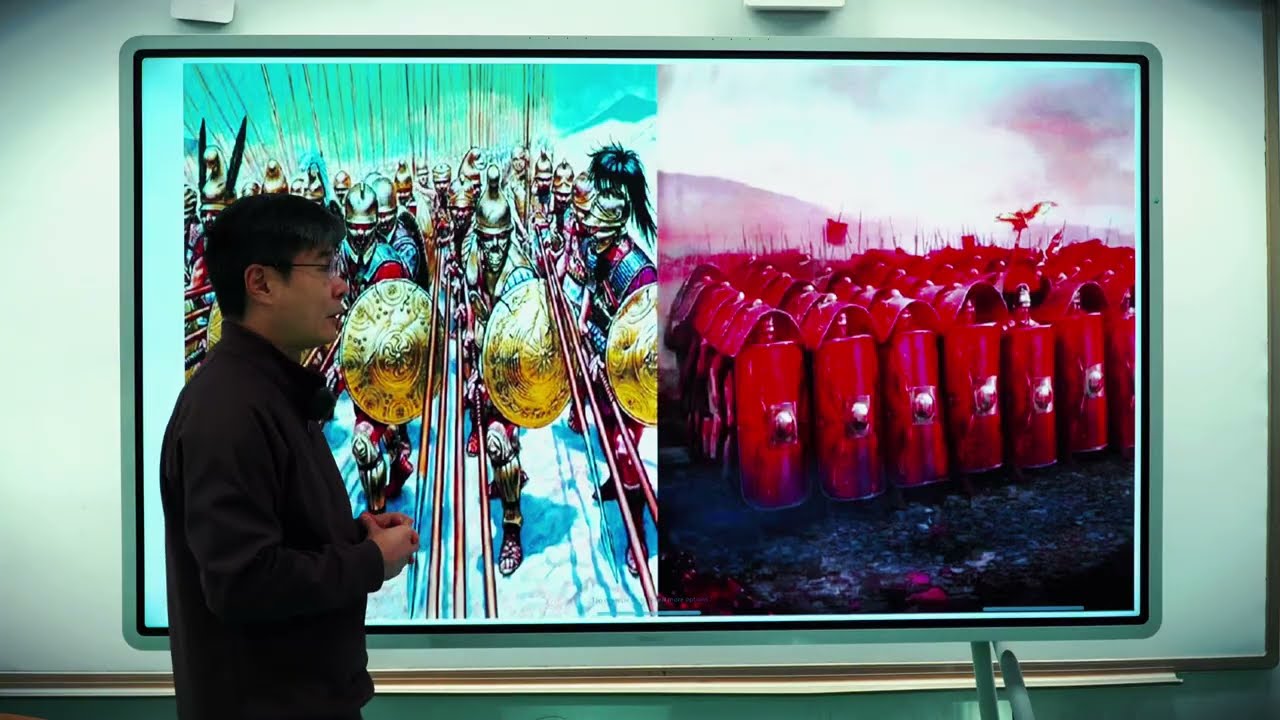
- Rome is presented as the “great anti-civilization” or “evil empire” — a society built entirely on war, violence, and conquest that eclipsed Persia, the Jews, and the Greeks after the Bronze Age collapse. Unlike civilizations based on reflection, philosophy, or love, Rome’s identity was rooted in militarism, hatred, and the systematic destruction of others. The episode argues that Roman history as commonly told is largely fabricated propaganda, written by Greeks under Roman sponsorship to justify Roman brutality.
Origins and Rise of Rome
-
Rome emerged in the borderlands of the Etruscan civilization on the Italian peninsula — a poor, mountainous, resource-scarce region surrounded by enemies.
- Because the land was poor and indefensible, Romans were forced to become the most warlike and militaristic people in the region.
- They were initially recruited as mercenaries by the wealthier Etruscans, who were themselves an advanced civilization influenced by Egyptians and Greeks.
- Over time, Rome conquered the entire Italian peninsula and then expanded across the Mediterranean through military conquest and road-building.
-
Rome’s concept of liberty was obedience to fathers, laws, and customs — survival through collective discipline, unlike the Greek concept of liberty as free speech.
- Citizenship was open to anyone who obeyed Roman customs, allowing Rome to incorporate conquered peoples and constantly replenish its armies.
- This gave Rome a decisive advantage over Athens and Sparta, which could not replace their soldiers as easily.
The Roman War Machine
-
The Roman legionnaire system differed from the Greek hoplite model in three key ways:
- Legionnaires needed less armor and equipment, so poor citizens could serve.
- They required far less training than hoplites.
- They were lighter and more mobile, designed for mountainous terrain rather than flat land.
- This allowed Rome to field massive armies of citizen-soldiers who, though often defeated in individual battles, could absorb losses and keep fighting — ultimately winning wars through attrition.
-
The heart of early Roman society was the Senate, composed of leading families who governed collectively when Rome was small, poor, and egalitarian.
- As Rome grew wealthy, the Senate became a vehicle for elite corruption, with senators concentrating wealth and land in their own hands.
The Punic Wars and the Destruction of Carthage
-
Rome’s main rival for Mediterranean dominance was Carthage, a wealthy trading civilization based in North Africa.
- Carthage hired mercenaries to fight its wars; Rome used its own citizens.
- This meant Romans became tougher and more unified through war, while Carthaginians grew decadent and corrupt.
- Carthaginians, as pragmatic traders, conducted cost-benefit analyses and were willing to surrender; Romans fought to the death and, upon victory, annihilated their enemies.
- Rome fought three Punic Wars against Carthage, ultimately burning the city to the ground and killing its entire population.
-
The episode argues that the famous Second Punic War story — Hannibal crossing the Alps, destroying Roman armies at the Battle of Cannae — is entirely fabricated.
- There is no archaeological evidence for the Battle of Cannae, despite the supposed death of 50,000–100,000 men.
- The double-envelopment tactic described would not have worked in ancient times without modern weapons.
- Hannibal’s behavior after his supposed victories makes no strategic sense: he never claimed kingship in Carthage, never demanded resources, and sat idle in Italy for years.
- The story was invented by Polybius, a Greek hostage who became Rome’s official historian, to justify the genocide of Carthage by framing Hannibal as an existential threat.
The Roman War Machine After Carthage
-
After destroying Carthage, Rome became the undisputed Mediterranean power but could not stop waging war.
- Because Italy was poor, the only way to generate wealth was through conquest — specifically, capturing slaves.
- The cycle worked as follows:
- Nobles wanted wars to capture slaves for their estates.
- Peasants were conscripted, borrowed money against their land to feed families, defaulted, and lost their land to nobles.
- Displaced peasants moved to Rome, where the state provided grain (the grain dole).
- Nobles bribed these landless peasants to vote for more wars, promising booty.
- This created a self-reinforcing system of slavery, debt, corruption, and inequality.
-
The conflict between upper nobility (Optimates) and lower nobility (Populares) defined Roman politics for centuries.
- Optimates believed their wealth proved their superiority.
- Populares like Julius Caesar exploited popular discontent to advance their careers, promising redistribution of wealth.
The Myth of Julius Caesar’s Gallic Wars
-
Julius Caesar, a wealthy lower-noble, obtained a generalship and invaded Gaul (modern France) for three reasons:
- To capture slaves — the most valuable commodity of the era — and enrich himself by underreporting kills and overreporting enslavements.
- To build a private, loyal army through shared combat experience and generous pay.
- To create a myth of himself as a great military conqueror, sending victory announcements back to Rome to build his political image.
- The episode compares this to Donald Trump’s use of The Apprentice and professional wrestling to construct a public persona of strength and business genius.
-
The famous Battle of Alesia, where Caesar supposedly defeated a massive Gallic relief army while besieging a fortified town, is also suspect — likely exaggerated or fabricated as propaganda.
-
After Gaul, the Senate tried to impeach Caesar, triggering a civil war.
- Caesar’s opponent, Pompey, had a superior strategy — starve Italy by siege — but the Optimates forced him into a premature battle at Pharsalus because they feared Pompey would become king if he won.
- Caesar’s loyal army defeated Pompey’s larger force, and Caesar made himself dictator.
- He was assassinated because the elite feared he would make himself king, cancel debts, and redistribute land.
Augustus and the Creation of Roman Culture
- After more civil war, Octavian (Augustus Caesar) emerged as the first Roman emperor by inheriting Caesar’s army and seizing Egypt as his private property, using its wealth to fund the military directly.
- Augustus was not a military genius but recognized that Rome needed a distinct cultural identity to match its political power, since Greek culture was still considered superior.
- He commissioned Livy to rewrite Roman history from a Roman (rather than Greek) perspective, and Virgil to write the Aeneid as a Roman counter-narrative to Homer’s Iliad.
The Aeneid as Anti-Greek Propaganda
- The Iliad ends with an act of love, forgiveness, and compassion — Priam kisses Achilles’ hand, they weep together, and Achilles returns Hector’s body. This became the foundation of Greek civilization.
- The Aeneid inverts this: Pyrrhus (Achilles’ son) brutally kills Priam’s son Polites in front of Priam, then murders Priam himself at an altar — with no mercy, no forgiveness, no compassion.
- All Roman schoolchildren memorized this, instilling a deep hatred of Greeks and a Roman identity built on violence and vengeance.
- Virgil reportedly asked for the Aeneid to be burned on his deathbed, understanding that using divine gifts to promote hatred was a sin. Augustus refused.
Roman Culture vs. Greek Culture
- Greek civilization was based on reflection, debate, openness, and empathy — exemplified by symposia (intellectual dinner parties with watered-down wine) and tragedies like The Trojan Women, which forced Greeks to confront their own capacity for cruelty.
- Roman culture was based on violence, excess, and spectacle:
- Gladiatorial combat — watching men kill each other and lions eat people.
- Banquets where the elite gorged, vomited, and gorged again while the poor starved.
- Orgy and excess as entertainment, with emperors like Nero as exemplars.
- The episode draws a parallel to American football and modern party culture as expressions of the same Roman spirit.
The Founding Myths of Rome
- Rome’s founding myths — Romulus and Remus, the Rape of the Sabine Women, the rape of Lucretia, Mucius Scaevola — are all presented as fabrications designed to encode Roman values:
- Romulus and Remus: Twins fight for kingship; Remus is killed. Rome is founded on fratricidal violence.
- Rape of the Sabine Women: Romans kidnap and rape women from neighboring tribes; the women are told it is their own fault for being raped, and eventually intervene to stop their fathers and husbands from fighting — uniting the nations through forced assimilation.
- Rape of Lucretia: A prince rapes a noblewoman; she demands revenge and kills herself. Her husband Lucius Brutus leads a revolt, expelling the kings and founding the Republic. When his own sons conspire to restore the monarchy, he personally oversees their execution — traumatizing himself to fuel his war against the enemy.
- Mucius Scaevola: A young Roman sneaks into the enemy camp to assassinate the king, kills the wrong man, and when captured, burns his own hand in a fire to demonstrate Roman fearlessness. The king is so terrified he withdraws.
- These myths are adaptations of Proto-Indo-European mythology, repurposed to create a culture of trauma, guilt, and demonic energy directed outward at enemies.
Secret Societies and the Psychology of Trauma
- The episode argues that secret societies derive their power not from hidden knowledge but from shared trauma, guilt, and hatred.
- The thought experiment: four teams must climb a Himalayan mountain. Team four, chased by demons they cannot escape, will always win — because the guilt and trauma of past actions forces relentless forward motion.
- Lucius Brutus, after executing his own sons, cannot stop — the guilt would destroy him if he rested. He must keep conquering or be consumed by the ghosts of his children.
- Secret societies create so much evil that members can only escape the psychological weight by doing more evil — they are, in effect, chased by demons of their own making.
The Transition to Jesus
- By the time Rome reached its peak, life under the empire was characterized by massive slavery, debt, corruption, and hopelessness.
- The episode sets up the next class: Jesus as the divine messenger sent to offer an alternative to the Roman world of hate — a message of love, redemption, and hope in response to the evil empire.