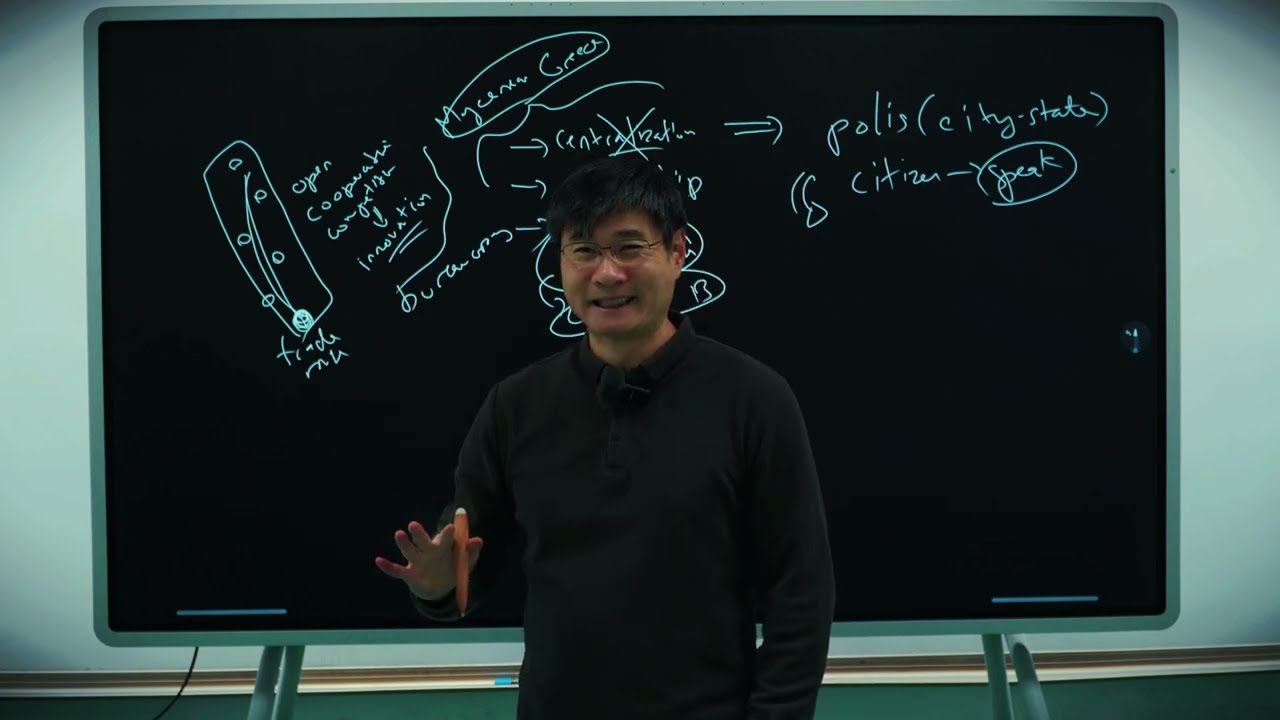
Homer as the “big bang” of Greek civilization — After the collapse of the Minoan Bronze Age empire, Greece entered a decentralized period of competing city-states (poleis), which created the conditions for an explosion of innovation, free speech, and education. Homer, an illiterate (and possibly blind) oral poet, emerged from this environment and produced the Iliad and the Odyssey, the foundational works of Greek civilization. His poetry was not propaganda but a deep exploration of the human heart, and it remains strikingly powerful even to modern audiences across cultures.
How the collapse of empire enabled Greek innovation
Empires suppress innovation through three features of bureaucracy:
Centralization creates monopolies, reducing competition and innovation.
Censorship restricts free expression and centralizes information.
Writing becomes a tool of propaganda rather than knowledge creation or self-expression.
The Minoan Empire (Bronze Age Aegean) followed this pattern, using a difficult writing system called Linear B that only elites could learn, reinforcing social hierarchy.
When the Bronze Age collapsed, the Greek world returned to a system of competing city-states (poleis).
The word “politics” comes from polis.
Because every citizen had to risk his life in war, every citizen gained the right to speak in public debate.
This created a culture where even farmers had to educate themselves and learn rhetoric (the art of speaking), driving massive innovation.
The writing system was reformed to match the new social reality:
Linear B was a syllabary (symbols representing whole sounds), deliberately hard to learn.
The Greeks developed the alphabet — symbols representing parts of sounds — the same system used today.
The Greeks added vowels, making it the most efficient and easy-to-learn writing system in the world.
This shift changed writing from a tool of control to a tool of knowledge-seeking and self-expression.
The Trojan War as the backdrop for Homer’s epics
Troy was a real place at the center of global trade, which made it a target for raiding. Over time, historical events became exaggerated legends.
The legendary cause of the Trojan War:
Three goddesses — Hera, Athena, and Aphrodite — quarreled over a golden apple inscribed “to the most beautiful.”
Zeus chose Paris, a prince of Troy, to judge.
Each goddess bribed Paris: Hera offered power (a kingdom), Athena offered wisdom, and Aphrodite offered the most beautiful woman in the world — Helen.
Paris chose Helen, who was already married to Menelaus, king of Sparta. Menelaus’s brother Agamemnon, the most powerful Greek king, organized a massive army to retrieve her.
The war lasted 10 years and produced many legends, including the heroes Achilles (the bravest warrior) and Odysseus (the wisest strategist, who devised the Trojan Horse).
The plot of the Iliad
Homer does not tell the entire Trojan War — he focuses on the conflict between Achilles and Agamemnon.
The story begins with Agamemnon refusing to return a captured girl (the daughter of a priest of Apollo) even when a plague strikes the Greek army.
Achilles confronts Agamemnon and demands he return the girl. Agamemnon agrees but takes Achilles’s own girl as compensation.
Achilles, enraged, withdraws from battle and asks his divine mother Thetis to persuade Zeus to help the Trojans win, so the Greeks will beg him to return and he can prove himself the greatest hero.
The Trojans, led by Hector (Paris’s brother), nearly destroy the Greek army and are about to burn their ships.
The Greeks beg Achilles to return with offers of treasure and Agamemnon’s daughter in marriage. Achilles refuses because Agamemnon himself has not apologized.
Achilles sends his lieutenant Patroclus to check on the situation, telling him only to save the ships and not push the Trojans back (to preserve Achilles’s own glory).
Patroclus, seeking glory for himself, disobeys and duels Hector, who kills him.
Achilled enters the battle, kills Hector, and becomes the greatest hero — but then falls into a deep depression.
Achilles mutilates Hector’s body, dragging it behind his chariot around Troy. This is depicted as a war crime that horrifies both Trojans and Greeks.
The gods arrange a meeting between Achilles and Priam (Hector’s father and king of Troy).
Priam sneaks into Achilles’s tent and, instead of killing him, kneels and kisses Achilles’s hand — the same hand that killed his sons.
This act of submission and courage breaks Achilles’s pride. He recognizes Priam as the greater hero.
The two weep together. Achilles returns Hector’s body and guarantees the Greeks will not attack during the funeral.
The Iliad ends not with military victory but with forgiveness — the real battlefield is inside the human heart.
The psychology of forgiveness: the Iliad’s deepest insight
Achilles’s depression stems from self-guilt, not grief alone. He knows he is responsible for Patroclus’s death because:
He picked a stupid fight with Agamemnon over pride.
He refused to fight when the Greeks begged him.
He sent Patroclus into battle with instructions designed to make Patroclus seek glory and die.
Priam’s act of forgiveness allows Achilles to forgive himself. This is the core message of the Iliad.
The speaker illustrates this with a thought experiment about three car accident scenarios:
Scenario 1: You are fully at fault (you were drunk).
Scenario 2: The other driver is fully at fault.
Scenario 3: The other driver is at fault, but you were also partly to blame (you were arguing and not watching the road).
People are least likely to forgive the other driver in Scenario 3, because they cannot forgive themselves first.
In real life, most situations are Scenario 3 — mixed responsibility — which is why forgiveness is so hard and so important.
A student applies this to China and Japan: China’s inability to forgive Japan for wartime atrocities may stem from China’s inability to forgive its own weakness at the time. The speaker agrees this is a valid application.
The broader claim: Forgiveness — of others and of oneself — is the hardest problem in human society. Solving it is what allows great civilizations to emerge.
The bicameral mind: why the Greeks were wiser than we are
The speaker draws on psychologist Julian Jaynes’s theory from The Origin of Consciousness in the Breakdown of the Bicameral Mind:
The right hemisphere of the brain receives information from the universe (vibrations, consciousness).
The left hemisphere interprets this information into everyday reality.
In ancient times, people experienced the right hemisphere’s input as voices of gods, spirits, and ancestors — hallucinated guidance from the divine.
This is why ancient cultures buried their dead as if still alive (with ships, horses, gifts) and practiced ancestor worship (the “cult of the skull” in Neolithic cultures) — they genuinely experienced the dead as still present and communicative.
The speaker connects this to Kant and Hegel:
Kant distinguished between the noumena (things in themselves) and phenomena (things as we perceive them). The brain filters reality through time and space.
Hegel saw the noumenal world as Geist (spirit/mind) — the universe is fundamentally consciousness.
If the universe is vibrations/consciousness, the right brain receives these vibrations and the left brain constructs reality from them.
The speaker argues that modern Western civilization has shut down the right hemisphere by insisting only on science, logic, and materialism. This makes us less creative and less wise.
Evidence that the universe may be consciousness:
Plants communicate with each other (scientifically verified).
Many great scientific discoveries came through dreams, daydreams, or sudden insight (Descartes, Einstein, Watson).
Common experiences — thinking of someone who then calls, feeling watched, knowing what someone else is thinking, having a conversation with an absent friend in your head, feeling a guardian angel — suggest we still access a spiritual dimension, but modern culture denies it.
In the ancient world, these experiences were not mysterious — everyone assumed they lived alongside spirits, angels, and demons.
How the Iliad reflects the bicameral mind
The gods in the Iliad are not fictional decorations — they represent the way ancient Greeks experienced their own emotions and the forces of nature as external, divine voices.
Example from the opening of the Iliad (Robert Fagles translation):
Homer begins by asking the Muse to “sing” through him — he is channeling, not creating.
When Achilles wants to kill Agamemnon, Athena appears to him alone (a hallucination no one else sees) and commands him to stop. He obeys.
This is “truthful but not factual” — Athena doesn’t literally exist, but the experience of being stopped by a divine voice captures how human emotions and decision-making actually work.
The speaker rewrites the same scene in modern prose and shows it is “factual but not truthful” — it describes what happens physically but gives no insight into why.
Another example: Priam’s visit to Achilles’s tent.
The Homeric version, with Hermes guiding Priam and the gods debating what to do, is far more powerful and psychologically insightful than a modern prose version that removes the gods.
The gods are how the ancient mind represented internal emotional and moral struggles.
The oral culture of Greece and its creative power
Greek civilization was fundamentally oral:
Citizens debated daily in the agora (marketplace).
Theater (amphitheaters seating ~10,000) staged plays by Sophocles and Euripides about the mysteries of the human heart.
Symposia involved drinking watered-down wine all night while discussing philosophy, love, death, and meaning.
Even written works (like Herodotus’s histories) were recited to audiences first — writing emerged from community and dialogue.
Socrates engaged people in the marketplace in philosophical debate.
Trials involved 500 jurors whom the accused had to persuade.
This constant public speaking and thinking about what it means to be human is what made Greek civilization great.
Modern literature as the product of a “dead God”
The speaker contrasts Homer with modern literature to show what is lost when the spiritual dimension is denied.
Tolstoy’s Anna Karenina begins with an affair that destroys families and ends in Anna’s suicide. Anna is searching for meaning through passionate love — she is, in effect, looking for God in sex and lust because “God is dead” in the modern world.
The speaker rewrites Anna’s suicide in heroic/Homeric prose, with Anna hallucinating her older self at the train station — a vision of her lonely future that drives her to step in front of the train. This version gives more psychological insight than Tolstoy’s naturalistic prose.
Virginia Woolf’s To the Lighthouse is offered as an example of modern “stream of consciousness” writing — the mind wanders without discipline, focused on trivial concerns (grocery bills, scattered worries) because there is no spiritual framework to give thoughts significance.
The speaker’s argument: When we stop believing in the spiritual and disconnect from the right hemisphere, our brains become cluttered with insignificant concerns. We live meaningless, insufficient lives. Our brains become, in effect, schizophrenic. Modern literature reflects this degradation.
Audience questions and YouTube comments
China and Japan: A student suggests China’s hatred of Japan reflects China’s inability to forgive its own weakness. The speaker agrees.
Africa: A commenter asks about African civilizations. The speaker acknowledges the gap and expresses interest in learning more.
Livestock as currency: A commenter correctly notes that livestock (cattle, sheep) was the main currency of steppe peoples, which solved logistical problems in warfare.
Altruism vs. utilitarianism: Once a society becomes too utilitarian, it is nearly impossible to restore balance, which leads to collapse.
Repetition from previous series: A commenter notes overlap with the speaker’s earlier “Civilization” series. The speaker explains the angle has changed — this series focuses on secret societies as a lens for understanding history.
Having children in dark times: When asked how people produce during horrible times, the speaker says children give hope, purpose, and energy. He has three children and says they are his motivation for teaching and building a legacy.