-
The episode presents an alternative theory of civilization that challenges the standard Marxist-derived model taught in most academic settings.
- The traditional model: Hunter-gatherers discovered agriculture, which produced food surplus. This surplus allowed a hereditary elite to emerge, who then developed religion, arts, science, writing, money, and property — collectively constituting civilization. This framework acknowledges benefits (religion, arts, science) but also costs (war, slavery, debt).
- The alternative model proposed: Humans were already religious, artistic, and capable of science from the very beginning — as evidenced by cave paintings and early temple complexes like Göbekli Tepe. Civilization did not give us these capacities; rather, civilization is a device created by elites to justify hierarchy and make it appear divinely ordained. People originally gathered voluntarily around temples for religious purposes; over time, temple leaders became hereditary and corrupt, prompting people to leave and build new temples elsewhere. Where temples sat at trade crossroads, they grew into cities because their location was too valuable to abandon. A “temple economy” emerged — a proto-taxation system where people brought food to the temple and priests redistributed it, enabling public works like irrigation. Writing, money, and bureaucracy developed to manage this economy. Mythology was then written down to encode the hierarchy as divinely mandated, making people believe the social order was ordained by the gods rather than constructed by elites.
-
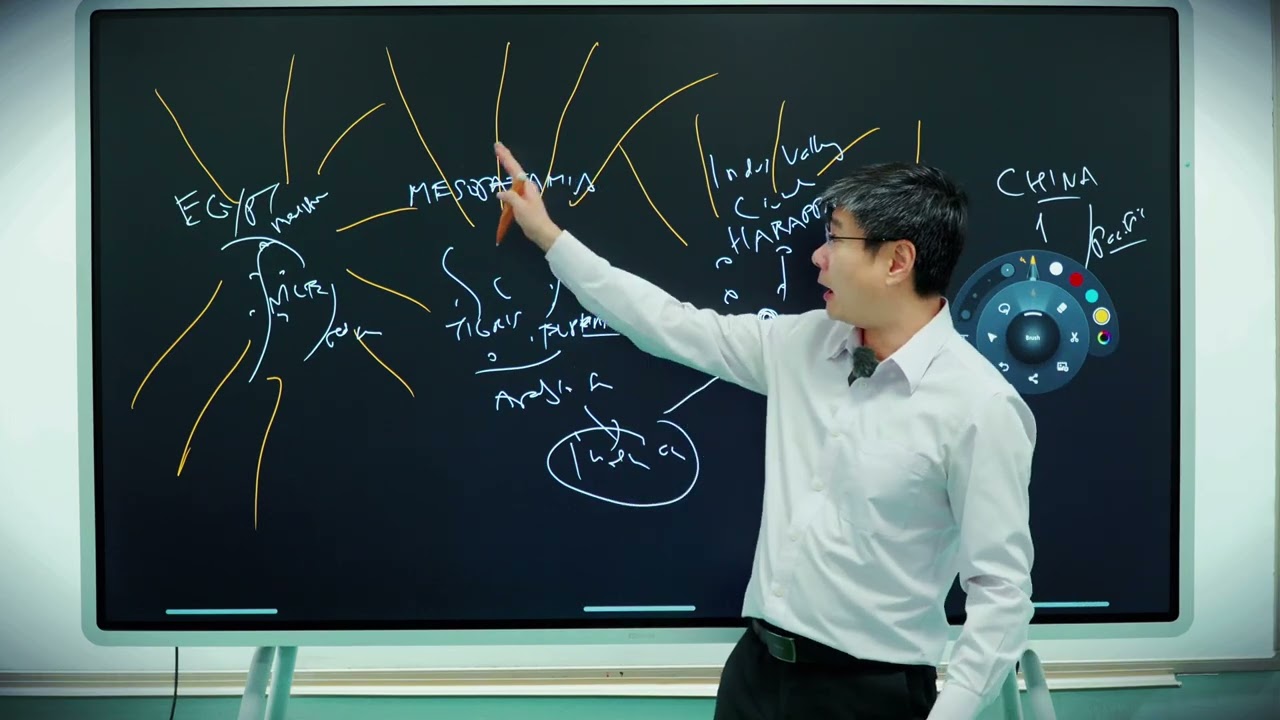
Geography explains where the four earliest civilizations arose — Egypt, Mesopotamia, the Indus Valley, and China — because they share three critical features:
- They sit at similar latitudes (not too hot, not too cold), ideal for agriculture.
- They are located by major rivers (Nile, Tigris/Euphrates, Indus, Yellow River), solving water, transportation, and farming needs.
- They have access to the sea (Mediterranean/Red Sea, Arabian Sea/Indian Ocean, Pacific), enabling trade and the flow of goods, people, and ideas.
- These civilizations are collectively the foundation of “Western civilization” — a term that properly includes the Middle East, Egypt, and South Asia, not just Europe and America. They were always in contact and influenced one another.
-
Sumer (in Mesopotamia) was the first major civilization because it sat at the center of global trade routes, connecting all other civilizations.
- Sumer invented writing (cuneiform), irrigation, and many technologies.
- Their language was unrelated to surrounding peoples, leading to debate about their origins — possibly a trading hub where different peoples converged and formed a new language.
- The rapid development of Sumer is sometimes attributed by conspiracy theorists to aliens (the Anunnaki), but the episode argues that when humans are brought together by necessity — in this case trade — they rapidly innovate. Necessity is the mother of invention.
- Sumerian ziggurats were temple complexes considered the literal homes of the gods. Only priests could enter; people delivered gifts through priests, who maintained control by mediating access to the divine.
-
History proceeds through a constant process of inversion, where each established order is overthrown by a new one:
- Egalitarian/animistic era: Society was fluid and dynamic; people believed everything contained the divine.
- Mother goddess era: With agriculture, societies worshipped a fertility goddess who was kind and compassionate — she served the people.
- Sky god era: As societies grew and went to war, male sky gods replaced the mother goddess. Now humans must serve the gods through struggle, toil, and exploitation of nature.
- Civil war/inversion era: Princes kill kings; sons kill fathers — hereditary power is violently contested.
- Bureaucratic era: Bureaucrats collude to steal power from the king — the servant rules the master.
-
The Enuma Elish is the most famous Mesopotamian epic and functions as a creation myth that justifies the new hierarchical order through inversion of the older mother-goddess religion.
- In the beginning, two primordial gods exist: Apsu (fresh water/river) and Tiamat (salt water/ocean). They create younger gods, who are noisy. Apsu wants to kill them; Tiamat warns the children, who rebel and kill Apsu. Tiamat, enraged, raises an army to destroy her children.
- The younger gods elect Marduk, a thunder/sky god, as their champion. Marduk kills Tiamat and splits her body like a dried fish — building the sky from one half and the earth from the other.
- This is not just a creation story but a proclamation of new values: the old religion of balance and harmony (worship animals, make sacrifices, live in balance) is replaced by a religion of exploitation, control, and domination — reflected in practices like irrigation, which is literally about controlling the earth.
- Marduk then creates a bureaucratic order: he establishes constellations, calendars, and divisions of time — all presented as divinely ordained rather than as priestly inventions for governance.
- He creates humans from the blood of Tiamat’s general Kingu, specifically to serve the gods as slaves. The Anunnaki (gods) are divided into upper and lower groups — establishing that some humans are “better slaves” than others, justifying social hierarchy.
- The epic ends with the declaration that Babylon is a divine city built by the gods for the gods, with humans existing to serve — this is the “mandate of heaven,” a concept found across civilizations.
-
The Epic of Gilgamesh is Mesopotamia’s other major literary achievement and encodes a theory of legitimate kingship.
- Gilgamesh is a giant, tyrannical king of Uruk who conscripts men for war and sleeps with all the women. The people cry to the gods for relief.
- The gods create Enkidu from clay (parallel to Adam in the Bible) — an animal-like man who is civilized through a prostitute. He fights Gilgamesh, they become best friends, and embark on adventures together, killing divine beings and disrupting the natural order.
- The gods decide one must die and choose Enkidu. Gilgamesh, heartbroken and terrified of his own death, embarks on a quest for immortality — and fails.
- He returns home and finds meaning in his walled city and his people’s happiness. The moral: immortality comes not from living forever but from doing great things for your people so you are remembered forever.
- The deeper theory: being a king means serving the people, not indulging yourself. The priests use this story to control the king — the king must learn humility, and the priests are the ones who control the messaging.
-
Myths are constructed through a layered process of consolidation and bureaucratic editing, which can be understood through a metaphor of house renovation — each era adds a new layer.
- Step 1 — Local legends: Each region has its own hero stories. Local kings claim descent from these heroes to justify their rule. The stories become tests of kingship — if Hercules fought a lion, so must you.
- Step 2 — Consolidation: As regions are unified into larger states, local stories are merged into composite epics (Gilgamesh combines multiple heroes). Oral tradition naturally exaggerates stories to keep them memorable — a student who got drunk before one exam becomes a student who gets drunk before every exam and always scores perfectly.
- Step 3 — Bureaucratic editing: Priests and bureaucrats take control of the stories and add moral messaging to control both the king and the people. Different bureaucratic factions produce different versions. The stories become less colorful and interesting but more useful for social control. This process is visible in Chinese classics like Romance of the Three Kingdoms and Journey to the West, which were originally more entertaining but were edited by bureaucrats into didactic texts for schooling.
-
The pattern of inversion repeats in Greek mythology (the Theogony) and explains the origin stories of major historical conquerors.
- Gaia (mother goddess) and Chaos give birth to the gods. Gaia marries Uranus, who beats their children. The children rebel; the youngest, Cronus, kills Uranus. Cronus then eats his own children out of fear they will overthrow him. Rhea hides Zeus, who grows up in secret, returns, poisons Cronus, and becomes king.
- This myth mirrors the real pattern of dynastic cycles: a hereditary elite becomes unhappy with the system; a prince becomes a warlord and overthrows the king; after the warlord dies, his foreign mercenary general (low birth, no local factions) slays the warlord’s heir and makes himself king.
- This explains the similar origin stories of Sargon of Akkad, Romulus and Remus of Rome, King David of Israel, and Genghis Khan — all were low-born foreigners who rose to power. The myth of Zeus (low-born foreigner who is secretly the king’s son) was created to solve their legitimacy problem.
-
Writing was invented not for noble purposes but to gaslight people into accepting hierarchy. A concrete example is the Sumerian text “The Debate Between Sheep and Grain.”
- Pastoralism (herding sheep and goats) was a free, independent lifestyle. Agriculture (growing grain) tied people to one place and made them easier to control and tax.
- In the debate, sheep argues it provides clothing, oil, food for soldiers, and is sacrificed by priests — it is essential and great. Grain argues it is bountiful, self-protecting, and requires less labor.
- The gods rule that grain is superior — a transparent piece of propaganda designed to convince free pastoralists to become enslaved farmers.
- This is why writing was invented: to encode these justifications in stone, making them appear permanent and divinely sanctioned.
-
Civilizations influence each other but also differentiate themselves. When asked whether Egyptian, Mesopotamian, and Indus Valley mythologies influenced one another:
- They almost certainly shared stories through trade contact, but elites also needed to prove their own culture’s superiority — hence Egypt built pyramids, Mesopotamia built ziggurats and composed great epics. Each civilization refracts shared influences to address local needs and assert uniqueness.
- The process is analogous to how people today are influenced by American popular culture but adapt it for their own purposes.
-
The gender of creator gods varies across cultures (e.g., Pangu in Chinese mythology is male and sacrifices himself to create the earth, while other traditions have female creators) because myths are edited over time to reflect the prevailing hierarchy.
- Originally, gods were likely asexual or both male and female, reflecting a balance of forces (yin and yang). As societies shifted from female-centered to male-centered power structures, the gender of creator gods was changed accordingly. It is nearly impossible to reconstruct the original versions.
-
Next episode preview: The discussion will turn to the steppe peoples — nomadic pastoralists who, despite being dismissed by agricultural civilizations, were the major conquerors throughout history (including Genghis Khan).
Secret History #13: Mandate of Heaven
Predictive History • • 57min → 7 min • #97