This episode launches a sweeping series on human history by challenging the dominant Darwinian, materialistic framework and proposing an alternative: that humans are fundamentally imaginative, spiritual, and empathic beings whose deepest nature has been suppressed by civilization rather than expressed by it.
Darwinism and Its Consequences
Charles Darwin’s On the Origin of Species introduced three core ideas: evolution is accidental (random genetic mutations), materialistic (only the physical world exists), and emergent (complexity builds bottom-up through survival of the fittest).
Before Darwinism, European societies were broadly Christian, holding that a single omniscient God created all people as equal, that the Holy Spirit gives life meaning and purpose, and that the world is a mystery requiring faith and humility.
Darwinism overturned this worldview and provided intellectual justification for 19th-century European imperialism, genocide, and colonization by dividing humanity into races and asserting white racial superiority.
Evolution gave rise to racism and eugenics: the belief that non-white and “unfit” people should be sterilized to prevent “diluting” the genetic pool; these ideas persist today.
Despite appearing to reject religion, evolution functions as a theology: it asserts that “might makes right” and that the strong surviving is inherently good.
Within just 20 years of the book’s 1859 publication, evolution became the dominant paradigm in Western science and education, and questioning it remains socially taboo.
Problems with the Standard Evolutionary Narrative
If evolution produces tremendous diversity, why is there only one surviving human species? The standard answer is that other species existed but Homo sapiens “won out,” yet this is asserted rather than explained.
Humans are unusual among primates in their drive to migrate across the entire globe, including into extremely remote and dangerous places like the Pacific islands, where there was no way to know land existed.
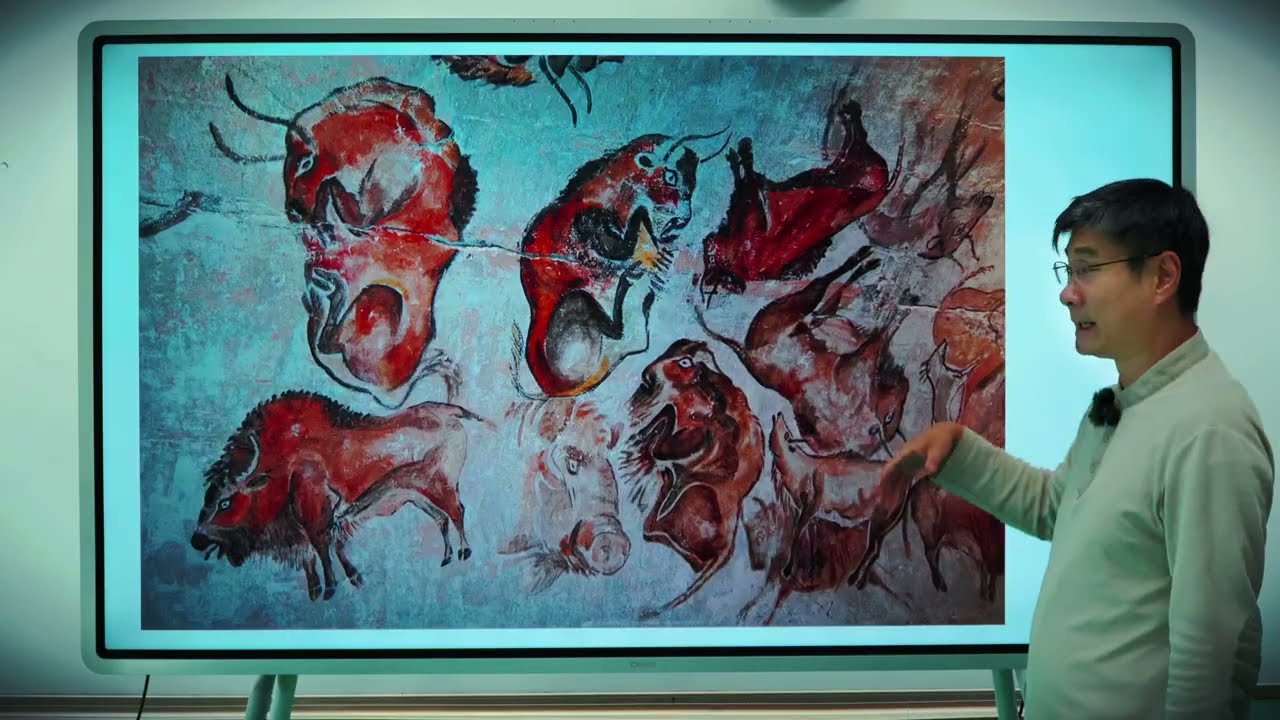
Early humans engaged in behaviors that make no survival sense: Neanderthals built elaborate ritual sites, and Homo sapiens created extraordinarily detailed cave paintings deep inside cold, dark, oxygen-poor caves far from food sources.
These behaviors suggest something beyond material survival was driving human activity.
The Ice Age World and Human Ingenuity
For most of human history, Earth was in an ice age, with much of the planet frozen over; humans survived by creatively using available resources, such as building houses from mammoth bones and tusks.
The knowledge of how to do this was not taught or planned: it arose intuitively. When humans work together, they share ideas almost telepathically, without needing to communicate verbally.
Early human social organization was diverse and fluid: small groups of five to ten for foraging, and large gatherings of hundreds or thousands for religious festivals, all coordinated intuitively without hierarchy or bosses.
If someone disliked a situation, they simply left and formed their own group, making early human society highly dynamic and creative.
Cave Paintings as Spiritual and Creative Expression
Cave paintings dating back 30,000–40,000 years are extraordinarily lifelike and carefully executed, showing that their creators spent significant time and effort on them.
They were not realistic records but surreal, mythological narratives depicting a cycle of life and death, destruction and renewal, and the unity of all things.
Animals were commemorated after being killed because humans believed in balance and harmony: taking life required thanking the sacrifice through ritual art, much as later civilizations built monuments to fallen soldiers.
Shamans, identified in paintings (such as the “bird-man” from Germany, 40,000 years old), were the leaders of early societies because of their wisdom and connection to the divine.
Music was central to these civilizations; language itself may have originated not for economic or hierarchical reasons but for singing and creative self-expression.
Caves as Spiritual Portals
Early humans believed the material and spirit worlds were connected through portals such as caves, rivers, and mountaintops, which is why paintings were placed deep inside caves.
Painting in low-oxygen cave environments induced a trance-like state, making the artists feel they were on the threshold between life and death and actually communicating with the spirit world.
The act of painting, singing, or storytelling was understood not as individual self-expression but as channeling the divine: the human was a portal or mechanism through which the spirit world communicated.
Shamans dressed as animals (such as bison) to better communicate with them in the spirit world and summon their return after being hunted.
Symbols and the Rejection of Writing
Archaeologist Geneviève von Petzinger cataloged geometric symbols found across European ice age caves; these symbols represent abstract concepts like energy, life force, and cycles that cannot be depicted as pictures.
These symbols constitute a proto-writing system, meaning early humans had the capacity to write but deliberately chose not to.
Writing was rejected because speech was understood as channeling the divine, and writing it down would be counterfeiting that divine inspiration; writing also turns communal, musical expression into a solitary, corrupted form.
The symbols were received through dreams and inspiration, and when drawn, their meaning was intuitively understood by others.
Art as a Living Tradition
The impulse behind cave paintings continues today in street art and graffiti, which similarly aim to give meaning to communities, tell stories of identity, and unify collective imagination.
Art’s purpose is to bring beauty to the world, to reveal how the spirit world operates within reality, and to create belonging and community through shared imagination.
Pre-Literate People: More Intuitive, Not Less Intelligent
Pre-literate people are more intuitive, imaginative, and empathic than literate ones; they can sense others’ emotions immediately without being told.
Indigenous art (such as Inuit art) reflects a worldview in which everything is unified, the divine is present in daily life, and one’s home is a temple.
Modern society dismisses such people as “stupid” because they cannot write essays or give speeches, but they are actually focusing their cognitive energy on empathy, imagination, and intuition rather than verbal abstraction.
Empathy as Humanity’s Superpower
A famous horse that appeared to do math was actually reading the emotional state of the audience through empathy, detecting changes in breathing and body language as it approached the correct answer.
An autistic boy in China who appeared to read his mother’s mind was actually detecting subtle differences in the pitch of her voice that only he could hear; together, mother and son devised an elaborate hidden emotional language to attract media attention and financial help for his education.
When people are placed in a room and asked to cooperatively paint a wall without speaking or planning, they produce remarkable work because empathy and the desire to support each other unlock creative potential.
Warriors on horseback throughout history were nearly invincible because horse and rider developed such deep emotional connection that the horse could anticipate the rider’s thoughts before they were formed.
Empathy is not learned through socialization; it is innate and is socialized out of people through schooling, screen time, and disconnection from nature.
The Resilience of Human Imagination
Humans are obsessed with creative expression and will find a way regardless of disability: Beethoven composed his greatest music while deaf because he saw music as visual vibrations and waves; John Milton wrote Paradise Lost while blind because he heard it as music and sang it to secretaries.
People who are deaf often develop deeper emotional intelligence and, when communicating together through sign language, display remarkable joy and connection.
The human imagination is resilient: if someone loses one sense, others intensify, and creative expression always finds a way when the will is present.
Alzheimer’s and the Return to the Divine Self
Alzheimer’s strips away socialization: as patients lose the ability to speak, verbalize, and communicate conventionally, what remains are spiritual desires (suddenly attending church), the urge to sing, and the urge to draw, even in people who never painted before.
Alzheimer’s patients who “hear voices” or “see things” may actually be perceiving what early humans always perceived: a world coexisting with spirits, ghosts, and fairies, which modern socialization trains people to ignore.
Psychedelic art similarly strips away socialization, producing images with no concept of time or space, depicting heightened reality, energy fields, and the unity of all things.
Vincent van Gogh’s paintings reflect a mind that had shed socialization and glowed with raw, unfiltered life.
Five Myths About Human Nature
Myth 1: Humans are driven by material desires (money, sex, power). Truth: Humans are fundamentally religious, spiritual beings who want to express themselves through art, music, and rituals, to differentiate themselves creatively, and to explore out of curiosity.
Myth 2: The natural unit is the family, and men protect their property including women. Truth: For most of human history, women controlled their own bodies, often slept with many men to create social cohesion and ensure that all men felt responsible for all children, making women the core of society.
Myth 3: Humans follow survival of the fittest. Truth: For most of human history, humans cared for the weak and believed those who were weakest had the most divinity; every killed animal was thanked as part of a shared life cycle.
Myth 4: Humans have gotten smarter and civilization is superior. Truth: Civilization has decreased human imagination; pre-literate people had better memories, sharper perception, deeper empathy, and greater emotional resilience.
Myth 5: We evolved from apes. Truth: Humans are uniquely imaginative and can choose their own evolution; believing we are apes leads to ape-like behavior, but we are fundamentally imaginative beings with control over our lives.
The Burial of Romito 2: A Case Study in Ancient Values
Romito 2 was a dwarf buried 10,000 years ago in an elaborate grave with jewelry, indicating he was highly prized by his community despite his deformity.
Archaeological evidence shows that Paleolithic hunter-gatherers frequently cared for individuals with disabilities until death and beyond, sometimes with remarkably lavish funerals.
Three explanations are offered: (1) maintaining cosmic balance and unity, since all are part of God; (2) stronger innate empathy in pre-literate societies; (3) appreciation of diversity as a divine gift, where difference meant special wisdom, intuition, or connection to the divine.
Today, marginalized and persecuted people often possess the greatest imagination, empathy, and storytelling ability, but modern society no longer celebrates these qualities.
Disconnection from the Divine in Modern Life
Society, through schooling and mass institutions, systematically separates people from their innate connection to the divine by removing children from parents, teaching abstract and meaningless facts, and demanding obedience and conformity.
People with cognitive disabilities or autism who are excluded from this socialization process often remain closer to the divine because they cannot be fully “brainwashed” by the system.
The modern surge in mental illness (depression, anxiety, eating disorders, suicidal tendencies), especially among youth, is caused by severing the innate human connection to the divine through social media, screens, and disconnection from nature and genuine human connection.
Social media traps imagination in meaningless pursuits (seeking likes, performing for others) rather than activities that create genuine purpose and meaning.
Empathy is innate, not learned: a mother and child are born with an emotional connection that becomes almost telepathic, and this connection is broken by too much schooling, screen time, and television, leading to a zombie-like existence without direction or meaning.