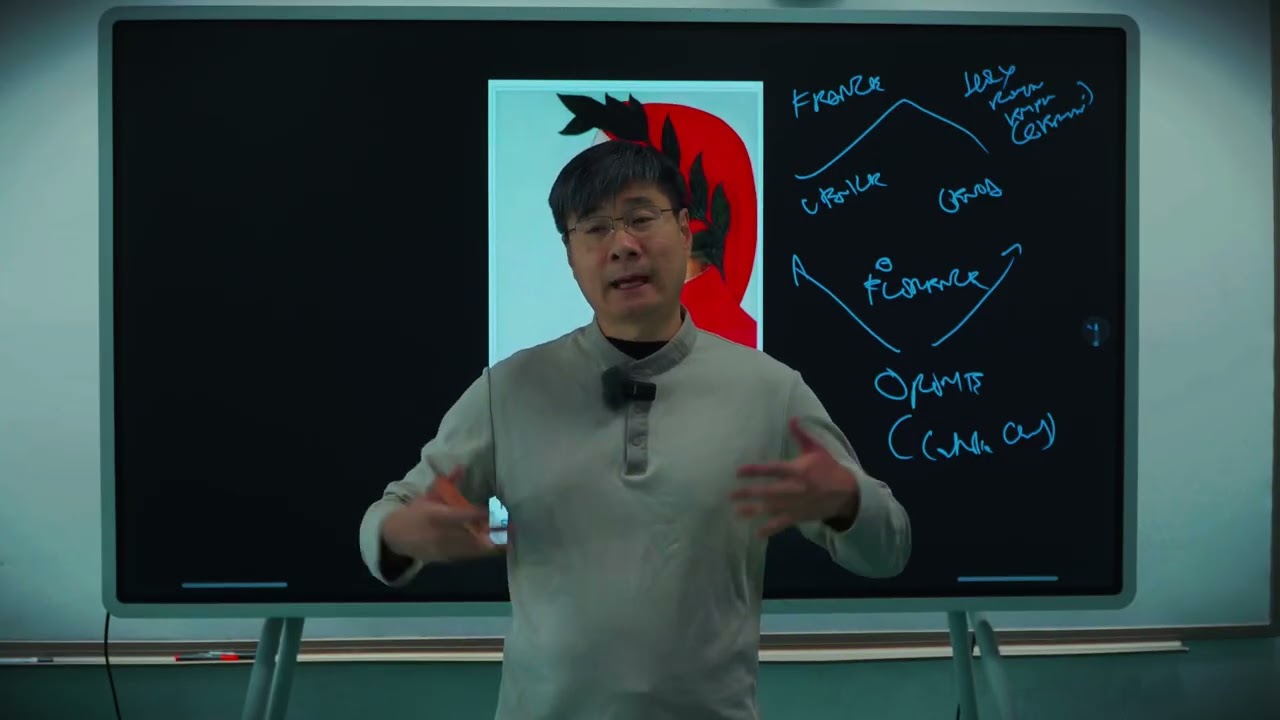
Dante’s Divine Comedy as a democratic, subversive masterpiece — Written around 1300 in Tuscan Italian rather than Latin, La Commedia (Dante deliberately called it “comedy,” not “tragedy,” to signal accessibility) was meant for ordinary people, not just elites. It is structured in three parts — Inferno, Purgatorio, and Paradiso — and uses rigorous mathematical structure and deliberate paradox to infiltrate the reader’s mind over decades of rereading, slowly remaking how they see the world. The poem is both a response to Virgil’s Aeneid and a direct challenge to the Catholic Church’s monopoly on salvation, arguing that love — not obedience, duty, or reciprocity — is the path to God.
Structure and Literary Devices
Three-part geometric architecture — Inferno is an inverted triangle (descending underground); Purgatorio is a mountain or pyramid (ascending toward Beatrice at the summit); Paradiso is structured like a solar system, culminating in the Empyrean where God resides. This mathematical symmetry is unique in poetry.
Paradox and cognitive dissonance as core mechanisms — The poem is designed to be memorized and read aloud. Its surface simplicity conceals deep contradictions that the reader’s subconscious unravels over time. The more you return to it, the more it reveals — it is meant to enter you and remake you.
The necessity of passing through hell — Dante must enter Inferno before reaching Paradiso. One interpretation: you cannot truly know good without confronting evil; good is not the absence of evil but its defeat. Another: Virgil and the Aeneid represent a worldview (duty, piety, empire, the rejection of love) that Dante must first recognize and internalize in order to ultimately transcend it.
Historical and Biographical Context
Italy around 1300 was fractured — City-states like Florence, Venice, Genoa, and Milan competed against each other, against the Catholic Church in Rome, and against European empires (France, the Holy Roman Empire). Within Florence, the Guelphs (pro-Papacy) fought the Ghibellines (pro-Empire); after the Guelphs won, they split into Black and White factions.
Dante’s life was shaped by this violence — Born into a Guelph family in Florence, he was embroiled in factional conflict his entire life. He was eventually exiled from Florence and never returned, spending his life under the patronage of various Italian aristocrats.
Beatrice as the emotional core — Dante fell in love with Beatrice when they were children (he was nine, she was eight). Because her family was more aristocratic, they married others. She died young, likely in her mid-twenties giving birth. Dante never forgot her, and she becomes the figure who redeems him from earthly conflict — she descends from heaven to guide him to God.
The Aeneid as the foundation of Church corruption — For a thousand years, Virgil’s Aeneid was dominant in Europe and became the intellectual foundation of the Catholic Church. Its emphasis on duty, piety, obedience, and the subordination of love gave the Church a framework to deny people direct access to God, concentrating power in the institution and leading to corruption and wars.
The Opening: Lost in the Shadowed Forest
“When I had journeyed half of our life’s way, I found myself within a shadowed forest” — Dante, in middle age, is lost in a savage, dense forest representing depression, confusion, and disconnection from God caused by the hatred and violence he has witnessed. He has lost the path and feels hopeless.
Virgil appears as savior, father, and teacher — Virgil, the most influential poet in European history and Dante’s greatest literary hero, promises to guide Dante out. Dante places absolute faith in him. But this elevation is deliberate: Dante must first put Virgil on a pedestal so that the reader can later recognize Virgil’s limitations and ultimately reject his worldview.
The Paradox of Virgil’s Account of His Mission
Virgil claims Beatrice summoned him from Limbo — He says Beatrice came to him in hell, weeping, asking him to help Dante because Dante loves her so much. Lucia (enemy of cruelty) also urged Beatrice to act.
This framing implies reciprocity — which contradicts Dante’s God — If God is perfect love, generosity, and forgiveness, God never requires anything in return. Free will and reciprocity are contradictions. So Virgil’s account is flawed in two possible ways:
Virgil is misinterpreting: God sent Beatrice unconditionally because Dante’s heart was calling out — there is no quid pro quo, but Virgil’s Aeneid-shaped worldview can only understand relationships as contracts.
Beatrice is telling Virgil what he can understand: She knows Virgil cannot grasp unconditional love, so she frames her mission in the language of reciprocal duty that his worldview accepts.
Either way, Virgil is an unreliable guide — Dante never tells us directly. He plants clues. The reader must recognize Virgil’s unreliability on their own to truly enter paradise.
Crossing into Hell: Charon and the Paradox of Obedience
Charon refuses to carry Dante because he is still alive — The ferryman of the dead shouts at corrupted souls: “Forget your hope of ever seeing heaven.” But when Virgil insists, Charon obeys.
The paradox: Charon is in hell because he rejects God’s authority, yet he obeys God’s authority — This makes no sense unless we recognize that Charon is not obeying God. He is obeying Virgil, the speaker. This reveals that Virgil is the true master of hell.
Why Virgil rules hell — The Aeneid created the emotional and cultural conditions for hell: its emphasis on piety, obedience, empire, hatred of enemies, and the treatment of love as a disease. The Catholic Church is based not on the Bible but on the Aeneid. Virgil’s poetry built the world that made hell possible.
Will and Desire: The Nature of the Soul
“Will” and “Desire” are the two key words repeated throughout the poem — Together they constitute the soul. You are what you want and what you move toward.
People are in hell because they choose to be — The souls line up obediently, signaled one by one like falling leaves. “Celestial justice spurs them on so that their fears turn into desire.” They are not in hell because they sinned — everyone sins. They are in hell because they desire to be there. Free will is fundamental: you do what you do because you choose it.
Limbo and Virgil’s Self-Deception
Limbo houses virtuous non-Christians — Homer, Plato, and Virgil himself dwell here. They did not sin, but they lacked baptism and are “punished just with this: we have no hope and yet we live in longing.”
Virgil claims he is in Limbo through bad luck, not choice — He says he arrived after Christ’s Harrowing of Hell and was not saved. But this is not true. As the poem progresses, it becomes clear that Virgil chooses to stay. There are paths to salvation available to him, but he desires to remain in hell.
This is the first major clue that Virgil’s account of reality is distorted — He presents himself as a victim of circumstance when he is actually a prisoner of his own worldview.
Minos Warns Dante: “Do Not Trust Anyone Here”
Minos, the judge of hell, tells Dante: “Be careful how you enter, whom you trust. The gate is wide, but do not be deceived” — Since Dante is with Virgil, the warning logically means: do not trust Virgil.
Virgil immediately shuts Minos down — “Why protest? Do not attempt to block his fated path. Our passage has been willed above.” Virgil invokes higher authority to silence the warning, confirming that he does not want Dante to question him.
Dante is planting seeds for the reader — In hell, nothing is what it seems. The person you most trust is the person you should least trust. Everything Virgil says must be questioned.
The Unnamed Shade: Virgil’s Refusal to Name Dido
In the circle of lust, Virgil names famous lovers — Semiramis, Cleopatra, Helen, Achilles, Paris, Tristan — a thousand shades. But one figure he pointedly does not name: “the other spirit who killed herself for love and betrayed the ashes of Sichaeus.” This is Dido.
The paradox: Virgil refuses to name the character he knows best — Dido is the most realistic, sympathetic character in the Aeneid — the one readers most identify with. Yet Virgil condemned her to hell. The likely reason: Dido was based on a real woman who rejected Virgil (possibly because of his appearance), and in his anger and embarrassment, he punished her in his poem. He feels guilty and refuses to face her.
Dante names Dido himself — an act of rebellion — Despite acknowledging Virgil as father, guide, and teacher, Dante deliberately invokes Dido’s name to resurrect her in memory and to signal that Virgil was wrong to condemn her and wrong to erase her. This is the first open act of defiance against Virgil’s authority.
The Method of Reading the Divine Comedy
You cannot understand it by reading alone — The poem requires intuition, imagination, and faith. It is a journey into your own heart. God reveals truth through your instincts, not through rational analysis alone. The cognitive dissonance it creates is the mechanism by which it remakes you over a lifetime of reading.