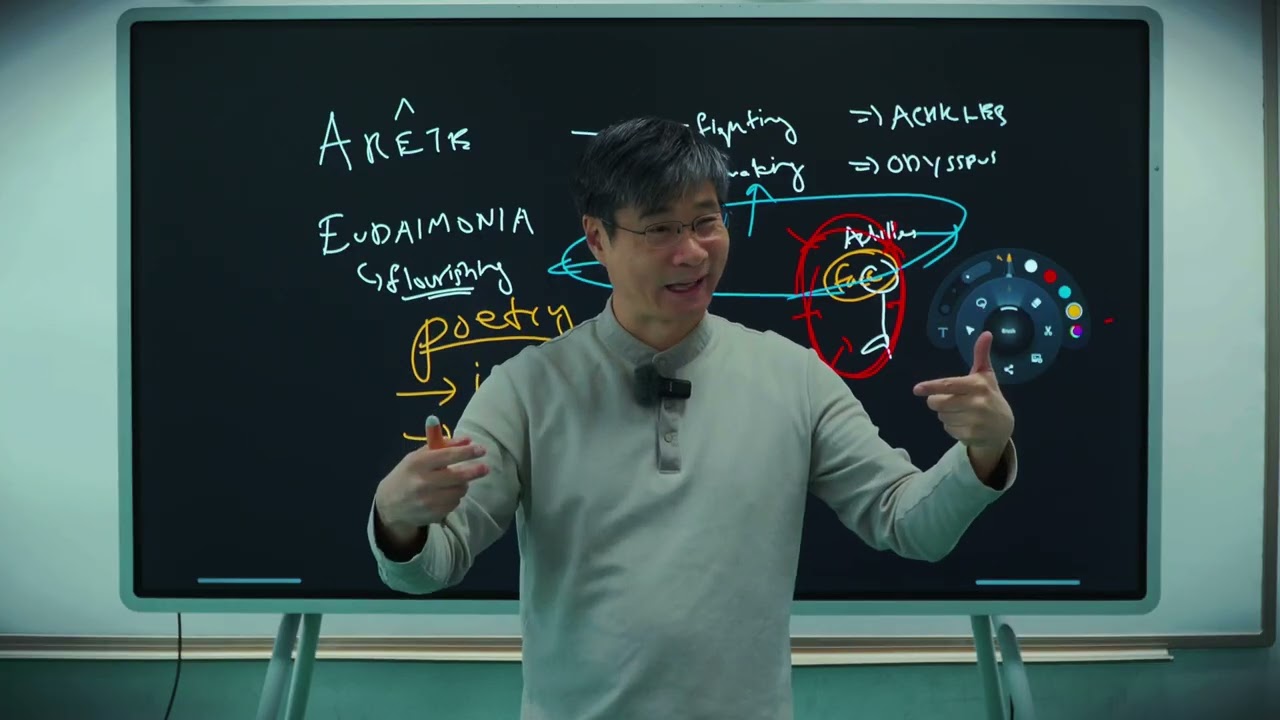
The episode explores how Homer’s Iliad—a single epic poem—served as the foundation for Greek civilization and, by extension, all of Western civilization, by examining the Greek concepts of arete (excellence or virtue) and eudaimonia (flourishing), the power of speechmaking as a form of reality-creation, the philosophical mechanics of how poets shape perception, and the role of poetry as a divine portal that connects humanity to a deeper, shared consciousness.
Arete and Eudaimonia: The Greek Foundation
Arete means virtue, excellence, or character—what makes you special and what you excel at; in Greek civilization, the two primary expressions of arete are war-fighting (embodied by Achilles) and speech-making (embodied by Odysseus).
Eudaimonia means flourishing—the idea that you can only be truly happy when you are expressing your arete and achieving your full potential.
Achilles chose to die young at Troy rather than live old at home because only through battle and glory could he achieve eudaimonia; without fighting, he literally cannot be himself.
When Agamemnon dishonors him and he withdraws from battle, he becomes deeply unhappy and seeks every way back to war—not for revenge alone, but because his identity depends on it.
Speechmaking as War: Creating and Imposing Reality
For the Greeks, war-fighting and speech-making are fundamentally the same activity pursued through different means: both aim to impose your reality onto the world and make others inhabit it.
War does this through brute force and demonstrated superiority.
Speech does this through beauty and truth, creating a new reality that others willingly submit to.
The long speeches in the Iliad (such as Odysseus’s plea to Achilles to return to battle) are not practical negotiations—they are attempts to project an entire imagined reality that the listener will internalize.
Odysseus expands Achilles’ imagination across time: he paints a vivid image of the Greeks starving in a desert (the present crisis), reminds Achilles of the promises he made to his father Peleus (the past), and conjures the riches and glory that await if Troy falls (the future).
The goal is to get Achilles to enter the world Odysseus has created and be convinced from within it.
Achilles counters with his own speech, but his reality contracts inward rather than expanding outward—he uses “I” obsessively, rejects the collective “we,” and spits on Agamemnon’s offers; this is a war of narratives, and Achilles refuses to be conquered by Odysseus’s reality.
The Mechanics of Memorable Speech: Poetry as Technology
The reason these speeches are so long and so memorable is that they are poetry, and poetry employs specific techniques designed to imprint reality on the listener:
Imagery: drawing vivid pictures that make abstract ideas concrete and visible.
Metaphors (connections): surprising juxtapositions (e.g., “the sky is like a snail”) that reorder how you see reality and make you remember.
Diction and syntax: careful choice and arrangement of words for maximum impact.
The Greek education system was essentially just memorizing the Iliad—through this, students internalized the art of speechmaking, learning that to accomplish anything in public life, you must stand before people, create a compelling reality, and make them accept it.
This practice became the basis of democracy, where persuasion through speech, not force, determines outcomes.
How Poets Create Reality: Kant, Time, and Space
Drawing on Immanuel Kant’s Critique of Pure Reason, the episode explains that humans are not passive observers of reality but active participants who shape reality through perception.
The world as it truly exists (the noumena) is just raw vibrations and energy—formless and imperceptible.
Our minds filter this chaos into understandable phenomena (things as they appear to us) through two internal frameworks: time (sequence) and space (sensation/the five senses).
Time and space do not exist outside us; they are mental structures we impose to make sense of the world.
Language is the tool that controls time and space—and therefore controls reality itself.
Before language, each person inhabits their own private time and space; through language, we arrive at a collective understanding of reality.
Poets create language, and therefore poets create reality itself.
Homer’s poetry creates a new shared reality in which people like Achilles can transcend personal grievances and act for the common good.
Poets as Prophets: Accessing the Universal Consciousness
Poets are essentially prophets with a divine connection to the universe (called variously Geist by Hegel, the collective unconscious by Jung, the realm of forms by Plato, or heaven by Christians).
The universe is described as a kind of divine psychic internet where every memory and every consciousness that has ever existed is stored—even after death.
Poets access this universal consciousness through deep inspiration and summon living characters from it; Homer brings Achilles, Odysseus, and others to life not as fictional constructs but as beings with real pasts, presents, and futures drawn from the universe itself.
This is why the Iliad feels alive even today—it connects us to the same universal source, which is why we can still identify with Achilles and predict his behavior.
The Iliad as a Living Portal: How One Poem Creates a Civilization
Homer was a bard who traveled from town to town reciting the Iliad orally to audiences of hundreds—he was doing exactly what Odysseus does in the poem, painting a shared movie for everyone to observe together.
Each listener brings their own unique consciousness and experience to the poem, so the Iliad becomes a shared creation—different for every observer yet connecting all of them to the same universal source.
The Iliad was created from inspiration flowing from the universe (the monad), and simultaneously serves as a portal back into the universe—reading it opens your mind, increases your “download speed” from the divine, and allows you to create new realities.
This is the mechanism by which one poem gave birth to an entire civilization: it was so alive, so connected to the eternal, that engaging with it transformed the people who encountered it, giving them access to deeper perception and collective meaning-making.
Greek Tragedy: Epiphany and Catharsis
Drawing on Percy Bysshe Shelley’s A Defense of Poetry, the episode explains how Greek theater (which grew directly from Homer’s influence) functioned as a tool for moral and intellectual education.
Greek tragedies follow a pattern: a great character is undone by hubris (arrogance)—Achilles has hubris, Hector has hubris, Oedipus has hubris; no matter how great you are, hubris leads to tragedy.
Watching tragedy produces two effects:
Epiphany: you recognize that hubris leads to downfall, which makes you more humble and self-aware.
Catharsis: you feel pity and terror for the character, you cry, and you purge your own hubris, hatred, and negative emotions—this makes you a more whole, empathetic, and moral person.
Through catharsis, the character lives in you and you live in the character; the drama becomes a mirror in which you see yourself and the fundamental truths of human nature.
The lesson of tragedy is not to avoid struggle but to acknowledge your limitations and fate while struggling on regardless—this is the essence of arete and eudaimonia.
Poetry as a Gateway to the Soul and the Divine
Poets uniquely combine two streams: the eternal/spiritual (the divine, the monad) and the material/present (human nature, lived experience), weaving both into words that express “the here and the forever.”
Certain words and images in poetry reawaken dormant memories—not just from this life but from past lives and the spiritual realm.
When we reincarnate, we lose our memories of the spiritual world (otherwise we couldn’t fully live this life), but poetry can reignite those buried memories and elevate the soul.
Poetry arrests the vanishing moments of life, preserves the most beautiful and divine aspects of human experience, and sends them forward through language—it “redeems from decay the visitations of the divinity in man.”
Poetry lets us see the divine everywhere by helping us perceive beyond time and space, connecting immediately to the eternal.
Poets as Unwitting Prophets and Legislators
Poets do not fully understand what they are doing—they are compelled by an inner fire they cannot suppress; they must speak the truth or suffocate under it.
Homer, for example, likely did not consciously analyze Odysseus’s rhetorical techniques—he was channeling the divine, acting as a portal for God/universal truth to speak through.
Poets are described as:
“The unacknowledged legislators of the world”—because the language they create shapes all of reality, law, and civilization.
“Mirrors of the gigantic shadows which the future casts upon the present”—they speak truths they do not fully comprehend, truths that resonate forward through time.
“The trumpets which sing to battle and feel not what they inspire”—they set forces in motion beyond their own understanding.
The episode concludes that all civilization flows from poetry: Homer’s Iliad gave birth to Greek civilization not by accident but because the divine willed that Homer speak a truth so powerful it would reshape the world through the language and reality it created.