-
Dante’s Divine Comedy is presented as the most influential work in European literature because it launches the intellectual and spiritual shifts that lead to the Reformation, the Renaissance, and modernity itself.
- The core of Dante’s revolution is a direct challenge to Virgil, who for about a thousand years was the dominant thinker in European intellectual life.
- Virgil’s Aeneid became the philosophical foundation for Augustine, whose Confessions and City of God in turn became the basis of medieval Catholic theology.
-
The Augustinian-Virgilian framework: human nature is fundamentally corrupt
- Augustine’s doctrine of original sin holds that Adam and Eve’s disobedience in eating from the tree of knowledge was driven by pride, the refusal to serve God humorously.
- Humans carry a divine spark because God breathed life into them, but their bodies are made from dust, which pulls them toward lust, pride, gluttony, sloth, and the other deadly sins.
- Because human nature is dirty and sinful by nature, people cannot trust their own intuition; the only path to salvation is obedience to the Catholic Church, which acts as a shepherd guiding the faithful to heaven.
- This framework defined medieval Europe for roughly a thousand years and is associated with the so-called Dark Ages, during which Europe fell behind the rest of the world in innovation, wealth, and intellectual creativity.
-
Dante’s counter-argument: human nature is fundamentally good, and individual intuition is trustworthy
- Dante accepts that humans are made of dust and drawn to bodily pleasures, but insists the divine spark never disappeared and still connects each person to God.
- If individuals activate that divine spark through love, they can seek truth for themselves without needing the Church as an intermediary.
- Love, not obedience, is the primary force: activating love within connects a person back to God, drives imagination, and makes creativity possible, which Dante sees as the ultimate purpose of the universe.
- The fundamental debate is therefore simple: if human nature is bad, you need hierarchy and control; if it is good, you should encourage individual intuition as much as possible.
-
The structure of Purgatory mirrors and inverts Hell
- Souls entering Purgatory are stamped with seven P’s on their forehead, each representing one of the seven deadly sins.
- They climb a mountain with seven terraces, each dedicated to cleansing a specific sin: pride, envy, anger, laziness, covetousness, gluttony, and lust.
- Each time a soul is absolved of a sin on a terrace, one P is removed; once all seven are gone, the soul reaches the Garden of Eden at the summit.
- There Beatrice descends from heaven to take Dante upward into paradise; Virgil guides Dante through Purgatory but must leave him at this point.
-
The terrace of envy illustrates the difference between material and spiritual conceptions of wealth
- Envy arises from focusing on the material world, where resources are finite and sharing is zero-sum: if one person has an apple, another does not.
- In the spiritual world, focused on God, resources are infinite; sharing love, generosity, and forgiveness creates more of each, because kindness reflects and multiplies, much like smiling at someone who then smiles at others.
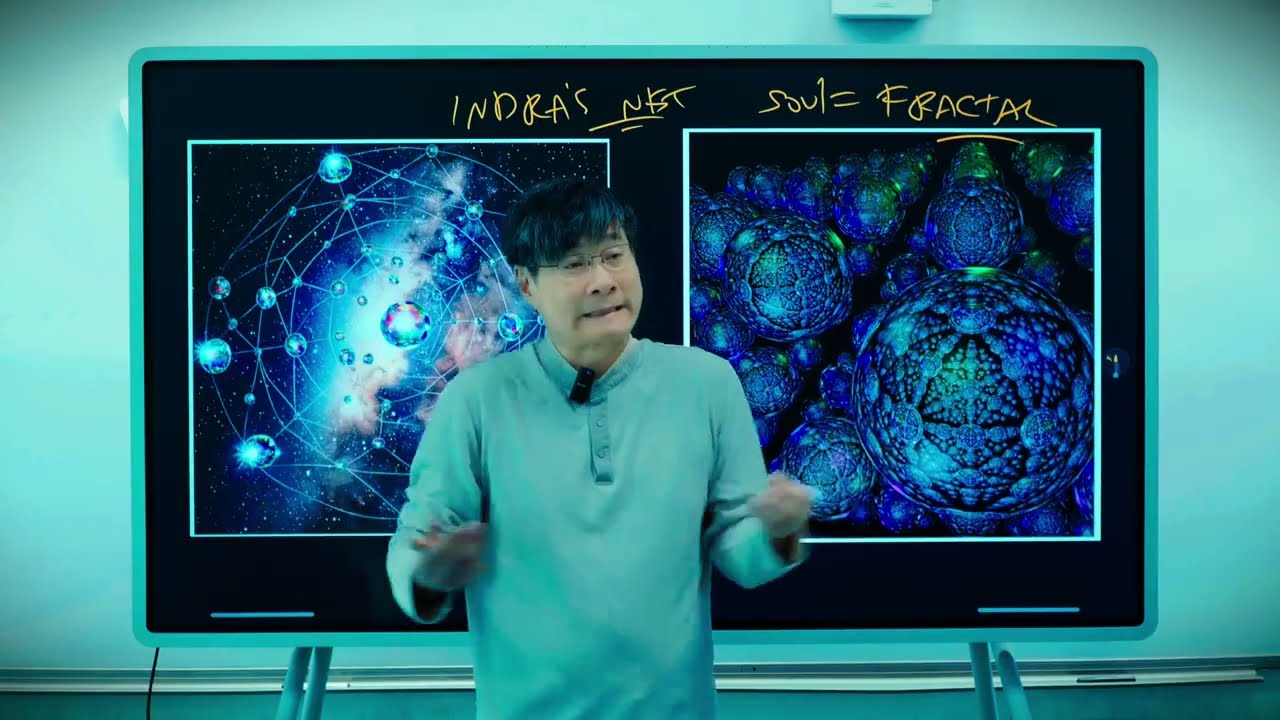
- This is visualized through the concept of Indra’s net from Hinduism and Buddhism: the universe is a net of pearls, each reflecting all others, so every soul is a fractal of the whole universe.
- If one pearl chooses to smile, every other pearl reflects that smile; if one chooses anger, the others reflect anger as well.
- This is why moral choices carry cosmic weight: the fate of the entire universe is reflected in each individual soul.
-
Virgil’s theory of love: the soul is drawn to beauty but cannot judge it
- Love is the fundamental force of the universe; the soul, created quick to love, responds to whatever pleases it as soon as beauty awakens it.
- The soul draws an image from a beautiful object, expands toward it, and tries to consume or absorb it, driven by its original purpose of returning to God.
- Because the soul is housed in a body made of dust, it becomes confused: it sees something beautiful, such as another person, and compulsively tries to possess or control it, unable to distinguish whether the object is good or evil.
- Virgil’s example is Dido in the Aeneid: Dido sees Aeneas, falls in love, tries to consume him, and when he leaves, she kills herself, driven mad by a love that cannot restrain itself.
-
Virgil’s solution: free will means obedience, not love
- Since love itself is morally neutral, like an animal’s hunger for food, goodness consists in the capacity to control emotions through reason.
- Reason is defined as obedience to authority: only by submitting to external authority can a person know right from wrong and restrain destructive impulses.
- This is the central message of the Aeneid: Aeneas begins as an emotional man who wants to fight, stay with Dido, and act on feeling, but learns to obey the gods’ mission above all else.
- At the end, when the defeated Turnus begs for mercy, Aeneas wants to show compassion but kills him instead, demonstrating that he no longer trusts his own intuition or emotions.
- Free will, for Virgil, is precisely this power to curb love through obedience; Beatrice later confirms this is what she means by free will.
-
The paradox of Statius: a Virgilian poet who reaches heaven despite not being a Christian
- Statius, a Latin poet and devoted admirer of Virgil, appears in Purgatory having cleansed himself of all sins and ready to ascend to heaven.
- This is deeply confusing to Virgil because Statius was never a public Christian; he was born before Christ was widely known and never formally converted.
- Statius explains that Virgil’s own poetry, especially the Aeneid, inspired him to become a poet and indirectly led him to Christianity: he was secretly baptized and lived as a secret Christian for centuries, punished for half-heartedness but eventually ascending.
- The key point is that Statius loved Virgil’s art but did not believe Virgil’s philosophy; he trusted his own intuition over Virgil’s teaching, and that is what saved him.
- This subtly undermines Virgil’s entire framework: if a non-Christian Virgilian can reach heaven, then Virgil’s claim that obedience to doctrine is necessary for salvation is wrong.
-
Virgil’s disappearance: why he leaves Dante without saying goodbye
- When Beatrice appears at the summit of Purgatory, Dante is overjoyed and turns to share his happiness with Virgil, only to find that Virgil has vanished without a word.
- This is paradoxical for several reasons: Virgil should be proud of Dante; Beatrice owes Virgil a favor for guiding Dante; and basic courtesy would require a farewell.
- One interpretation is that Virgil cannot bear to witness the relationship between Dante and Beatrice, which embodies everything Virgil’s philosophy rejects.
- Dante’s love for Beatrice is about giving, sharing, and bestowing: Beatrice rejected him, yet he loved her all his life and placed her in paradise through that love.
- Virgil’s love, exemplified by Aeneas and Dido, is about taking, consuming, and controlling: Aeneas used Dido and abandoned her, sending her to hell.
- Virgil would rather remain in hell for eternity than admit his worldview is wrong; his pride prevents him from acknowledging that Dante’s understanding of love surpasses his own.
-
The broader arc: Dante’s Divine Comedy as a systematic dismantling of the Virgilian-Augustinian worldview
- Throughout Purgatory, Virgil and Dante agree on many points, such as the nature of envy and the structure of love, but key paradoxes accumulate that challenge Virgil’s authority.
- Characters like Cato (a non-Christian in Purgatory) and Statius (a secret Christian in heaven) break Virgil’s rules about who can be saved and how.
- The work builds toward Paradise, where Dante will fully articulate his alternative vision: that love, creativity, and individual intuition, not obedience and hierarchy, are the path to God.
Great Books #11: Dante's Revolution
Predictive History • • 1h1 → 5 min • #152