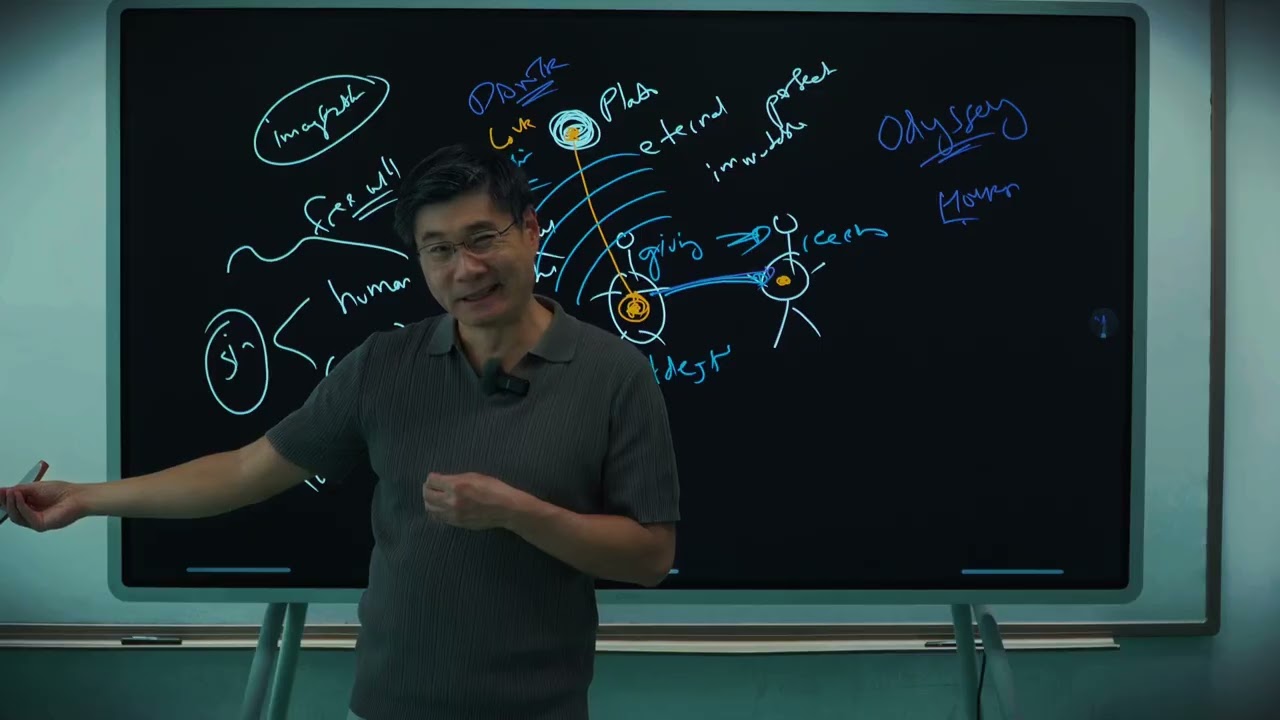
Dante’s Inferno constructs a vision of hell that is not a place of arbitrary punishment but a psychological and spiritual architecture built from the inside out — each soul is there because it has chosen, through an inability to forgive itself, to remain trapped. The episode walks through Dante’s cosmology, the logic of his hell, and the paradoxes he plants at its deepest levels to unsettle the reader’s confidence in the reality of what we’re being shown.
Dante’s cosmology: why we exist
God in Dante’s framework is the Platonic monad — eternal, perfect, and immutable — but this perfection creates a problem: a perfect being cannot imagine, create, or grow, because it already knows everything and lacks nothing.
To solve this, God creates humans, who exist across three planes — the ethereal, the spiritual, and the material — and who possess free will, the capacity to feel pain, to sin, and crucially, to imagine.
When God breathed life into humans, a divine spark entered them. That spark is love, and it carries an eternal compulsion to return to its source — God.
The way the spark returns to the source is by loving another person unconditionally. It does not require reciprocation. A mother loving a child who does not love her back still causes the spark to glow.
When the spark glows through unconditional love, the person’s understanding of the universe expands beyond the self. This expansion of imagination is the mechanism by which the universe itself expands — something God, being perfect and unable to imagine, cannot do on its own.
This framework is independently arrived at by Homer in the Odyssey: Odysseus’s love for Penelope is what allows him to conceive of the Trojan horse, and their reunion is what heals his war trauma. Dante never read Homer — he read Virgil — yet both poets converge on the same understanding of how love, imagination, and return to source work.
How sin creates hell
If love expands the imagination and moves the soul toward God (heaven), sin that goes unforgiven contracts the soul inward, trapping it in a self-made hell.
The key mechanism is not that others refuse to forgive you — it is that you refuse to forgive yourself. The sin becomes so heavy that the soul believes it is unworthy of God, and so it imprisons itself.
Space and time are constructs of imagination. A soul that commits a grave sin imagines itself into a specific place in hell and can remain there for eternity — unless, during life, it chooses to redeem itself. No one else can redeem you.
In the Iliad, Achilles traps himself in hell after causing Patroclus’s death. He mutilates Hector’s body out of guilt and self-hatred. Only when Priam forgives him can Achilles begin to forgive himself and restore his own soul.
The structure of hell
Hell is organized in descending circles, with the severity of punishment increasing as you go deeper. The principle is not just personal sin but how far the sin pushes others away from God.
The deeper the circle, the more people the sinner traps in hell and the longer they remain trapped. The worst sin is treachery, because it destroys the bonds of trust that make love possible.
Limbo (first circle): The mildest realm. Virtuous people who were born before Christ and therefore had no knowledge of God. They did nothing wrong but were never baptized. Julius Caesar is here. It is described as pleasant but eternal — people live forever in a kind of earthly existence.
Lust (second circle): Sinners like Dido and Cleopatra are swept forever in a whirlwind. The punishment mirrors the sin — they were swept away by their passions in life, so they are swept by wind in death.
Gluttony (third circle): The overindulgent are subjected to ceaseless cold rain. The punishment reflects the insatiable desire that defined their lives — they can never stop consuming, and now they can never stop being rained upon.
Violence, fraud, and treachery (lower circles): As the circles descend, the sins move from self-destructive to other-destructive. Violence harms others directly. Fraud and deception reduce other people’s capacity to trust and love, spreading like a virus that diminishes everyone’s connection to God.
Every punishment is designed to force self-reflection, but no soul is compelled to reform. Free will governs even in hell — people remain because they believe they deserve to be there.
The worst sin: treachery and the story of Count Ugolino
Treachery is the gravest sin because it destroys bonds formed by free will and trust, which are the very structures that enable love. Dante distinguishes four types of treachery, each worse than the last:
Betrayal of family — the least severe, because family bonds are involuntary; you are born into them.
Betrayal of guests and friends — the most severe, because these bonds are chosen freely and built on trust. Destroying them destroys a person’s capacity to love anyone.
Count Ugolino, a real historical figure and political leader of Pisa, is Dante’s central example. Ugolino spent his life betraying others in pursuit of power. Eventually he was betrayed by an Archbishop, who imprisoned him and his four sons in a tower and threw away the key, leaving them to starve.
As starvation set in, Ugolino’s sons offered themselves to him to eat — a final act of love. But Ugolino, having spent his life in betrayal, could not recognize love when he saw it. He ate his sons. This is a metaphor for what betrayal does: it cannibalizes the souls of everyone around you.
In hell, Ugolino is frozen in a lake (representing immutability and the incapacity to change) and eternally bites the head of the Archbishop. But the real source of his torment is self-hatred — he knows it was his own pursuit of power that condemned his children, not the Archbishop. This mirrors Achilles mutilating Hector’s body while the real wound is the loss of Patroclus.
The bottom of hell: Satan and a paradox
At the very center of hell is Satan (Lucifer), but he is not a ruler — he is a machine. He has no ideas, no words, no free will, no agency. He has three heads, each chewing a traitor for eternity. He flaps his wings mechanically, creating the wind that freezes the lake. He is what a soul becomes when it fully removes itself from God: organic life reduced to mechanism.
The three figures being chewed are Judas Iscariot (who betrayed Jesus), Brutus, and Cassius (who betrayed Julius Caesar). Judas’s presence makes sense, but Brutus and Cassius create a paradox: if betraying Caesar is as bad as betraying Jesus, then Caesar must be equivalent to God — but Caesar is in limbo, not heaven.
This paradox suggests that the reality Dante is seeing may not be what it appears. The one who would have motive to place Brutus and Cassius in hell is Virgil, whose patron was Augustus Caesar, Julius Caesar’s adopted son, who deified Caesar. Virgil is the one navigating and negotiating through hell — not Satan, who has no agency. This raises the possibility that Virgil, not Lucifer, is the true master of what Dante is being shown.
The transition to purgatory: Cato and more paradoxes
After climbing past Satan, Dante and Virgil emerge on the shores of Purgatory, which is a mountain they must climb to reach heaven. The guardian of Purgatory is Cato, who presents another set of paradoxes:
Cato was born before Jesus, which should limit him to limbo at best — yet he is in Purgatory and is its guardian.
Cato killed himself, which is a sin that should place him in hell — yet he is in Purgatory.
Cato opposed Julius Caesar, just as Brutus and Cassius did — yet they are being chewed in Satan’s mouth while Cato guards the gateway to salvation.
When Cato questions how Dante and Virgil escaped hell, Virgil is unusually deferential — even afraid. He subtly reminds Cato that his wife Marcia is still in limbo, implying he could treat her well or poorly depending on Cato’s cooperation. It is almost a bribe.
Cato’s response is striking: he says that because Marcia now dwells beyond the river in hell, she no longer has the power to move him. He once loved her, but now he does not — not out of cruelty, but because he has been freed and she has not.
This illustrates a core principle: love cannot override free will. If Cato truly loved Marcia, he would let her choose for herself. He cannot force her to self-reflect or to desire redemption. She must will it on her own. Love that tries to compel is not love.
Cato instructs Virgil to cleanse Dante of hell’s stains before entering Purgatory, and tells them the sun will show them how to climb the mountain. The journey continues upward.
Dante’s method: misunderstanding as the path to understanding
Dante deliberately constructs paradoxes and contradictions throughout the Inferno to force the reader into misunderstanding first. It is through recognizing and correcting those misunderstandings that genuine understanding emerges.
The same principle applies to virtue: to become truly virtuous, one must first sin. Sin reveals limitations and creates the conditions for growth. This process — sin, recognition, self-forgiveness, expansion of imagination — is what drives the soul’s journey and, cosmologically, what drives the expansion of the universe itself.