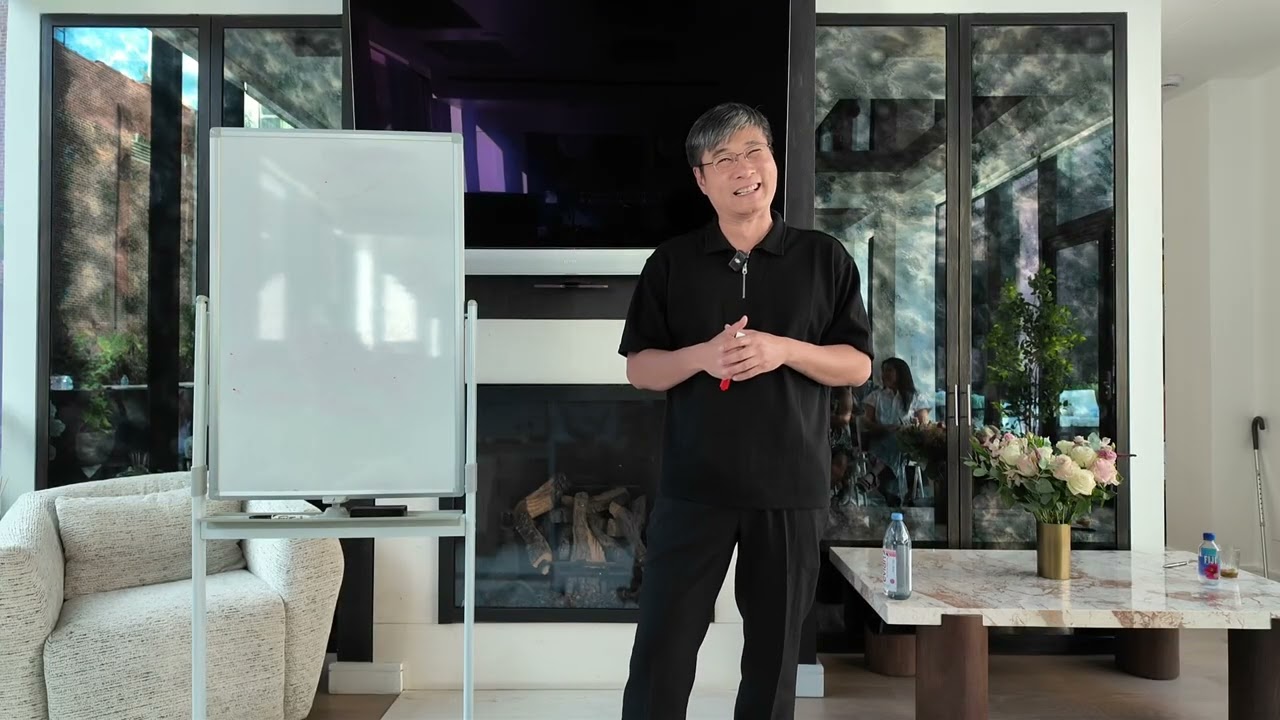
Professor Jiang delivered a lecture in New York City on August 15, 2026, arguing that the war in Iran is not a traditional geopolitical conflict but an eschatological war driven by the convergence of transnational capitalism and messianic secret societies, and that the global economic system built on the U.S. dollar reserve standard is collapsing.
The global economic structure and its fatal flaws
The world economy rests on two pillars: the GCC supplies cheap energy to East Asia, which manufactures goods for Western consumption, all mediated by the U.S. dollar as global reserve currency.
The dollar system creates three structural disasters for the United States: loss of financial independence (the Eurodollar system puts dollar creation outside U.S. control), financialization (hollowing out manufacturing for speculation, causing corruption, inequality, and debt), and Pax Americana (a $1.5 trillion military budget to guarantee maritime trade the U.S. doesn’t actually need for its own defense).
The 2008 crisis revealed the breakdown: Wall Street was bailed out while homeowners were not, creating a K-shaped economy where regulatory capture lets financial elites control policy levers.
Wealth from the military-industrial complex concentrates in Northern Virginia suburbs (Loudoun County per capita income tripled in 20 years), and financialization drives inequality because consolidated capital yields higher returns (5% in markets vs. 2% in factories), making the rich richer and the poor poorer.
The Iran war as an eschatological conflict that threatens the global economy
The U.S. strategy of “decapitation” failed; Iran proved resilient and closed the Strait of Hormuz, choking energy flows to East Asia.
The war expanded: Houthis control the Bab el-Mandeb, Hezbollah and Israel fight, Iraq is involved, and a Saudi-Turkey-Pakistan military alliance formed to counter the Houthis.
Iran realized four attack points (Hezbollah, Houthis, Hamas, Iraqi militias) can choke the entire Middle East; GCC pipeline proposals are impractical because drones can attack pipelines too.
Russia can supply Iran via the Caspian Sea; China can supply via Belt and Road railways — forcing the war to go global and link with Ukraine.
The Japanese yen carry trade ($4 trillion in liquidity) is critical: Japanese corporations borrow at 0% and buy U.S. Treasuries at 5%, providing global liquidity. If Middle East oil disruption sinks the yen, the Bank of Japan recalls liquidity, collapsing the U.S. AI/data-center bubble (50% of U.S. GDP growth).
Two simple solutions would end the war and save the U.S. economy: give Iran $2 trillion (Plaza Accord style, reversing liquidity flows) and contain Israel (embargo weapons, sanction). Neither will happen.
The core puzzle: why does the most powerful nation serve the interests of a tiny state (Israel, 9 million people) against its own survival? The answer requires an eschatological lens.
Capitalism as a series of historical accidents, not a planned system
First accident: Calvinism’s double predestination (God pre-decides heaven/hell) subverted Catholic indulgences but created anxiety — wealth became proof of election, yet Calvinism demanded saving/investing rather than spending, creating capital accumulation.
This birthed the Dutch Republic, the first middle class, and the spice monopoly, but Dutch wealth invited Habsburg invasions.
Second accident: the 1688 Glorious Revolution merged Dutch capital with English naval protection, transferring Dutch gold to the Bank of England.
Third accident: the 1694 Bank of England, a private bank guaranteed by Parliament (the nation), not the king — enabling infinite financing (England lost six of seven battles to Napoleon but won the war by printing money to bribe allies).
This model was copied in the Federal Reserve. These were unplanned responses to specific problems, not strategic designs.
Philosophical contradictions engineered to justify transnational capital
Democracy and private property are structurally contradictory: democracy means rule by the people (who could vote to redistribute), but private property is framed as an inalienable God-given right. The contradiction resolves by telling people “you choose to respect property.”
Reason and emotion were artificially separated: historically they were unified (heart-mind in China, Greek gods as emotions). The split serves capital — “reason” means capital’s free movement; “emotion” means family, tradition, nation, community — anything obstructing capital is labeled irrational prejudice.
Public philosophy (empiricism, skepticism, utilitarianism — Hume, Bentham, Locke) justifies the system openly; the secret management layer is Freemasonry, the “religion of reason” (holy empire of capital).
Freemasonry reorients human cognition: historically status came from community/lineage; now it comes from money. It organizes capitalism secretly because democracy is a facade for banker rule.
Secret societies as the coordination mechanism for transnational capital
Transnational capital requires solving three problems: information (speed), infiltration (agents in key positions), coordination (cross-border action). The Rothschilds’ 1815 Waterloo coup (knowing the result three days early via fast ship) exemplifies this.
Three transnational forces converged: Freemasons, Jesuits, Jewish diaspora → the Illuminati. Not a monolithic conspiracy but a convergence point where pro-capital factions from each group coordinate secretly.
Game theory: aligning with transnational capital wins; opposing it loses (monarchy, Catholic Church, community withered). Secret societies provide career advancement, investment access, elite university admission for members’ children.
Continuity is not institutional (Templars → Freemasons → Skull and Bones) but functional: secret societies form around charismatic leaders, decay through arrogance, and are replaced. The most durable are eschatological — they span centuries via script, scale via shared mission, and energize participants (jihad-like fervor).
Cabala theology and its literalist messianic factions
Cabala: God is the will to bestow; creates Adam Kadmon (cosmic man) as will to receive. Adam Kadmon rejects God’s gift from ego, breaking the universe. Purpose: spiritual alchemy to re-enable receiving God’s gift.
Radical factions read this literally through the Bible: Jews must return to Israel, build the Third Temple, triggering the Gog-Magog war. When Jews are most desperate, God saves them — “opening the heart” means repentance. This is the script driving Middle East events.
The Cabala unleashes sexual energy: reunion with God is a sexual union. Peter Hegseth’s press conferences resemble orgasm — these actors experience the end-times as ecstatic.
Why force it? Waiting for everyone to open their hearts voluntarily is “too goddamn slow.” Creating catastrophic conditions forces universal repentance. Fanatics willing to sacrifice (martyrdom, $30M to unseat one Congressman) outcompete rational actors.
China as a parallel system hollowed out by transnational capital
China uses families, not secret societies — tighter, but limited to ethnic networks and non-eschatological (political, not spiritual).
Transnational capital colonized China in the 1980s-90s: built factories to extract demographic energy, then funded infrastructure spending (highways, skyscrapers) via 2008 BIS agreement to strengthen the yuan for resource imports. This created the same corruption, inequality, and debt.
China is now exhausted; capital is shifting to the Middle East (Pax Judaica). China will likely be embargoed, turtle up, and face urban-rural famine dynamics like the Great Leap Forward.
The alliance of transnational capital and messianic secret societies
Capital has no intrinsic value — it extracts human energy, attention, consciousness. Wealth creation requires simultaneous wealth destruction; war and revolution are the most efficient destroyers.
The U.S. is overcapitalized (moral/social/political decay, no domestic returns). War in the Middle East creates the best investment opportunity: destroy, then rebuild (New York subway analogy — burn it down, then invest in the new one).
Capital moves to “virgin territory” anchored by Pax Judaica: Israel, Argentina, Australia, Ukraine, Mediterranean. U.S. collapse → civil war → destruction → new investment cycle.
Capitalism requires constant destruction/revolution/war; without them, it cannot function. Messianic fanatics (Cabala) and capitalists are mutually useful: both are “crazy” in complementary ways.
AI as the fulfillment of the “holy empire of reason”
AI extends the Freemason project: frictionless movement of goods, people, ideas. Humans (with emotions/biases) are the constraint. AI/Neuralink aims to synchronize consciousness, wipe out prejudice, achieve “godhood” via collective reason.
Whatever stops AI’s advance is “antichrist” in this framework (Peter Thiel’s usage). AI is not a revolution but capital’s logical culmination.
Q&A highlights: collapse, survival, and meaning
China’s future: No secret society equivalence; families dominate but are non-eschatological. China hollowed out by capital; will likely close borders, face urban famine, and stagnate. Xi’s longevity underestimated — leaders with “steel determination” and advanced medical access live longer than expected.
Dollar future: No one wants reserve currency status (loss of control, financialization, military burden). Default outcome: a basket system, but more likely total plumbing breakdown where currency becomes irrelevant because nations can’t trade.
Bronze Age collapse analogy: 8 billion people depend on cheap Middle East energy/fertilizer. Remove GCC → famine in Africa, revolution in Europe, mass migration, war. Interconnection creates fragility, not resilience. Most will die not from hunger but psychological inability to accept collapse.
National draft: Not necessarily military — economic collapse (AI bubble burst, wealth evaporation) creates desperation; a national works program becomes the only option. Young people now have parental cushions; when those vanish, compliance follows.
Personal path: Professor Jiang’s path is teaching — discovered by noticing what flows smoothly vs. what resists. Trusting the universe: if he got into the U.S., it was meant; if not, also meant.
Imagination and the Monad: Real wealth is attention/imagination (social media captures it for free). Imagination comes from the Monad (universal consciousness); evil is a human construct to explain suffering. Free will is the Monad’s gift — we chose this materialistic world; we can choose another.
Artists as prophets: Role is to reveal truth, give hope, show new possibilities. Historically all artists were prophets; now they’re in Brooklyn drinking matcha.
Parenting: The child belongs to God, not the parent. Trust the child’s telos; control creates mutual unhappiness. His 8-year-old doesn’t speak English because he hasn’t asked to learn.
Compromise: Jiang refused all compromise (UN job in Afghanistan — couldn’t sleep knowing locals starved while he earned six figures facilitating opium/fentanyl supply chains). Suffering is preferable to self-betrayal.
Plato’s Cave awakening: The hellish process (weeping, brain reconfiguring) is spiritual alchemy / semantic reconnection. Once through, you never go back. Sympathy for those not ready — they’ll awaken in a later incarnation.
Great books: Dostoevsky (Karamazov, Crime and Punishment), Tolstoy (Anna Karenina), Raymond Carver (Cathedral). Start with what you enjoy; read an hour daily.
Teaching: The three most powerful words: “I am wrong.” Models self-reflection, humility, self-forgiveness — gives students permission to learn from mistakes.
Spreading faith: Don’t convince; live the truth. Others gravitate naturally.
Positive view of the present: Crisis forces deep questioning — awakening the dormant soul. This room represents heads emerging from sand. Collective truth-seeking builds the solution.