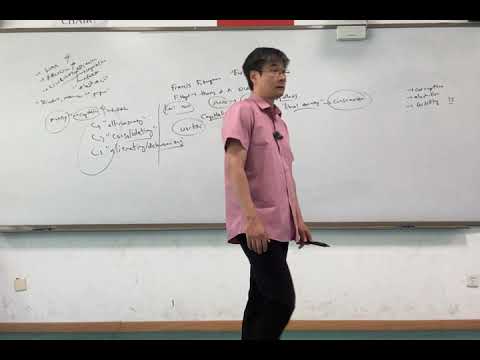
In a May 31, 2024 class, Jiang Xueqin analyzes Vladimir Putin’s speech calling on all of Russian society to prepare for “Total War,” arguing that Putin’s true aim is not primarily military conquest or defense against NATO, but the radical moral and spiritual transformation of Russian society through war as a disciplining mechanism. Jiang frames this as a civilizational project rooted in Russia’s unique philosophical and historical identity, and introduces the concept of “putinism” — continuous war as a tool to unify, purify, and rejuvenate a nation he sees as corrupted by Western consumerism.
The Crisis in Russian Society
Russia faces severe internal decay that Putin views as existential:
Corruption: Russia is the most corrupt society in Europe; elites steal wealth and flee to the West.
Economic weakness: Russia’s GDP is lower than South Korea’s (despite having three times the population) and even lower than the state of Texas.
Alcoholism: About 16–17% of Russian males are alcoholics; one in three deaths is alcohol-related, and male mortality is rising.
Demographic collapse: The fertility rate is 1.5, well below the replacement level of 2.1; population has been declining since 2000.
If these trends continue, Putin believes Russia will cease to exist as a nation.
Putin’s Diagnosis: Western Civilization as the Cause
Putin rejects the liberal democratic explanation that Russia’s problems stem from lack of democracy.
Instead, he argues that Western civilization — with its gospel of liberal democracy, human rights, freedom, and consumerism — has deceived and corrupted the Russian soul.
Russians have abandoned their own civilization and identity in pursuit of Western values, which Putin sees as hypocritical lies that destroy nations from within.
This corruption manifests as alcoholism, low fertility, and moral decay — symptoms of a people who have lost their civilizational anchor.
The Philosophical Framework: Fukuyama, Hegel, and the Dialectic
Jiang explains the intellectual backdrop through Francis Fukuyama’s “The End of History” thesis:
Fukuyama used Hegel’s dialectic (thesis → antithesis → synthesis) to argue that history progresses through competing ideas.
Capitalism (thesis) led to industrialization but was too extreme, producing communism (antithesis), which was also too extreme.
The synthesis is liberal democracy, with consumerism at its core — the idea that people exist to buy things, and trade replaces war.
Fukuyama claimed this system represents the final, optimal form of human governance — the “end of history.”
The Problem with Capitalism and Consumerism
Jiang outlines the historical problem of how societies optimize workforce participation, traditionally answered by war, religion, and civilization — all of which provide structure, meaning, and purpose but create suffering, superstition, or racism/imperialism.
Over time, these motivators became more abstract to scale to mass societies (e.g., polytheism → monotheism; barter → money).
Capitalism replaced war/religion/civilization as society’s organizing principle, but it has critical flaws:
It is all-consuming, prioritizing profit growth over societal or planetary well-being.
It consolidates wealth — money naturally concentrates in fewer hands.
It alienates and dehumanizes people, reducing them to their productive output and bank balance.
Marx identified these problems and proposed making the worker the center of society instead of capital.
From Worker to Consumer: The Neoliberal Revolution
After World War II, industrial societies adopted socialist-inspired policies that made the worker the organizing unit:
Strong unions, excellent public services, affordable universities, and robust healthcare characterized the 1950s–70s.
CEO pay was roughly 20 times the average worker’s salary.
In the 1980s, the “Revolt of the Elite” (Reaganism in the US, Thatcherism in Britain) dismantled this model:
The elite rejected egalitarianism and re-centered society around capital.
CEO pay exploded to 200–300 times the average worker’s salary.
The consumer replaced the worker as the central social unit: government shifted from promising good jobs to promising low prices and abundant goods.
Consumerism is subtly but profoundly different from worker identity:
Workers develop political consciousness — they organize, demand reforms, and act in solidarity.
Consumers are individualized and competitive — they compare purchases, post on social media, go into debt, and resent each other.
Consumers apply economic logic to all decisions (e.g., evaluating a potential partner by wealth), making them unable to organize or rebel.
Jiang calls consumerism the “perfection of slavery” — people willingly choose their bondage and never rebel, which is why Fukuyama saw it as the end of history.
Russia’s Intrinsic Rebellion Against Slavery
Putin’s argument, as Jiang presents it, is that Russian civilization instinctively rebels against slavery — but because consumerism is a “perfect” system of control, Russians don’t know how to rebel consciously.
Instead, they rebel passively: through corruption, alcoholism, and refusing to have children.
Putin sees himself as the leader who will free his people even if they enjoy their prison, by replacing consumerism with a new organizing concept: the warrior.
The Warrior vs. The Consumer
The consumer acts alone, avoids risk, preserves life, and lacks imagination.
The warrior believes through courage and collective action he can shape history; he finds meaning in struggle and solidarity.
Jiang illustrates this with a thought experiment:
People given a million dollars become competitive, indebted, and hateful.
The same people stranded on an island facing flesh-eating monkeys immediately unite, fight together, find purpose, and even celebrate death as meaningful sacrifice.
War gives society structure, meaning, and purpose — it makes people happier, more unified, and more disciplined.
Evidence That War Is “Working” for Russia
Since the 2022 invasion of Ukraine, Russia has shown signs of societal improvement:
The economy is surviving and even strengthening under sanctions.
Russia produces 150,000 ammunition shells per month — far outpacing the United States.
Full employment in war industries means less drinking, less corruption, and potentially rising fertility.
Putin has stated that soldiers who die in battle are honored as heroes, whereas those left to themselves “drink themselves to death.”
War, for Putin, is a rejuvenation mechanism — like going to the gym to cut fat and get lean.
Putinism: Continuous War as Ideology
Jiang introduces “putinism” as a new ideology that will challenge liberal democracy:
The idea is that society should engage in continuous, small-scale wars to discipline, unify, and strengthen the nation.
War is no longer primarily about conquering others (imperialism) but about transforming oneself — like exercise for the body politic.
Putinism is a direct response to the perceived spiritual emptiness of consumerism and liberal democracy.
This ideology could spread to other nations with warrior cultures (Japan, Germany, Britain), leading to a multipolar world where regional hegemons each maintain themselves through continuous conflict.
Contradictions and Risks of Putinism
Nuclear escalation: Large-scale wars are too dangerous in the nuclear age, so putinism depends on small, contained conflicts (like Ukraine). A war against France or Britain could trigger nuclear war.
Pyramid scheme dynamic: War is expensive; Nazi Germany had to keep conquering to fund its wars. Russia may face the same trap — exhausting itself and needing further conquests for resources.
Succession crisis: Warrior cultures need a king. Putin is a strategic genius who unites Russia, but when he dies, rival generals will likely fight for control, potentially leading to civil war. Russia may not survive beyond Putin, even if putinism as an idea endures.
Civilizational differences: Not all societies are warrior cultures. China, for example, is not — it was historically dominant, protected by natural barriers, and finds war exhausting. Russia, by contrast, has been invaded repeatedly (e.g., 1941 German invasion killed 20 million) and has developed a culture that can be energized rather than destroyed by war.
Putinism vs. Slavery
A student asks whether putinism is just another form of slavery at a larger scale.
Jiang argues it is actually anti-slavery in a crucial way: warriors can rebel and mutiny — they can march on Moscow and overthrow a leader. Consumers never rebel (no one stops buying things for moral reasons). This is precisely why warrior cultures were dominant historically and why elites eventually replaced them with consumerism — warrior culture is a direct threat to political leaders.
Popular Support and the Dynamics of War
Most Russians (likely 90% or more) do not want war — they want peace and safety for their children.
But history is determined by the most determined and organized minorities, not by majority preference (analogous to how small, organized factions like AIPAC shape US policy).
War itself unifies societies: even populations initially divided (like Ukraine, where half the population were Russian speakers and a third were sympathetic to Russia) rally together when attacked.
The Deeper Civilizational Stakes
Putin sees Russia first and foremost as a great civilization that must fight wars to defend itself.
He frames the Ukraine war as a response to NATO encroachment — NATO expanded five times after the Soviet collapse and was moving into Ukraine, threatening Russian civilization.
The defense of civilization justifies war, and this process is what creates putinism.
Looking Ahead
Next class will examine Putin’s strategic genius and how the Russian worldview differs fundamentally from the Western one.
Jiang will also discuss what a US war in Iran would require: American retreat to its borders and a turn toward isolationism.