-
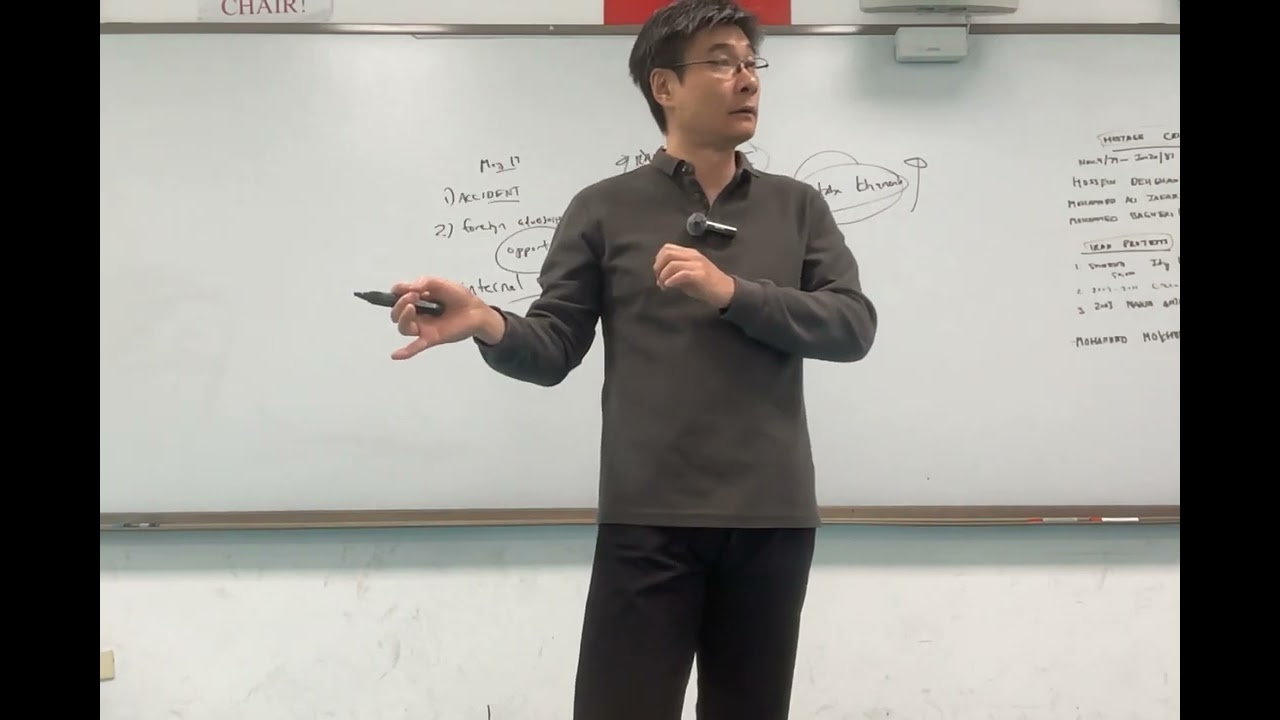
On May 19, 2024, Iranian President Ebrahim Raisi died in a helicopter crash in foggy conditions while returning from a dam opening ceremony in Azerbaijan, killing all nine people on board including the president, the foreign minister, and senior security officials. The official explanation is an accident caused by bad weather and an aging American-made helicopter that Iran could not properly maintain after the 1979 revolution. However, using game theory analysis, the class examines whether the crash could have been an assassination, and if so, who had the motive and opportunity to carry it out.
-
The three analytical problems in assessing the event
- Very little reliable information is available, since the Iranian government controls what is disclosed
- Some of the available information may be false or misleading
- The official narrative (accident) may not be true but is the one most people accept
-
The accident theory is the most probable explanation
- Helicopter crashes happen frequently; the 2020 crash that killed Kobe Bryant and his daughter is cited as an example
- The helicopter was an old American model from the 1970s that Iran could not maintain after the revolution due to the cutoff of US cooperation
- Bad weather and fog likely caused the pilot to crash into a mountain
- This is the explanation most likely to go down in history
-
The foreign adversary theory (US, Israel, or Azerbaijan) is considered unlikely
- Opportunity is a major problem: it is very difficult for a foreign government to plan an assassination of an Iranian leader inside Iran
- Motive is also unclear: the US and Israel have killed Iranians before (General Soleimani in 2020, nuclear scientists, generals in Damascus in April 2024) but each time there was a clear strategic threat justifying the action; Raisi did not pose a comparable direct threat
- The risk of killing a sitting president without clear motive makes this theory weak, though it cannot be entirely ruled out
-
The internal enemy theory is considered the most compelling alternative
- Opportunity exists: Raisi was traveling in a convoy of three helicopters, and only his helicopter crashed; the other two, likely carrying military escort, were fine, meaning those close to him had the means to cause an accident
- The key motive centers on the succession to Supreme Leader Ayatollah Khamenei, who is 85 and expected to die within the next few years; Raisi, at 63, was widely seen as Khamenei’s chosen successor and the most likely next Supreme Leader
-
The Islamic Revolutionary Guard Corps (IRGC) is identified as the group with the most to gain from Raisi’s death
- The IRGC was founded in 1979 by Ayatollah Khomeini because he distrusted the regular army, which had sworn allegiance to the Shah; the IRGC’s mission is to protect the Islamic Republic and export the revolution, not to defend the nation in a conventional sense
- During the Iran-Iraq War (1980-1988), the IRGC proved its loyalty and effectiveness by organizing the Basij, a volunteer army of poor religious villagers who were given rifles and plastic keys symbolizing entry into heaven, and who ran across Iraqi minefields in human wave attacks that exhausted Iraqi forces
- Because of this war record, the IRGC gained enormous power and today controls an estimated 10-50% of the Iranian economy, including the navy (and thus the Strait of Hormuz and smuggling routes), the missile program, and all foreign policy through the “Axis of Resistance” (Hamas, Hezbollah, Houthis, Shia militias in Iraq, and the Assad regime in Syria)
- This monopoly of power has led to economic stagnation and repeated protests (1999 student protests, 2009 Green Movement, 2022 Mahsa Amini protests), but the IRGC has become more powerful precisely because it is seen as the most loyal enforcer of the regime
-
Why the IRGC would want Raisi dead
- If Raisi became Supreme Leader, he would likely reduce the IRGC’s power and establish his own power base, just as Khamenei did when he succeeded Khomeini in 1989
- If Khamenei’s son Mojtaba Khamenei becomes Supreme Leader instead, the IRGC’s position remains secure because Mojtaba is extremely unpopular and would depend entirely on the IRGC to maintain power, making him loyal and obedient to their interests
- Mojtaba’s ascension would also create a political legitimacy crisis because Iranians oppose hereditary leadership (the 1979 revolution was against the Shah’s monarchy), but this crisis would actually benefit the IRGC by making the regime even more dependent on them
- Raisi was seen as an obstacle because he and other politicians had been urging restraint and patience in responding to provocations (after Soleimani’s assassination in 2020 and the Israeli strike on the Iranian Embassy in Damascus on April 1, 2024), while the IRGC wanted escalation and vengeance
-
The ideological character of the IRGC leadership
- Many top IRGC leaders are former participants in the 1979 US Embassy hostage crisis, including Hossein Dagghan (Defense Minister 2013-2017), Mohammad Ali Jafari (IRGC commander 2007-2019), and Mohammad Bagheri (current chief of staff of the Iranian military)
- These individuals spent months reassembling shredded US Embassy documents, which revealed that the US Embassy, not the Shah’s palace, was the true center of power in Iran, and that the US had orchestrated the 1953 coup against Iran’s democratically elected government
- This experience created a deep hatred of America, which they view as the “Great Satan,” and a desire for war to avenge historical wrongs
- The IRGC is supported by tens of millions of Basij volunteers, poor and religious, who can be mobilized for human wave tactics
-
The internal debate within Iran
- There are Iranians and politicians who question why Iran is spending resources on conflicts across the Middle East when the economy is suffering; they argue that withdrawing from regional conflicts and focusing on economic development would reduce the threat from the US, Israel, and Saudi Arabia
- The IRGC views such politicians as cowards, weak, and not true believers, and sees them as obstacles to their revolutionary mission
-
What to expect if the IRGC did orchestrate the assassination
- A new presidential election in late June 2024 will likely be won by current vice president Mohammad Mokhber, who comes from the IRGC (unlike Raisi, who came from the judiciary), advancing IRGC interests
- Rhetoric will become more extreme, preparing the population for total war and an eventual American invasion
- There will be harsher crackdowns on political dissent
- The IRGC cannot defeat the US in open combat (US satellite surveillance and special forces make that suicidal), so their strategy is to provoke the US into invading Iran, where Iran would have the advantage
- Provocations may include: accelerating the nuclear program, encouraging proxies (Hezbollah, Hamas, Houthis, Shia militias) to attack Israel, the US, and Saudi Arabia, attacking shipping lanes, and launching terror campaigns globally
- The professor emphasizes that observing these developments does not prove the IRGC killed Raisi, but if the IRGC did kill him, these are the outcomes that should be expected
-
Broader implications
- Any new Iranian leader would likely see the IRGC as a problem because of their fanaticism, their monopolization of the economy, and the regional tensions they create
- The IRGC’s preferred outcome is Mojtaba Khamenei as Supreme Leader, which preserves their power monopoly
- The professor notes that in a future war with the US, Iran would not win but would inflict massive suffering, with tens of millions of Iranians potentially dying, which is why politicians like Raisi advocated restraint
- The next class will examine what an actual war between the US and Iran would look like
Geo-Strategy #7: Who Killed Iranian President Ebrahim Raisi?
Predictive History • • 49min → 5 min • #8