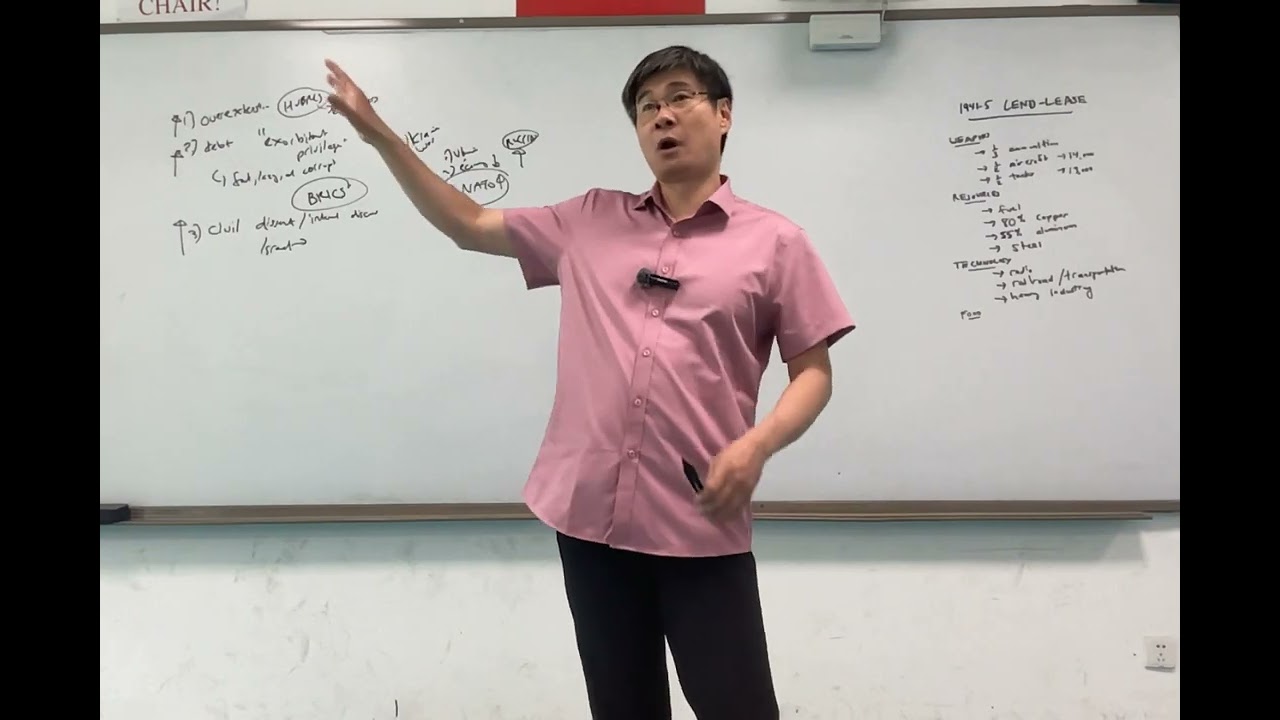
Jiang Xueqin’s June 5, 2024 class analyzes Vladimir Putin’s long-term strategy to destroy the American Empire by exploiting three historical causes of imperial collapse—overextension, debt, and civil discord—drawing on game theory, World War II history, and a comparison of Russian and Western strategic thinking.
How empires die
Empires collapse when three conditions occur simultaneously:
Overextension: Fighting too many wars at once, driven by hubris—a blindness to one’s own limitations and the strategies of opponents; Jiang argues the US is currently antagonizing Russia, Iran, and China at the same time while preparing for a potential Taiwan conflict.
Debt: The US dollar’s reserve currency status (the “exorbitant privilege” established at Bretton Woods in 1945) allows America to print money rather than make it, but this is unsustainable; BRICS+ (now including Saudi Arabia and the UAE, key petrodollar nations) is building an alternative financial system, and if these countries exit the US system, America’s $35 trillion debt becomes unpayable.
Civil discord: A nation falls apart when people no longer believe in its binding myths; Jiang points to growing US political polarization, the Gaza war turning young Americans against the idea of American goodness, and a statistic that one quarter of young Americans now view Osama bin Laden positively.
Putin’s strategy in Ukraine
When Putin invaded Ukraine in February 2022, the US expected three outcomes: Ukraine would defeat Russia, sanctions would collapse the Russian economy, and NATO would become more united—all three predictions proved wrong.
Russia is winning through attrition; Ukraine has lost an estimated 500,000 men and cannot sustain the fight.
The Russian economy has grown stronger because the world needs Russian oil and food; countries have made side deals with Russia, and its manufacturing base has expanded under a war economy.
NATO has become more divided, especially Germany, whose manufacturing economy depends on cheap Russian gas; the US blew up the Nord Stream pipeline and is waging a trade war with China, Germany’s key export market, angering Germans.
The war has exposed American overextension: the US is not manufacturing new weapons but redirecting existing stockpiles from Japan, South Korea, and elsewhere to Ukraine.
The war is generating civil discord in America, where most citizens oppose sending hundreds of billions to Ukraine while Americans lack health insurance.
The Hamas attack and Middle East escalation
The October 7, 2024 Hamas attack on Israel and Israel’s response in Gaza have advanced Putin’s goals by:
Diminishing American prestige globally, as the US is seen as enabling genocide; college protests will expand.
Demonstrating that the US cannot control Israel—many now say Israel controls America.
Creating a Middle East powder keg where Iran or Hezbollah could enter the war at any moment, further overextending the US.
Jiang suggests Putin may have known about or encouraged the attack, as Putin is the clear winner and America the clear loser.
Future geopolitical predictions
If Putin’s goal is to destroy the American Empire, several developments are expected over the next three to four years:
Ukraine war drags on without expansion: Putin will not seek peace or attack Poland; keeping the war at its current level turns Ukraine into a black hole that drains NATO money and creates friction between the US and Europe, especially Germany.
Iran provokes a wider war: Putin will offer Iran a nuclear umbrella guarantee, emboldening Iran to attack Israel, expand its nuclear program, or disrupt Red Sea shipping, provoking a full-scale US invasion that further overextends America.
North Korea becomes belligerent: With Russian assurances of protection, North Korea will threaten South Korea, forcing the US to divert resources and possibly bribe North Korea; the 30,000 US troops in South Korea make this a credible distraction.
BRICS+ expands: The alliance will likely announce a new currency or trading system; it does not need to replace the dollar—only threaten confidence in it, since finance runs on confidence.
Russia-China relationship deepens: Putin will maintain close ties with Xi Jinping; Russia does not need China to act against the US, only to remain neutral, preventing the US from triangulating against Russia.
Why the US would want China’s help
The US has strong incentives to ally with China against Russia:
To reduce overextension by securing peace in East Asia and eliminating the Taiwan threat.
China is a major buyer of US dollars and US debt; losing Chinese purchases would make America’s debt unsustainable.
Historically, Russia and China have more geopolitical conflicts with each other than China has with the US, including border wars; a US-China alliance would force Putin onto the defensive along the Russia-China border.
China is already moving away from the dollar, converting holdings into gold and encouraging others to do the same.
Why China aligns with Russia despite tensions
China’s policy makers recognize their situation is dire: the economy has collapsed, demographics have collapsed, and China is completely dependent on imported oil and food.
The US is waging an economic war against China and surrounds it with military bases; an American embargo would cause China to collapse.
China needs new trade routes and a reliable partner for energy and food—Russia is the only viable option, making the Russia-China alliance one of necessity rather than natural alignment.
America’s Taiwan strategy
The US claims China will invade Taiwan to justify defense spending for the military-industrial complex, but there is no evidence of this.
The current US-China relationship is mutually beneficial: China sends cheap goods to America, and the US sends dollars that the Chinese Communist Party stores in American banks—a deal that serves both Wall Street and the CCP.
Even if China took over Taiwan, America would lose little; the semiconductor industry can be relocated. The issue is about saving face, driven by imperial hubris.
Stalin’s strategic brilliance in World War II
Jiang uses Stalin’s actions in World War II to illustrate the Russian strategic imagination, arguing that Stalin was a genius who deliberately engineered the best possible outcome from a losing position.
In 1939, six global powers existed: the Soviet Union, Japan, the US, Britain, Germany, and France. Game theory suggests the Soviet Union should have been the target of a coalition of all other powers because it was resource-rich but militarily weak, and communism threatened every other nation.
Instead, Stalin signed the Molotov-Ribbentrop Pact with Germany, partitioning Poland and supplying Germany with resources, ensuring that when Hitler invaded Poland, Britain and France declared war on Germany but not the Soviet Union.
Operation Barbarossa and game theory analysis
When Hitler invaded the Soviet Union in June 1941 (Operation Barbarossa), conventional history calls it a grave strategic blunder by Stalin, who ignored intelligence, purged his generals, refused to defend the border, and naively trusted Hitler.
Jiang argues the opposite using game theory, analyzing four scenarios:
A: Soviets attack first and reach Berlin—the entire world unites against the Soviet Union; the Soviets lose.
B: Soviets attack but are stopped at the border—Japan still invades, Britain negotiates with Germany; the Soviets do not win.
C: Germans attack and are stopped at the border—Germany and the Soviet Union destroy each other; the US and Britain benefit.
D: Germans attack and nearly destroy Moscow—this is what happened, and it was the best outcome for the Soviet Union.
In scenario D, the US and Britain were forced to save the Soviet Union to prevent Germany from capturing Soviet resources and becoming invincible; through Lend-Lease, America gave the Soviet Union $200 billion (in today’s dollars) in weapons, resources, technology, and food—essentially industrializing the Soviet Union for free.
Lend-Lease provided one-third of all ammunition, one-third of all explosives, half of all aircraft (14,000 planes), half of all tanks (13,000), 80% of copper, 55% of aluminum and steel, plus radio technology, railroad transportation, and heavy industry.
The German invasion also gave Stalin national unity through the Great Patriotic War; the Soviet Union lost 26 million people, which forged an unbreakable will to fight.
The result: instead of the world uniting against the Soviet Union in 1939, the world united against Nazi Germany and handed the Soviet Union the technology, money, and resources to become a global superpower, which then enabled the communist victory in China.
The Russian strategic imagination
Three qualities define Russian strategic thinking, as exemplified by Stalin and Putin:
Intuition: The ability to read the political winds and sense the mood of the world (the German concept of Zeitgeist); Putin senses the American Empire is dying and feels emboldened to act.
Imagination: The ability to predict how actions will change future conditions—to see several moves ahead.
Multiple personalities: The ability to embody different personas simultaneously, making Russian leaders unpredictable; Stalin appeared as a trusting “sheep” to Hitler while being a strategic “wolf,” convincing Hitler to invade by saying “I trust you”—the one thing Hitler, who trusted no one, could not resist.
Stalin could only execute this strategy by genuinely being multiple people at once, not merely pretending.
Western vs. Russian philosophy
The differences between Russian and Western strategic thinking stem from deeper philosophical traditions, with the West inheriting British thinking:
Narrow vs. broad: Britain is an island and thinks narrowly; Russia is the world’s largest country and thinks broadly. Russian literature (Tolstoy’s War and Peace) is epic and sweeping, while British literature (Jane Austen, Thomas Hardy) is narrow in focus.
Empiricism vs. mysticism: British philosophy (David Hume) holds that we can only know what we experience, limiting imagination; Russians believe in mysticism—forces beyond understanding, prophets sent by God—allowing for greater imaginative leaps.
Logic vs. intuition: The British demand logical, step-by-step reasoning; Russians allow intuitive jumps that do not follow linear logic.
These three British traits—narrow, empirical, logical—create bureaucratic thinking that dominates Western academia and prevents great strategic leaders from emerging; no one like Putin or Stalin could arise in the American or British system because their ideas would be dismissed as crazy for lacking evidence and logic.
The Russian system can produce great leaders when the right person arises, but is weak without them; the British system does not need great leaders but cannot produce them.
The Greeks were more like the Russians in valuing intuition and imagination; the West actually inherited its thinking more from the Romans than the Greeks, meaning we live in a Roman world rather than a Greek one.
Russia’s main cultural influence is Christianity, which Russians view as a purer, more ancient form of the faith—pre-Augustine Christianity—with Greek elements absorbed through the Christian tradition.