On March 3, 2026, Professor Jiang delivers a lecture analyzing the US-Iran War, which began on February 28, 2026, when the United States and Israel launched a decapitation strike killing Iran’s Supreme Leader Khamenei. The lecture uses game theory to explain the strategic logic of the conflict, the vulnerabilities of both sides, and the broader geopolitical stakes, including the potential for global economic collapse and wider war.
The Opening Strike and Its Meaning
In the early morning of February 28, US and Israeli forces struck Tehran, killing Supreme Leader Khamenei along with his daughter, son-in-law, and grandchildren.
Khamenei was 86 and reportedly had prostate cancer, meaning he was near death regardless.
The Iranians initially denied his death, then reframed it as a deliberate choice to stay and die as a martyr rather than flee to Moscow.
The same morning, a school in southern Tehran was struck, killing approximately 150 primary school girls.
The US and Israel claimed the school was adjacent to a military base and that an errant air defense missile, not their own weapon, caused the damage.
Iran insists the strike was deliberate. Professor Jiang notes this is consistent with Israeli actions in Gaza and Palestine.
The purpose, he argues, is to signal total commitment and provoke the Iranian population into full resistance.
For Iran, this is not an economic or territorial war but a religious jihad against the “Great Satan” (the US), motivated by the martyrdom of their leader.
Shia Islam, the faith of Iran, is built around the concept of martyrdom and self-sacrifice for the common good.
Shia Muslims are a global minority (roughly 10% of Muslims) and have historically been persecuted, which reinforces this identity.
The death of Khamenei is therefore not a decapitation but a galvanizing sacrifice that motivates total war.
The GCC as the Lynchpin of the American Empire
The Gulf Cooperation Council (GCC) states—Dubai, Abu Dhabi, Bahrain, Qatar, Kuwait, and others—are among the wealthiest and most strategically important places in the world.
Dubai’s economic model depends on being perceived as safe, neutral, and tax-free, attracting tens of thousands of Western expatriates and capital.
These states have historically been under US military protection, allowing them to focus on aviation, finance, logistics, and tourism without investing in their own defense.
Immediately after the war began, Iran attacked GCC states, shutting down Dubai’s airport and causing panic among wealthy residents, some of whom offered $250,000 for evacuation flights.
Professor Jiang argues Dubai is “dead” as a long-term proposition: Westerners will not move to a place that can be attacked by Iran at any time.
The GCC’s strategic importance goes far beyond its own wealth.
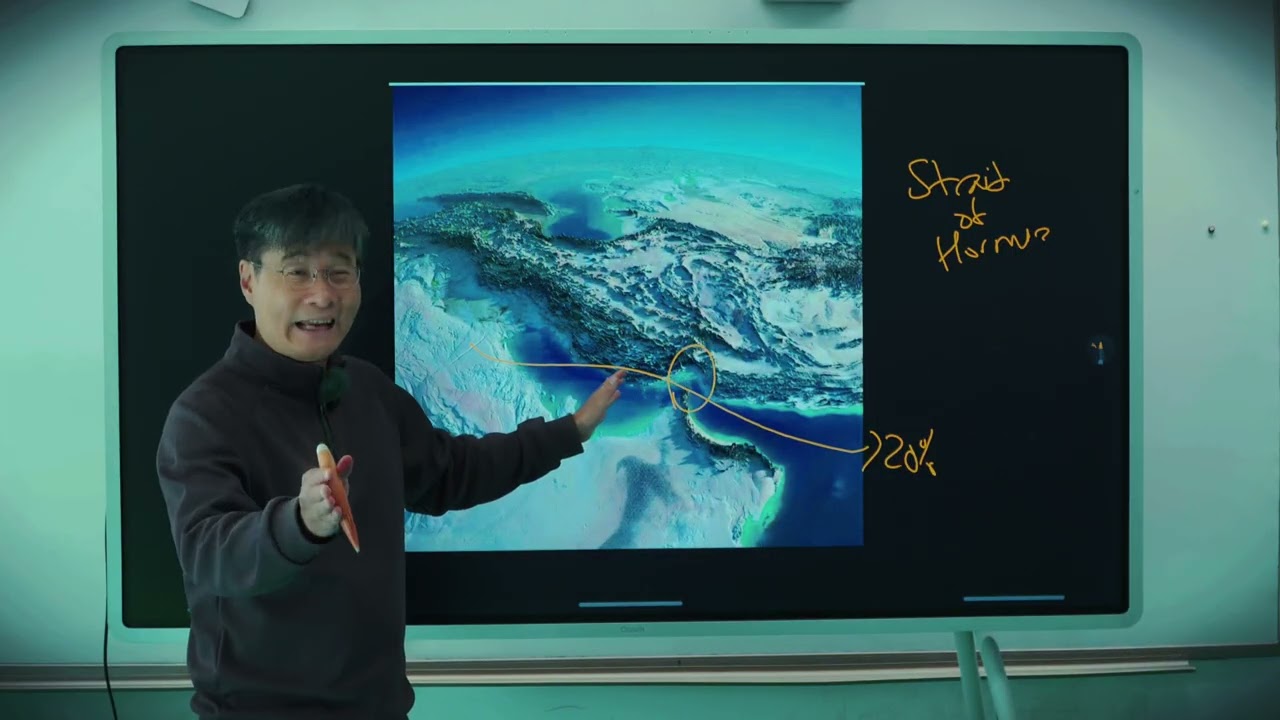
The Strait of Hormuz is a 33-kilometer-wide chokepoint through which 20% of the world’s oil flows to Asia, India, Pakistan, South Korea, China, and Japan.
India depends on this route for 60% of its oil, China for 40%, Japan for 75%.
Japan’s Prime Minister Takaichi has said Japan would run out of oil in 8–9 months if the strait remains closed, collapsing the Japanese economy.
Iran has closed the Strait of Hormuz.
The petrodollar system is the foundation of the American empire: GCC states sell oil exclusively in US dollars, which gives the dollar its value.
If the GCC collapses, the petrodollar collapses, and with it the US economy and global financial system.
Food vulnerability: The GCC imports 80% of its food. With the strait closed, these states face starvation.
Water vulnerability: The GCC has almost no fresh water and depends on desalination plants for 60% of its water supply. These plants are easy targets for cheap drones.
Geography: Iran as Mountain Fortress, GCC as Exposed Desert
Iran is mountainous, allowing it to hide rocket bases, drone launchers, and missile systems that are extremely difficult to locate and destroy.
From these positions, Iran can attack three categories of GCC targets at will: American military bases, oil and energy infrastructure, and desalination plants.
The GCC is flat desert with no natural defenses, making it essentially indefensible against Iranian drone and missile attacks.
At any point in the war, Iran could choose to destroy the entire GCC, and there is nothing the US or anyone else could do to stop it.
Iran’s own critical weakness is water.
Iran suffers from severe drought driven by climate change. Lake Urmia, once the sixth-largest saltwater lake in the world, has largely dried up since 1984.
The US-Israeli strategy is to destroy Iran’s water infrastructure—dams, reservoirs, power plants—to make the country uninhabitable, triggering either internal rebellion or a refugee crisis.
The war is thus a mutual destruction scenario, resembling a game of chicken: both sides can destroy the other, and the question is how far each is willing to go.
Iran’s Shia martyrdom culture means it is willing to go very far.
The GCC states are materialistic monarchies whose populations are 90% foreign expatriates who will flee under pressure, making them structurally fragile.
American Military Bases: Designed for Show, Not War
The US maintains military bases throughout the Middle East, originally established to protect the Anglo-American-imposed monarchies from their own populations.
These bases were designed during the Cold War under the doctrine of Mutually Assured Destruction (MAD), meaning they were never intended to fight a real conventional war.
They function as symbols of imperial authority—an “aura of invincibility”—rather than as functional defensive positions.
As a result, they are exposed and indefensible against Iranian drone and missile attacks, giving Iran a pretext to strike them and thereby destroy the GCC economy and, by extension, the American empire.
Asymmetric Warfare: Cheap Drones vs. Expensive Missiles
Iran’s primary offensive weapon is the Shahed drone, which costs approximately $35,000–$50,000 each.
Iran produces about 500 per day and has an estimated 80,000 in inventory.
These drones are easily transportable by truck, can be hidden anywhere, and can destroy desalination plants, oil fields, hotels, and other critical infrastructure.
The US and its allies defend with systems like THAAD (Terminal High Altitude Area Defense) and Patriot missiles, which cost approximately $1 million each.
Often two or three missiles are needed per drone, meaning the defender spends $2–3 million to counter a $50,000 threat.
These defense systems are large, slow, and easy for Iranians to locate and target.
This asymmetry exists because American military doctrine was shaped by the Cold War, where the purpose of weapons was to project power and intimidate, not to fight cost-effective wars.
The American military is described as corrupt, focused on spending rather than winning, and structurally incapable of adapting to 21st-century drone warfare.
The Two Grand Strategies
The American-Israeli strategy is to destroy Iran as a coherent nation-state.
First, destroy water infrastructure to create humanitarian crisis.
Second, exploit Iran’s ethnic diversity—the country contains Persians in the center and at least 10 other ethnic groups in the borderlands—by sponsoring separatist movements, arming minorities, and encouraging them to fight each other over water.
The goal is to fracture Iran into ethnic enclaves in perpetual conflict, eliminating it as a geopolitical threat. This plan is never stated openly because of its destructive nature.
The Iranian strategy is to create a global Shia jihad that overthrows the American empire.
Iran seeks to unite Shia populations worldwide (in Pakistan, Iraq, Bahrain, and beyond) in a religious war against the US and its client states.
Attacks on American embassies in Pakistan and Iraq are early signs of this strategy.
The broader goal is to rally the entire Muslim world—including the 90% who are Sunni—against the American-backed dictatorships that rule most Muslim-majority countries (Saudi Arabia, Egypt, Algeria, etc.).
If successful, this would establish a “Pax Islamica” with Iran as the leader of the Islamic world, ending American hegemony.
The GCC’s Financial Role and the US Stock Market
GCC states recycle their oil revenues into US financial markets, particularly into a handful of AI-driven technology companies (Nvidia, Microsoft, Google, Apple) that account for roughly a quarter of US stock market growth.
UAE, Saudi Arabian, and Kuwaiti investments in US markets have grown dramatically since 2012.
If Iran cuts off GCC oil revenues, these states can no longer invest in US markets, which would cause the stock market to collapse and trigger a US economic depression.
This is the mechanism by which Iran can destroy the American empire without firing a single shot at the American homeland.
The Risk of Wider War
Europe (specifically Germany, France, and Britain) is considering entering the war because it depends on GCC energy supplies, especially since it has cut off Russian energy due to the Ukraine war.
If Europe enters, Russia cannot allow Iran to fall (as it would be next), and China, while officially neutral, has its own strategic interests.
The war in the Middle East is connected to the Ukraine war, and together they risk becoming a true world war.
Two critical open questions:
Will the US commit ground troops (potentially 500,000–2 million soldiers) to topple the Iranian government?
If Iran is losing, will it use nuclear weapons?
Professor Jiang notes that the Americans are actually destroying the urban, educated, progressive Iranians who would most support regime change, while leaving alone the rural Shia militants who are most committed to jihad—a strategically self-defeating approach.
Water Scarcity as the Underlying Crisis
Water stress is the defining long-term crisis of the Middle East.
Egypt uses water at 6,420% of what its environment can sustainably produce; Saudi Arabia at 883%; Bahrain at nearly 4,000%; Dubai at 17,000%.
Iran is at 72% water stress, which is serious but far less extreme than the GCC.
This means Iran can destroy the GCC faster than the US can destroy Iran, but Iran’s own water vulnerability remains a critical weakness that the US and Israel plan to exploit.