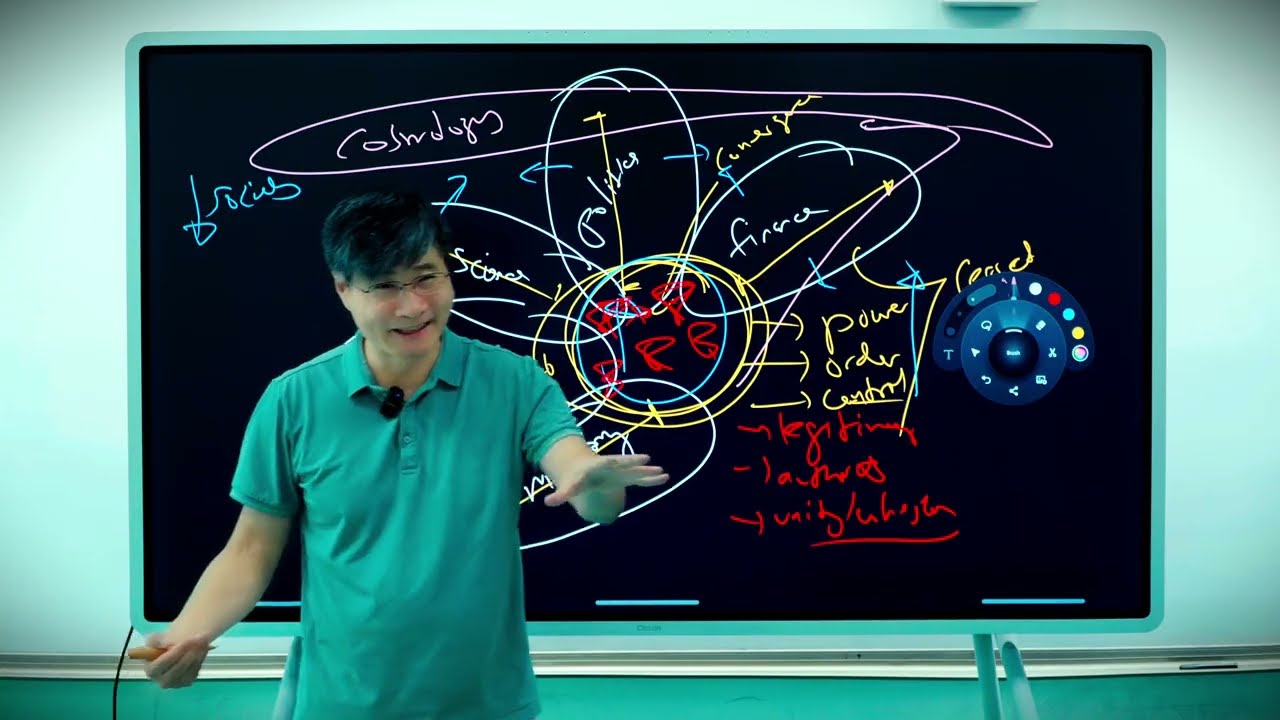
- This lecture connects last semester’s study of secret societies and eschatology with this semester’s focus on game theory, arguing that popular conspiracy theories about how the world works—while not factually true—are intuitive, explanatory, and paradoxically predictive. The professor then offers a literal, game-theoretic framework for understanding history as driven by competing secret societies, elite convergence, and the pursuit of a “holy empire of reason” now being realized through artificial intelligence and techno-Marxism.
The Conspiracy Theory Framework and Its Paradoxes
-
The professor lays out a simplified version of a popular grand conspiracy theory:
- The Knights Templars, founded in 1118 to protect Christian pilgrims, evolved into a powerful bank and political-military-religious-finance convergence, making them a threat to both the Catholic Church and the French crown.
- In 1314, the Church and the King of France outlawed them, burned their leader Jacques de Molay at the stake, and accused them of worshipping Baphomet.
- The Templars had absorbed Hermetic philosophy, Neoplatonism, and Gnosticism in Jerusalem—all heretical to the Catholic Church.
- Rather than disappearing, they allegedly reemerged as Scottish Rite Freemasons, who then created the American and French Revolutions, the Bank of England, World War I, World War II, and are now conspiring toward World War III to usher in a one-world government based in Jerusalem, controlled by an AI surveillance state.
- The theory also claims the Templars learned to communicate with interdimensional demons (including Lucifer) through ritual sacrifice, and that the purpose of the AI state is to summon these beings so the elite can live forever.
- Some versions trace the lineage back to Rome and 13 families that became Venice.
-
The professor identifies three major problems with this theory:
- There is no evidence demons exist or that a thousand-year conspiracy is real.
- The actual elite do not believe this theory—they think it is nonsense.
- It is anti-historical, oversimplifying complex events and ignoring other causal factors.
- It is also anti-game theory: history shows that powerful people become arrogant and fall (the “iron law of history”), making a continuous, coordinated conspiracy implausible.
-
Yet the theory has three compelling qualities:
- It is intuitive—it makes more sense to people than standard school history.
- It is explanatory—it offers a clear, coherent account of how the world works.
- It is predictive—even though the elite deny plotting these outcomes, the predicted events (one-world government, AI surveillance state) are likely to happen anyway.
- This creates a paradox: the theory is not factual but is truthful—it gives real insight into how the world works.
A Literal, Game-Theoretic Explanation
-
The professor argues the conspiracy theory is best understood as metaphorical, and offers a literal framework:
- There are mystics and cultists (poets, philosophers, occultists) who spend their lives trying to uncover the secrets of the universe—astrology, alchemy, eschatology, sacred geometry (the underlying mathematical essence of reality).
- There are people who seek power, wealth, and fame, who recognize they need these same secrets to achieve their goals.
- These power-seekers form secret societies to access and implement occult knowledge, all pursuing their own version of eschatology (the end goal of history).
- Secret societies also need agents or messianic figures to propel society forward—historically Julius Caesar, Napoleon, Hitler, Stalin; today Trump and Putin.
- These individuals believe they are the true messiah leading the world forward, while the secret societies view them as “useful idiots.”
- Different occultists and societies compete, each promoting different individuals to achieve their particular vision.
-
A second framing: society consists of different fields (politics, finance, science, religion, military), each with a diversity of beliefs.
- In each field, an extreme minority seeks power, order, and control.
- These power-seekers across all fields converge and coordinate, giving them a huge structural advantage.
- As society becomes larger, more bureaucratic, and more corrupt, this convergence becomes stronger and more cohesive relative to the fragmented whole, making secret societies more powerful over time.
-
Secret societies compete with each other on three criteria:
- Legitimacy—why are you more legitimate than other societies?
- Authority/expertise—why do you have more knowledge?
- Unity/cohesion—why are you more unified?
- To solve this, societies reimagine history, claiming continuity with older and older traditions (Knights Templars → Freemasons → Illuminati → Rome → Babylon) to appear more legitimate and authoritative.
- This is why people believe these societies stretch back to Rome or Babylon—not because it is true, but because elites in every era behave the same way (seeking power, order, control), creating an illusion of continuity.
-
The characteristics of those who win the competition for power:
- They are addicted to power—obsessive, expansive, all-consuming; they cannot stop seeking more.
- They behave as though possessed by demons—and in fact they do worship demons, because they are open-minded seekers of all secrets and will worship any god (Lucifer, Baphomet, Osiris, Isis) in search of ultimate knowledge.
- The system persists not because of a single conspiracy but because elites replace other elites while pursuing the same agenda: more power, more order, more control.
- Powerful people are fundamentally different from ordinary people—likely psychopaths who only care about power—and they naturally converge with each other.
Albert Pike and the Ideology of American Freemasonry
-
Albert Pike (1809–1891) is considered the grand architect of American Freemasonry.
- One-third of American presidents were Freemasons; today’s American military, CIA, and FBI trace their ideological roots to Freemasonry.
- His book Morals and Dogma is the standard textbook of American Freemasonry.
-
Key passages and their meaning from Morals and Dogma:
- The rough ashlar vs. the perfect ashlar: Society is chaotic and diverse (rough stone); the goal of Freemasonry is to create order out of chaos by perfecting humanity into a geometric cube—a symbol of divine perfection.
- The cube has 6 faces, 12 lines, 8 points—all derived from sacred numbers (3, 5, 7, 9). Mathematics and geometry are the language of God.
- The goal is to turn society into a cube, and ultimately everyone into a cube—through artificial intelligence.
- Freemasonry as the ultimate religion: It encompasses all previous religions—Egyptian Hermeticism, Pythagorean mystery cults, the Kabbalah—and syntheses the best ideas of humanity.
- Each person must become a “stone”—stoic, unrelenting, perfect faith—through reflection and reason, surrendering emotions to geometry.
- “Socrates should enter into an atom and produce Marcus Aurelius”—the height of humanity is reason over emotion.
- The eschatology of Freemasonry: Create a “holy empire of reason” through revolutions worldwide.
- The Freemasons claim credit for the French Revolution and for sponsoring Napoleon to achieve a one-world government.
- They rewrite history to show themselves as the natural evolution of the Knights Templars, borrowing the stonemasons’ identity for protection after the Templars were hunted.
- They plan decades and even centuries ahead (claiming to avenge Jacques de Molay’s death in 1314).
- The Degree of the Rose: God is infinitely wise; all evil and suffering are part of a divine plan leading to redemption and regeneration of the world. Masons should hasten that day.
- Hierarchy and ranks: Scottish Rite Freemasonry has 33 ranks. Climbing requires constant reinvention, mental flexibility, and adopting new ideas—training members into mastery of knowledge.
- Completeness: Freemasons incorporate all philosophies (Neoplatonism, Hermeticism, Kabbalah) to have an explanation for everything.
- Humans are souls trapped in material bodies; the spiritual war is between material desires (sex, food, money) and spiritual connection with reason.
- Victory comes through geometry—turning oneself into a sacred cube connected to the divine.
- Fraternity through communion: Sharing meals creates bonds. In extreme forms, some Freemasons literally eat the corpses of dead members to connect with the spiritual energy they believe remains in the body.
- The most extreme, most fanatical members win out in secret society competition.
- The compass and square:
- The compass sets boundaries (rules); the square limits and disciplines.
- At entry level, focus on the square (self-discipline). At middle level, learn to rule others. At master level, combine both to lead the Freemasons to control the whole world—the holy empire of reason.
- The “G” in the Freemason symbol has three interpretations:
- Geometry (the square and compass)
- God/Grand Architect—God created the world then left, so humans must perfect it themselves
- Generative principle—male energy activating female productivity
- Combined: Generative + Geometry = God = Artificial Intelligence
- The original impetus of Freemasonry was to prove they could be God by creating life (historically called golems); now this drive manifests as the push to create AI.
- Today’s AI leaders (Sam Altman, Peter Thiel, Larry Ellison, Elon Musk) appropriate this tradition to justify building an AI surveillance state.
- The rough ashlar vs. the perfect ashlar: Society is chaotic and diverse (rough stone); the goal of Freemasonry is to create order out of chaos by perfecting humanity into a geometric cube—a symbol of divine perfection.
Zbigniew Brzezinski and the Technocratic Vision
-
Zbigniew Brzezinski, National Security Advisor to Jimmy Carter and founder of the Trilateral Commission (funded by David Rockefeller), wrote Between Two Ages in the 1970s.
- He is likely not a Freemason and probably never read Albert Pike, but thinks identically because he is obsessed with power, order, and control.
-
Key passages and their meaning:
- Democracy inevitably leads to polarization (left vs. right, Democrats vs. Republicans), creating persistent social crises.
- The solution is technocracy: a bureaucracy run by engineers using AI, data, and statistics to govern society better.
- “Persisting social crisis, the emergence of a charismatic personality, and exploitation of mass media to obtain public confidence would be the stepping stones in the peaceful transformation of the United States into a highly controlled society.”
- Written 40–50 years ago, this perfectly describes America today: the left-right divide, the emergence of Trump as a charismatic figure, and social media as the mass media tool.
- Conservatives/Republicans will win the civil war because they are preoccupied with public order and fascinated by gadgetry—they are the ones who will implement the AI surveillance state.
- Democracy and liberalism were a historical accident—useful for America’s past but too divisive for the future.
- “Marxism represents a further vital and creative stage in the maturing of man’s universal vision”—Marxism is good because it is the end point of history, a victory of reason over belief, implementing the Freemason project in the real world.
- The AI surveillance state is ultimately techno-Marxism—communism implemented through technology.
Larry Ellison, Oracle, and the CIA
- Larry Ellison, founder of Oracle, is one of the most powerful men in America and a key player in Operation Stargate (building AI data centers across the US with Trump).
- Oracle was originally called RSI and was a database company designed to collect and organize data for companies and governments.
- In its first five years, Oracle was incompetent—it constantly lost data.
- Yet its clients were the CIA and the Navy, who kept funding it despite it not working, even putting their own resources into helping Oracle survive.
- Oracle is effectively a creation of the CIA and the Navy—the reason is unclear (charisma, family connections, luck), but the relationship is deeply curious.
Peter Thiel, Palantir, and the Cult of Monopoly
-
Peter Thiel is arguably more powerful than Elon Musk:
- He recognized Trump’s potential in 2016 and supported his campaign.
- He mentored JD Vance, funded his venture capital career and Senate race, and promoted him as Trump’s VP.
- He is a mentor to Mark Zuckerberg and Sam Altman.
-
From his book Zero to One:
- “Competition is for losers. Capitalism is for losers. What you want is monopoly. What you want is communism.”
- To build a great company, you need a secret—either a secret of nature or a secret about people.
- “The best entrepreneurs know this. Every great business is built around a secret that’s hidden from the outside. A great company is a conspiracy to change the world.”
- “If you want to start a company, start a religion first.”
- “The best startups might be considered slightly less extreme kinds of cults. People at a successful startup are fanatically right about something those outside it have missed.”
- Thiel explicitly says: don’t build technology, study the occult, figure out the secrets of humanity, and build your company around that.
-
Sam Altman echoes Thiel’s language: the most successful founders are on a mission to create something closer to religion.
- Altman sees no fundamental difference between AI and humans—both are just energy to be exploited and shaped into cubes for the holy temple of reason.
-
Alexander Karp, Thiel’s co-founder of Palantir, wrote The Technological Republic manifesto calling for a technocracy.
- Oracle creates databases of all information about everyone; Palantir uses that data to predict behavior—the ultimate AI surveillance company.
Peter Thiel and the Antichrist
- Thiel has been giving speeches about the Antichrist:
- The Antichrist is defined as anyone who opposes the AI surveillance state.
- The logic: the Antichrist rises by playing on fears of technology and seducing people with “peace and safety”—therefore, those who resist the AI state are the Antichrist and must be destroyed.
- This inverts the obvious interpretation (that the AI state itself is the Antichrist) to justify crushing all opposition to achieve the holy empire of reason.
The Eschatological Vision: AI as Human Perfection
- Freemasonry’s core eschatological vision is a one-world government based in Jerusalem where everyone obeys, creating a perfect world.
- The method of control: AI implanted in the brain (a “bicycle chip”) that programs obedience—telling you to pay taxes, not drive drunk, etc.
- This is human alchemy—turning imperfect, sinful, error-prone humans into obedient, programmable robots.
- Human subjectivity is bad because it leads to sin, errors, and confusion.
- If everyone thinks alike through AI, humanity achieves a common brotherhood—becoming God itself.
- The professor frames this as a “good thing” from the elite’s perspective: peace, happiness, safety through total control.