The US-Iran conflict represents the first true 21st-century war, marking a fundamental shift in how wars are fought. The speaker argues that warfare has evolved through three distinct phases over the past few centuries, and that the current conflict with Iran illustrates the latest stage: a slow, methodical strategy of economic strangulation, societal division, and infrastructure destruction designed to turn a population against its own government, rather than direct military confrontation.
How Warfare Has Evolved
Pre-modern warfare focused on destroying a state’s military capacity by killing soldiers on a battlefield. The side that won the battle won the war. This worked when armies were small and professional.
20th-century warfare shifted to destroying a state’s productive capacity because nation states could replenish soldiers from populations of millions. The goal became killing civilians and destroying factories, as seen in World War II firebombing campaigns against Germany and Japan.
In World War II, the Allies won not through superior strategy or morality but because American and Soviet factories were out of reach of Axis bombers, while German and Japanese cities were systematically destroyed.
Dresden was firebombed into oblivion. In Japan, Nagoya (size of Los Angeles) was 40% destroyed, Tokyo (size of New York) was 40% destroyed, and Yokohama was 60% destroyed.
21st-century warfare is different because nuclear weapons make total annihilation self-defeating, and populations are too large to kill outright. The new goal is to use the population against the state by sowing discord, strangling the economy, and destroying civilian infrastructure so that people turn on their own government.
The Nation State as the Engine of Population Growth
The world’s population has grown from roughly 2 billion to 8 billion, which the speaker attributes not to scientific progress alone but to the political revolution of the nation state.
Without synthetic fertilizers, the Earth could only support 1–2 billion people. The nation state created the political will to develop and deploy the science and technology needed to grow populations.
Jean-Jacques Rousseau’s social contract theory, born from the French Revolution, provided the intellectual foundation. His key ideas:
Freedom is given by God and cannot be surrendered without surrendering one’s humanity. “Give me liberty or give me death” was not a slogan but a lived reality for French citizen-soldiers who charged cannon fire with no military training.
A good government is measured by population growth. The best state is one whose population increases the most without external help.
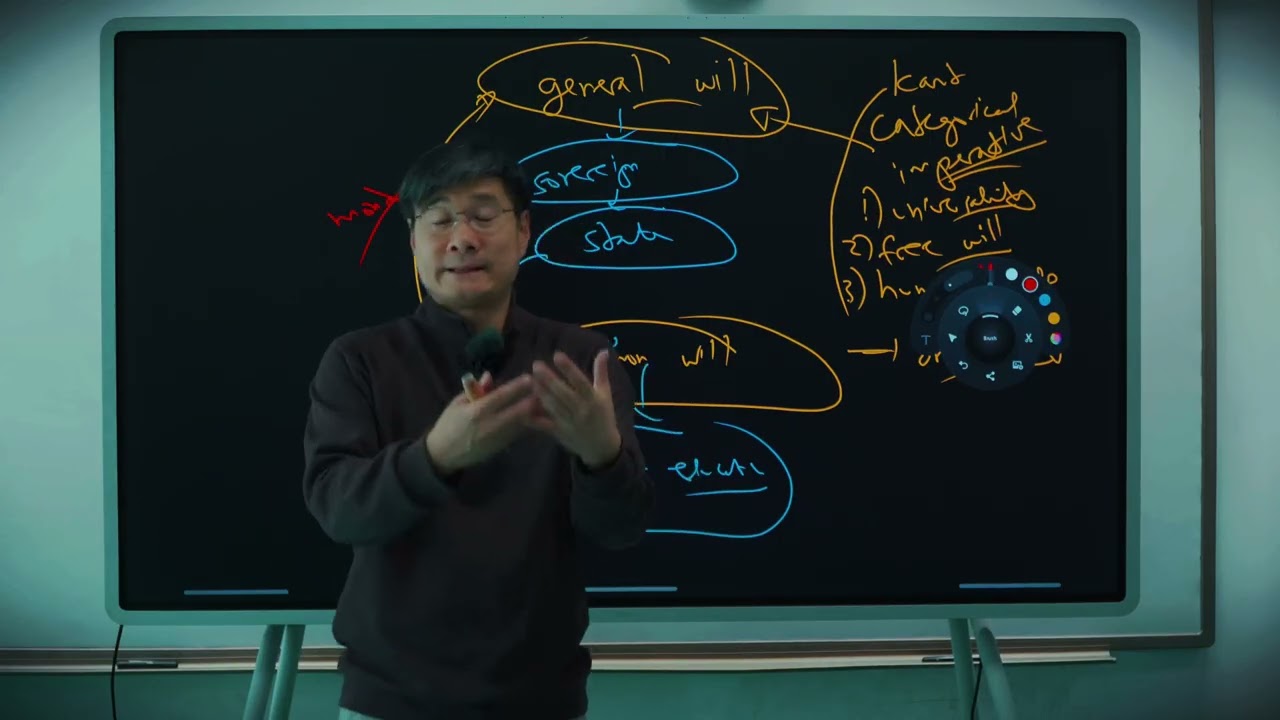
The “general will” (who we could be) matters more than the “common will” (who we are), drawing on Kant’s categorical imperative: universality, free will, and treating humans as ends in themselves.
France became the dominant European power because its citizens were willing to fight and die for the idea of liberty, while rival monarchies relied on mercenary professional armies who feared death.
German nationalism emerged as a response to French conquest. Johann Herder argued that language, culture, and race bind people together. Otto von Bismarck unified Germany through “iron and blood,” and his famous 1862 speech declared that great questions would be decided not by speeches and majority votes but by military power.
Bismarck also pioneered worker reforms (health insurance, pensions, accident insurance) because he understood that a nation state’s war capacity depends on the health and productivity of its entire population, not just its soldiers.
Mussolini articulated the peak of nation-state mythology: “We have created our myth. The myth is a great passion. It is not necessary for it to be a reality. It is a reality in the sense that it is a stimulus, is hope, is faith, is courage. Our myth is the nation.”
America’s version of the nation state was different: a game-like system where anyone could come, work hard, and get rich. After World War II, the US spread this consumer capitalism globally. After the Soviet collapse, globalization made this the dominant world system.
The problem: the game concentrates wealth among a few players while everyone else falls into debt. The system is now unstable and unsustainable, requiring a reset through war.
World War II as the Template and Its Limits
World War II killed 20–30 million people (likely more), yet global population growth never stopped. The war demonstrated that the nation-state concept was so powerful that entire civilizations could be destroyed and populations would still recover.
The speaker argues that a future world war, given current population levels, would kill at least 50% of humanity.
The Ukraine War as a 19th-Century Conflict
The war in Ukraine is essentially a 19th-century-style war focused on killing soldiers on the battlefield, resembling World War I more than modern warfare.
The US-Iran War as the First 21st-Century War
Round one: “Shock and Awe” failed. The US attempted to decapitate Iran’s leadership, destroy its military, and eliminate its war production capacity. This did not work because Iran spent 20 years preparing: leadership is decentralized, military assets are hidden in mountains, and factories are buried underground.
The coming shift to 21st-century strategy will have three components:
Economic strangulation: Destroying Iran’s ability to generate revenue. The US has already blockaded Kharg Island, through which 90% of Iranian oil exports flow (primarily to China). The US also aims to break Iran’s control of the Strait of Hormuz by seizing key islands and coastlines with ground forces.
Ethnic tension: Positioning forces near minority regions in northwest and southeast Iran to encourage local uprisings, forcing Iran to fight on multiple internal fronts simultaneously.
Destroying civilian infrastructure: Targeting dams, reservoirs, power plants, roads, and railways to deny civilians access to water, electricity, and food. The goal is to make the population so desperate and angry that they blame and attack their own government rather than the US military.
Tehran is a city of 10 million that does not grow its own food. Attacking road and railway hubs can starve the city without destroying all food production.
Power plants are easy to destroy and create cascading failures across society.
The speaker emphasizes these are war crimes under the Geneva Convention, but argues the US will abandon legal constraints as it becomes more desperate to win.
Weather Warfare as a Weapon
In 2012, Iranian President Ahmadinejad accused the US of conducting weather warfare against Iran through cloud seeding, creating droughts by forcing rain to fall elsewhere (such as Dubai) before clouds reached Iran.
Operation Popeye (1967–1972) is a documented US military operation during the Vietnam War that extended the monsoon season in Vietnam by seeding clouds, making it harder for Vietnamese forces to resupply through tunnel networks.
President Lyndon Johnson stated: “He who controls the weather will control the world.” The speaker notes that weather manipulation technology exists and that its effectiveness and scalability are the subject of ongoing debate.
The Color Revolution Playbook
The US has a well-established strategy for overthrowing governments using local populations, called the “color revolution playbook”:
Invite young people from target countries to the US to learn how to organize protest movements.
Finance NGOs and youth movements in target countries.
Control social media to galvanize unrest.
Bribe security services not to intervene.
Recent example: Nepal (2023), where young protesters overthrew the government holding signs in English with American phrases like “Boomer, Times Up” and “We Pay You Flex Enough”—languages most Nepalese do not speak or read. The speaker argues this proves the protests were orchestrated by Washington for Washington, not organic local movements.
Arab Spring (2010–2012) is another example where Twitter and Facebook were instrumental in organizing uprisings across the Middle East.
America’s Control of Global Chokepoints
The US controls key maritime chokepoints including the Strait of Malacca, the Panama Canal, and the Strait of Gibraltar. Even though Iran controls the Strait of Hormuz, the US can position aircraft carriers in the Indian Ocean to enforce blockades.
This power allows the US to strangle not just Iran but any country dependent on trade, including China. A significant portion of the Chinese economy depends on exports; a blockade could collapse GDP, cause mass unemployment, and trigger internal unrest.
The Response to 21st-Century Warfare: Eschatology
When asked how a country like Iran can respond to this strategy, the speaker invokes game theory and the concept of eschatology—a religious framework that gives meaning to suffering.
The strategy is to tell the population that their suffering is part of God’s plan, that endurance through hardship will make them invincible, and that martyrdom leads to heaven.
This creates fanaticism that makes a population willing to fight and die regardless of material disadvantage.
Historical example: The Iran-Iraq War (1980s). Iran had no tanks, no helicopters, and no professional army. Iraq was supported by both the US and Soviet Union. Iranian youth as young as 16 ran into battle with rifles against tanks and helicopters, some throwing grenades into armored vehicles. This fearlessness galvanized the population and terrified the Iraqis. Iran was winning until the US supplied Iraq with chemical weapons.
The speaker estimates that only 10–20% of a population needs to commit to this eschatological framework for a nation to survive 21st-century warfare.
The dark corollary: defending against 21st-century warfare may require population management, which can mean culling one’s own people through famine, disease, or violence, enforced through AI-powered surveillance states. The speaker presents this not as a recommendation but as an inevitability given the logic of the system.