-
This lecture, delivered on April 7, 2026, by Professor Jiang to his Beijing high school students, analyzes the escalating US-Iran war and argues that America’s approach is driven more by Hollywood-style optics and propaganda than by sound military strategy, which will ultimately lead to its failure.
- The war has reached a critical point: Trump has threatened to destroy Iranian civilian infrastructure (power plants, bridges, universities) if Iran does not open the Strait of Hormuz, which could trigger Iranian retaliation against GCC oil and desalination facilities, cutting 20% of global energy supply and causing worldwide famine due to fertilizer shortages.
- The planting season makes fertilizer access critical; without it, global food production can only support 1–2 billion people instead of 8 billion, meaning mass starvation in Africa and South Asia.
- Fuel price spikes are already visible across the US, Australia, China, and Europe, with projections that civilian aviation could collapse as ticket prices multiply tenfold.
- Russia’s oil exports have been hit by 40% due to Ukrainian drone strikes on oil terminals and an undeclared US naval blockade that seizes Russian tankers—a form of state piracy reflecting America’s shift from promoting global trade to controlling sea lanes by force.
- Germany has banned males aged 17–45 from leaving the country for more than three months without army permission, a prelude to national conscription driven by the loss of Russian and GCC energy supplies, which will force German remilitarization.
- The war has reached a critical point: Trump has threatened to destroy Iranian civilian infrastructure (power plants, bridges, universities) if Iran does not open the Strait of Hormuz, which could trigger Iranian retaliation against GCC oil and desalination facilities, cutting 20% of global energy supply and causing worldwide famine due to fertilizer shortages.
-
America’s strategic shift is from being the global reserve currency that taxed every dollar transaction to becoming a mafia-like power that controls maritime choke points to starve adversaries into submission.
- The four key choke points are: the Panama Canal (why a third of the US Navy is in the Caribbean), the Strait of Hormuz, the Strait of Malacca (through which most of China’s Middle Eastern and African resources flow), and Greenland (the Arctic choke point).
- Russia is expected to militarize its shadow fleet of ~1,000 ships, providing mercenaries to engage the US Navy in a war of attrition designed to degrade American naval capacity over 1–2 years, not to defeat it outright.
- China’s strategy is to triangulate between Russia and America, negotiating with and paying off both sides to maintain its position as the primary beneficiary of oceanic trade.
-
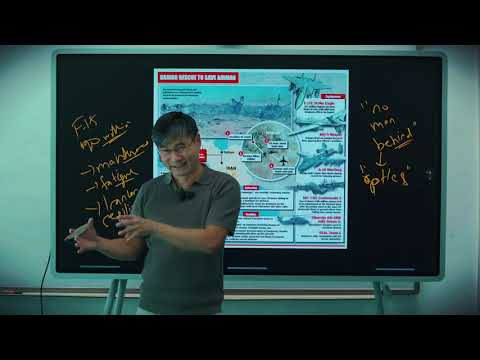
The central case study of the lecture is the alleged US rescue of a downed F-15 pilot in Iran, which Professor Jiang argues was actually a failed ground invasion aimed at stealing Iran’s enriched uranium from a nuclear facility.
- The F-15 was shot down despite claimed US air superiority, likely due to maintenance issues, pilot fatigue, and Iranian heat-seeking missiles that do not rely on radar.
- The US military’s “no man left behind” doctrine is driven not only by genuine values but by the need to maintain an aura of invincibility—if a pilot is captured and paraded on Iranian TV, it is a massive propaganda defeat.
- The official rescue narrative has multiple inconsistencies:
- The pilot allegedly hiked 2.1 km up a mountain ridge in the Zagros Mountains over 48 hours despite a broken ankle while evading capture.
- The US built a makeshift landing strip 200 km from the crash site, deployed 155 aircraft, and lost an estimated $300 million in planes (C-130 transports destroyed by sand, helicopters blown up by their own forces).
- No casualties were reported despite heavy clashes and missiles visible in videos.
- The rescued pilot was never identified, never interviewed, and remains completely anonymous—unusual for what should have been a propaganda triumph.
- Evidence suggests the real mission was a Pentagon plan (leaked by the Washington Post) to insert special forces and seize Iran’s nuclear stockpile:
- Journalist Barak Ravid reported on March 7 that the US was considering sending special forces to seize Iran’s uranium.
- The Washington Post later leaked a detailed Pentagon plan involving building a landing strip near a nuclear facility and deploying hundreds or thousands of troops.
- The generals likely presented the plan expecting Trump to reject it; when he embraced it enthusiastically, they refused to carry it out and were fired by Secretary of War Pete Hegseth.
- Among the recovered IDs at the crash site was a woman who specialized in nuclear technology engineering—an unusual inclusion for a pilot rescue mission.
- This pattern mirrors past failures: Operation Eagle Claw (1980 Iran hostage rescue) was aborted after sandstorms disabled aircraft, and the Jessica Lynch rescue (2003 Iraq) was staged as a Hollywood action scene when she was actually being treated well in an Iraqi hospital and could have been picked up peacefully.
-
Professor Jiang argues that the US is fighting a war of optics rather than a war of strategy, and this is rooted in the deep institutional collaboration between Hollywood and the Pentagon.
- Three requirements to win a war: economics (fight cheaply and quickly), organization (implement simple strategies), and logistics (maintain supply). The US is failing on all three while being consumed by narrative management.
- The Pentagon-Hollywood relationship works both ways: Hollywood glorifies US wars and frames soldiers as noble protagonists while stereotyping enemies, but it also brainwashes the Pentagon into believing war can be scripted like a movie.
- Over 2,500 war-themed movies and TV shows have been made with Pentagon assistance, requiring script changes to align with military recruitment and PR goals.
- Examples include Saving Private Ryan (based on a real Lincoln letter but fictionalized), Black Hawk Down (the real hostage was released for a ransom; the movie invented a dramatic rescue), and Jessica Lynch (the Pentagon fabricated a story of abuse and a heroic rescue).
- Special forces culture (Delta Force, Navy Seals) is driven by personal glory and the prospect of post-war book deals and movie adaptations, rather than by organizational discipline and strategic thinking.
- Trump and his inner circle live in an alternate reality where failures are spun as successes, making it impossible to learn from mistakes—the same pattern seen in the Ukraine war, where Americans were told daily that Russia was on the verge of collapse.
-
Despite America’s self-destructive approach, both the US and Iran can claim to be achieving their strategic objectives, making a negotiated peace nearly impossible.
- Iran’s objectives: remove the US from the Middle East, deter Israel, and destroy/reset the global economy in its favor.
- America’s objectives: destroy Iran as a viable nation-state (balkanize it, destroy its infrastructure, encourage ethnic conflict) and isolate it from trade with Russia and China.
- Because these objectives are not mutually exclusive, both sides believe they are winning: America sees Iran being destroyed and sees that as victory; Iran sees America being expelled from the region and the global economy collapsing and sees that as victory.
- Professor Jiang concludes that America will not lose its empire from this war—worst case, it retreats—but it will fail to achieve meaningful strategic outcomes because it is fighting a Hollywood war rather than a real one.
Game Theory #19: The Hollywood-Pentagon Complex
Predictive History • • 54min → 5 min • #140