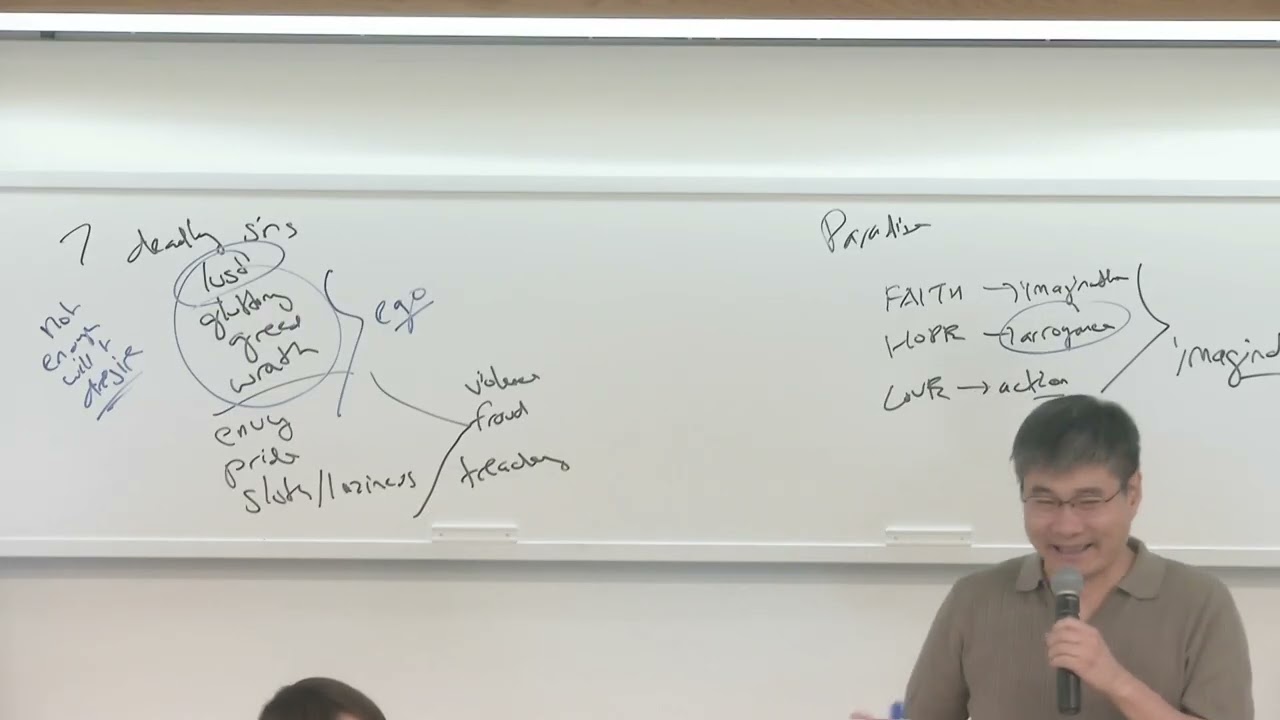
This lecture continues a close reading of Dante’s Inferno, focusing on Cantos 10–20, while developing a broader interpretive framework: Dante is not merely mapping the afterlife but issuing a prophetic social critique of Florence and, by extension, any society in decline. The professor argues that Dante’s ultimate message across the Divine Comedy is to live a life of faith, hope, and love—where faith means believing God exists and loves us, hope means believing your actions matter, and love means actively opposing injustice. The Inferno functions as prophecy in the biblical sense: a furious warning to the present, not fortune-telling about the future.
The Architecture of Hell and the Logic of Sin
Dante organizes Hell so that the deeper you descend, the worse the crime. The upper circles (lust, gluttony, greed, wrath) punish sins people do to themselves, while the lower circles (violence, fraud, treachery) punish sins done against others—especially against God and the social fabric.
The four upper deadly sins (lust, gluttony, greed, wrath) are reinterpreted by Dante not as excess of ego but as lack of will, hope, and self-love. Francesca, blown forever in the storm of lust, is not a figure of passionate excess but of escapism—she fell in love with the idea of love from romance novels, not with a real person. She had insufficient faith, hope, and love to take her own life seriously.
The professor illustrates this with a ranking exercise: paying a million dollars for sex (at least involves will and action), writing love letters to a celebrity (passive fantasy), and buying an AI robotic wife (complete despair and self-abandonment). The third is worst because it represents giving up on oneself entirely—the opposite of the hope Dante demands.
The three sins the Church considers deadly but Dante places only in Purgatory (envy, pride, sloth) are replaced in Hell by violence, fraud, and treachery—sins that actively destroy others’ capacity to live good lives.
Fraud vs. Violence: Why Lying Is Worse Than Killing
Virgil explains that fraud is worse than violence because fraud destroys trust, which is the foundation of love and community. Violence harms the body; fraud corrupts the imagination and makes reality itself unreliable.
Fraud severs the bond of love that nature forges between people. Treachery is the worst form because it destroys even the special trust that builds on top of natural love—it perverts reality itself and sets off a vicious cycle of betrayal throughout society.
Usury (money-lending at interest) is punished because it exploits others’ creative capacity without participating in creation itself. Dante’s own father was a money-lender, yet Dante condemns usurers to Hell—illustrating his commitment to divine justice over family loyalty. Only his great-grandfather is in Heaven.
Dante as Prophet: The Black Death and Divine Judgment
Dante died in 1321, and his work was not fully understood until the Black Death of 1357, which killed a third to half of Europe. People then recognized Dante as a true prophet who had foretold divine retribution.
The professor frames this through a parenting analogy: if your child is a drug addict committing crimes, true love means letting them hit rock bottom so they can recover—not enabling them. God’s judgment, however terrible, is an expression of love: He intervenes when a society becomes so corrupt that ordinary people can no longer live lives of faith, hope, and love.
This inverts Catholic theology: for the Church, sin risks damnation; for Dante, God always forgives, but that very forgiveness creates responsibility. When society makes goodness impossible, divine judgment becomes necessary to restore the conditions for human flourishing.
Canto 10: Heresy, Meritocracy, and the Cruelty of Competition
In the city of Dis, heretics burn in tombs. The first heresy Dante names is Epicureanism—the belief that the soul dies with the body—because it eliminates any need for faith, hope, or love.
Dante encounters Cavalcante, who asks where his son Guido (Dante’s rival poet) is. Dante ambiguously implies Guido is dead, causing Cavalcante despair—even though Dante knows Guido is alive. This is an act of cruelty born of competitive jealousy.
The professor compares this to a modern anecdote: two best friends at a top Chinese university in the 1990s, one of whom receives her friend’s Princeton admission letter in the mail and throws it away out of jealousy. This illustrates the pathology of meritocracy: a winner-take-all culture where even friends become enemies, where people keep score constantly, and where apologizing feels like admitting debt rather than rectifying wrong.
The professor argues that modern meritocracy is not truly meritocratic—elite universities are roughly half legacy admissions—but the belief in meritocracy makes inequality worse because the successful feel they deserve it, while the old aristocracy at least felt embarrassed about inherited privilege.
Canto 11–12: The Structure of Violence and the Problem of Augustus Caesar
Virgil explains the three rings of violence: against others (tyrants, murderers), against oneself (suicide), and against God and nature (blasphemy, sodomy).
Alexander the Great is found boiling in the river of blood among tyrants, while Julius Caesar is in Limbo. This seems paradoxical since both were conquerors. The explanation: Virgil was commissioned by Augustus to write the Aeneid, and the Roman Empire is part of God’s plan, so Caesar must be honored. But this raises the question of Augustus Caesar himself, who is conspicuously absent from the Divine Comedy—never given a place in any circle.
The professor argues Augustus is the worst figure of all: he corrupted divine poetry (Virgil’s gift) to serve empire. His crime was so great that Dante consigns him to a fate worse than Hell—annihilation, total erasure from God’s universe. This is Dante’s most subversive move: the man who made the Roman Empire possible, and thus made Christianity possible, is condemned to nonexistence for weaponizing sacred art for political power.
Canto 13–14: Suicide and the Giant’s Apathy
Suicides are transformed into trees in a dark forest, tormented by harpies that eat their leaves. The punishment reflects the sin: they rejected their bodies in life, so in death they are bodies without humanity.
The professor emphasizes that suicide is a sin because it represents total abandonment of faith, hope, and love—a rejection of God so complete that even divine intervention seems pointless. It also damages society by showing others that despair is justified.
In Canto 14, a giant (Capaneus) is punished for blithely enduring fire and brimstone with complete apathy—he doesn’t care. The professor notes this is the only non-human punished in Hell, and his indifference reveals a key point: only humans can be redeemed because only humans carry an indelible divine spark. The giant cannot be saved; humans are punished precisely because salvation remains possible for them. The punishments are designed to force reflection and recognition of that spark.
Cantos 15–16: Sodomy, Narcissism, and the Decline of the Elite
Dante encounters his beloved teacher and father figure Brunetto Latino among the sodomites, running endlessly across burning sand. Brunetto is virtuous in every other respect—his only sin is homosexuality. This creates a major paradox: why would Dante condemn someone he loves like a father?
The professor argues the issue is not the physical act but what it represents in Dante’s framework: narcissism, self-love turned inward, and the abandonment of social responsibility. Homosexuality, like incest (which the professor argues is implicitly present in this circle), represents the elite turning away from society—loving only their own kind, refusing to reproduce, refusing to model propriety for others.
The key distinction is between societies on the rise (where elites hide such behavior and still fulfill social duties) and societies in decline (where elites openly celebrate self-indulgence). The professor contrasts the 1960s university message (“change the world, serve humanity”) with today’s (“be yourself, celebrate yourself”). The shift from service to self-celebration is, for Dante, the hallmark of civilizational decline.
Three more distinguished Florentine nobles appear in Canto 16, also condemned for sodomy. They lament that Florence is now characterized by “excess and arrogance”—newcomers, quick wealth, and moral decay. These are the best Florence has to offer, yet they are in Hell, underscoring how thoroughly the elite have abandoned their responsibilities.
Paradiso 16: The Golden Age of Florence and the Causes of Decline
The professor jumps to Paradiso 16, where Dante’s great-grandfather Cacciaguida describes early Florence in its glory and explains its decline. The old families were pure, dedicated to community, and virtuous. The cause of decline: immigration (mixing with outsiders who brought different values), which led to materialism as the only shared value, which in turn led to factionalism, greed, and moral collapse.
The professor acknowledges this is not politically correct but argues Dante’s diagnosis applies today: rootlessness, loss of tradition, multiculturalism without shared values, and the replacement of community service with money-making and self-celebration.
Students push back with arguments for immigration (vibrancy, creativity, scientific talent) and multiculturalism (tolerance, diverse perspectives). The professor counters that population decline is itself a symptom of civilizational decline (people can’t afford families), and that immigration is a short-term remedy masking deeper problems. He also notes the paradox that in today’s world—despite unprecedented openness—no one can produce works like the Divine Comedy, suggesting that spiritual and creative vitality has declined even as tolerance has increased.
Cantos 17–20: Fraud, Simony, and Fortune Tellers
To descend from violence to fraud, Dante and Virgil ride Geryon, a monster with the face of an honest man and the tail of a scorpion—the perfect embodiment of fraud, which seduces with a trustworthy appearance and then stings.
In the circle of fraud, money-lenders sit buried in sand with purses around their necks—the debt they used to enslave others now traps them.
Pimps and seducers are whipped by demons, circling endlessly—the coercion they inflicted on others is now inflicted on them.
Flatterers drown in excrement—the verbal filth they produced in life becomes their eternal medium.
Simoniacs (those who sold holy offices and relics) are buried head-first in holes with their feet on fire. Dante confronts Pope Boniface VIII and delivers a furious tirade against Church corruption. The modern equivalent is universities selling credentials through legacy admissions, donations-for-admission schemes, and inflated tuition—trusted authorities profiting from their sacred mission.
Fortune tellers walk with their heads twisted backward, able only to see behind them. Their sin was claiming to see the future, which destroys free will and reduces human imagination. The professor argues that modern equivalents include influential journalists, podcasters, and media figures who push narratives with emotional force, restricting rather than expanding people’s capacity to think for themselves.
The Cumulative Diagnosis: Why Societies Decline
By the end of the lecture, the professor and students compile a list of the characteristics of civilizational decline drawn from Dante’s Inferno:
Meritocracy as a winner-take-all culture that makes people cruel, jealous, and incapable of apology
Excess and arrogance among the elite, who abandon social responsibility
Narcissism and self-celebration replacing service and community
Homosexuality and incest as symbols of elite inward-turning and exclusion (not the acts themselves but the attitude they represent)
Immigration without assimilation, leading to materialism as the only shared value
Fraud and the breakdown of trust in institutions (media, government, universities, Church)
Censorship and the inability to speak honestly about controversial topics
Extreme wealth inequality and lack of social mobility
Decline of aesthetic and spiritual standards; replacement of the sacred with the commercial
Post-truth: the annihilation of shared reality and trusted authority
Directed education that defines success narrowly and suppresses imagination
The professor concludes that by Dante’s standards, contemporary society is deeply in decline—more so than Dante’s own time, because at least Florence had roots, tradition, and community, whereas modern society is rootless and spiritually empty despite its material abundance and tolerance.