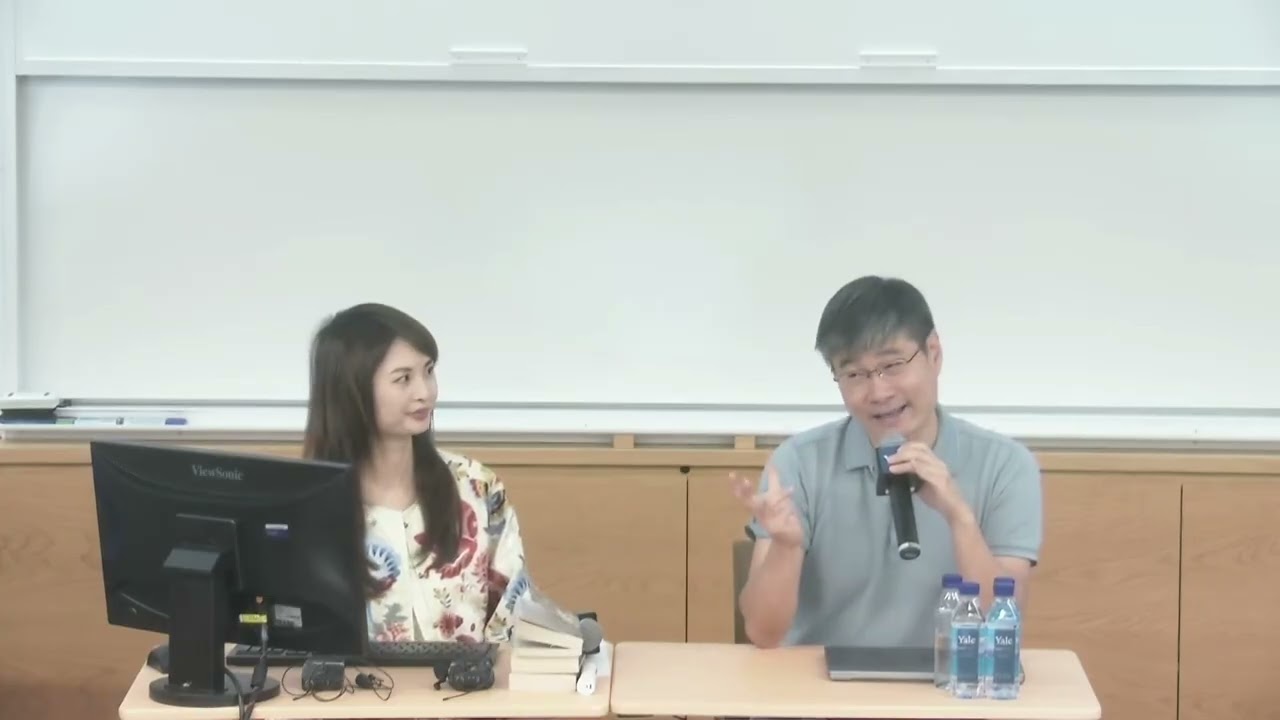
This is the final session of a 12-day seminar on Dante’s Divine Comedy, covering the last cantos of Purgatorio (Cantos 26–33), in which Dante reaches the top of Mount Purgatory, meets Beatrice, is purified, and prepares to ascend to Heaven. The session is taught by a Yale-affiliated instructor (referred to as “D” or “Jiang”) and hosted by Carol, with a diverse international group of students participating in person and via livestream. The central arc is the emotional and spiritual climax of Dante’s journey: the reunion with Beatrice, the shocking rebuke that follows, Virgil’s silent departure, and Dante’s final purification through the rivers Lethe and Eunoe before ascending to the stars.
Opening Questions and Thematic Setup
Nature vs. God: Dante distinguishes natural laws (physics, chemistry, biology) from spiritual laws; natural laws govern the physical world, but God is the entirety of the cosmos, including spiritual planes and the soul, which is governed by divine law.
Lucifer in Hell: Lucifer is frozen in the lowest circle of Hell, endlessly crying in eternal regret and remorse for rebelling against God. Angels are created perfect with free will and make a single, irreversible choice for or against God; Lucifer chose pride and independence, and his punishment is consuming regret.
Angels vs. Humans: Angels are perfect, beyond time and space, and make one permanent choice. Humans are imperfect, make mistakes repeatedly, and are allowed to err because they “don’t know better.”
Divine Inspiration and Revelation: Great poets (Homer, Virgil, Dante, Milton) all believed they were channeling the divine through revelation, not creating from scratch. Revelation is like breaking open a boulder to reveal an already-existing angel inside.
Dreams as Emotional Channels: Dreams are how the cosmos interacts with us through emotion; the soul feels an emotion, reflects on it, and interprets it through time and space. The important part is the emotion felt, not the literal vision. A student shares an anxious dream about being distracted from a goal, which the instructor connects to the anxiety of embarking on an independent life journey.
Plato vs. Aristotle in Dante: While scholars often frame Dante as Aristotelian, the instructor suggests Dante may not have read Plato or Aristotle directly but channeled their ideas through cosmic access. The creative process is revelation, not synthesis.
Dante’s Influence on the Renaissance:
Taught people to look upward to the divine rather than downward to the material world; a direct challenge to modern AI-worship and techno-solutionism.
Was a democrat who wrote in Tuscan vernacular rather than Latin, making elite education accessible to common people; the Renaissance produced great artists from common backgrounds (e.g., Leonardo da Vinci).
Expanded the boundaries of the cosmos by visualizing Hell, Purgatory, and Heaven, igniting infinite artistic imagination.
AI, Billionaires, and Power: The instructor is deeply skeptical of tech billionaires (Elon Musk, Sam Altman, Mark Zuckerberg, Peter Thiel, Steve Jobs), viewing them as hustlers primarily motivated by money, immortality, and creating an AI surveillance control grid. The real threat is not liberation but enslavement.
Education and Access: Education should not be about credentials or elite institutions but about the willingness to ask questions, admit wrong, and push past comfort zones. AI and online platforms can democratize access, but economic precarity (gig work) undermines the time and will to learn.
Predicting the Ending of Purgatory
The class brainstorms how they would write the ending of Purgatory where Dante meets Beatrice. Their predictions include:
An epiphany where Dante transfers trust from Virgil to Beatrice.
A wedding or allegorical union between Dante and Beatrice.
A cosmic celebration (earthquake, light, heavens opening).
Virgil revealing true colors or a final conflict.
A slow-motion cinematic embrace.
A final doubt or distraction for Dante.
A climactic poem of praise from Dante to Beatrice.
Virgil’s resolution: either rising to heaven or walking away.
Spoiler: None of these predictions are correct. The actual ending confuses scholars and defies expectations.
Canto 26: The Terrace of Lust and the Poets
Dante’s Character Arc: In the final terrace of lust, Dante observes shades embracing and is focused on knowledge and understanding rather than his own shadow (fame). This shows his transformation from self-absorption to a focus on the light and mission.
The Homosexual Shades: Two groups of shades pass each other, crying “Sodom” and referencing Caesar being called “queen” during his triumph. They are atoning for the sin of lust. Dante’s concern is framed as being about procreation and family devotion rather than same-sex love per se.
Andy’s Research: In Inferno, the sodomites are clerics and academics who abused their positions of power over young men (rape, exploitation). In Purgatory, the homosexual shades are consensual adults, suggesting a more progressive view: one can be gay and still reach heaven, as long as there is no abuse of power or rape.
Historical Context: The Inquisition was popular among common people because it addressed the widespread abuse of young boys by priests and teachers.
Guido Guinazelli and Arno Daniel: Dante meets two famous Florentine poets he deeply admires. They are humble, focused on redemption rather than former fame, and do not care about their poetic reputations.
Canto 27: The Wall of Fire and the Dream of Leah and Rachel
The Wall of Fire: Dante must pass through a wall of fire to enter the Garden of Eden. For the first time, he doubts Virgil and hesitates. Virgil gets him to cross by reminding him that Beatrice is on the other side.
Virgil’s Knowledge: Virgil, though from Limbo, knows the fire is harmless because he has been given the truth as a poet and understands that fire reveals truth. He can go to heaven at any time but lacks the will to choose it.
The Dream of Leah and Rachel: Dante dreams of Leah (who gathers flowers to adorn herself) and Rachel (who sits gazing at herself in a mirror all day). This references the biblical story of Jacob, who worked seven years to marry Rachel but was tricked into marrying Leah first, then worked another seven years for Rachel.
Emotion of the Dream: The dream is about longing. Dante sees himself as a new Jacob expecting a wedding with Beatrice (Rachel). But the dream reveals a hidden narcissism: Rachel (Beatrice) is looking at herself, suggesting Dante’s true desire is for Beatrice to praise and admire him, not pure love.
The Paradox: Dante thinks his journey shows his love for Beatrice, but the dream reveals a hidden agenda of narcissistic desire for adulation.
Canto 28: The Garden of Eden and the Two Rivers
Matilda: Dante meets Matilda, the guardian of the Garden of Eden (an inversion of the biblical banishment; here it is the entry to paradise).
The Two Rivers:
Lethe: Erases the memory of sin.
Eunoe (Dante’s invented word): Restores the memory of good deeds.
Both must be tasted to enter heaven.
Why Forget Sin? Sin traumatizes and distorts the soul; remembering it would pollute heaven and weigh down the soul. The rivers are a form of baptism, washing away the spiritual trauma of sin. On earth, one cannot simply forget sins; one must do good deeds to heal.
Free Will: Everything is governed by free will. You choose to do penance in purgatory, but you cannot choose to forget; the rivers are a divine gift.
Canto 29: The Triumph Arrives
The Paradox of Indignation: In the Garden of Eden, Dante feels “just indignation” (righteous anger) at Eve for eating the fruit, even though he is about to meet Beatrice and should be purely happy. This is paradoxical because he has already passed through the terrace of wrath and should be purged of anger.
The Church Triumphant: Beatrice arrives in a grand procession (a Roman triumph) representing the victory of the church. The structure includes:
24 elders (Old Testament books)
4 evangelists (Gospels)
1 griffin (representing Jesus, with two natures: lion and eagle)
2 authors of Acts and major epistles (Luke and Paul)
4 authors of lesser epistles (Peter, James, John, Jude)
1 apocalypse (John)
Plus Beatrice and 100 angels, totaling 144 (12×12, the number of the saved in Revelation).
Numerology: The meeting occurs on a divinely significant day (March 30, 1300), constructed around the number three. Dante is meticulous with mathematical and numerological symbolism throughout.
Canto 30: Beatrice’s Arrival and Virgil’s Disappearance
Dante’s Emotion: Seeing Beatrice again after 20 years, Dante’s soul shakes with overwhelming emotion—fear, excitement, happiness, sadness all converging. His first instinct is to turn to Virgil for comfort.
Virgil’s Disappearance: Virgil is gone. He has accomplished his mission and simply vanished without goodbye. Dante weeps: “Virgil, the gentlest father, Virgil to whom I gave myself for my salvation.”
Why Virgil Left:
He has no purpose after completing his mission.
He does not want to face Beatrice, who would offer him entry to heaven, forcing him to confront his own lack of will.
He is afraid of God, having used his divine poetic gift for earthly fame and empire (the Aeneid).
He cannot conceive of heaven; for him, it would be hell.
He does not want to witness true divine love, which negates his worldview that love is control and possession.
He is afraid of being convicted by the existence of divine love.
Dante’s Reaction: Dante is heartbroken and angry at Beatrice for dismissing Virgil. He loves Virgil so much that even Beatrice’s sternness toward Virgil upsets him.
Beatrice’s Scolding: Beatrice tells Dante not to weep for Virgil; he will need his tears for another sword. She is imperious and stern, like an admiral commanding ships.
Canto 30 (continued): Beatrice’s Rebuke
Beatrice’s Anger: Beatrice rebukes Dante for abandoning the path of righteousness after her death. When she was alive, her love guided him toward God. After she died, he followed “mere appearances” (shadows, false loveliness) and turned to other pursuits.
What Dante Did Wrong: After Beatrice’s death, Dante wrote poetry for fame, power, and competition with other poets, rather than as an expression of divine love. He fell in love with his own shadow (fame). This is why Beatrice had to come down to Hell to ask Virgil to guide him through Hell to see the consequences of sin.
Beatrice’s Narcissism Claim: Beatrice explicitly claims she is the most beautiful thing in the universe and that Dante should have kept loving her after her death. This is shocking and seemingly narcissistic, but it is framed as a test and a revelation of Dante’s true motives.
Righteous Indignation Comes from Love: Beatrice’s anger is a form of love. Only because she loves Dante does she get angry at his failures. This is a central theme: just indignation is born of love.
Canto 31: Dante’s Confession and Baptism
Dante’s Confession: Under Beatrice’s interrogation, Dante admits he was “turned aside by mere appearances” (fame, shadows). He is overwhelmed with shame and collapses.
Baptism: Matilda (the woman gathering flowers) plunges Dante into the river Lethe up to his throat, making him drink the water. Then he is drawn out and bathed in the dance of the four cardinal virtues (nymphs who are stars in heaven).
Purification Complete: Dante is now fully purged of sin. What redeems him is not the journey through Hell and Purgatory per se, but remembering his complete love for Beatrice. Love is what saves him.
Canto 32: The Apocalypse and the History of the Church
Rewriting Revelation: Canto 32 is Dante’s rewriting of the Book of Revelation, showing the past, present, and future of the Catholic Church.
The Vision:
The griffin (Jesus) pulls the chariot (the Church) to earth.
A bird of Jove attacks the chariot (early Roman persecution).
A fox enters the chariot (early Christian heresy).
An eagle plunges into the chariot and leaves it feathered (Constantine’s donation; the merger of empire and church, corrupting the church).
A dragon emerges from the earth (the Antichrist/Satan, a corrupt pope who corrupts the church from within).
The chariot is transformed into a monster with horns.
A harlot (Babylon) appears with a giant (Florence, which exiled Dante; the Holy Roman Empire initially allied with Florence against the Pope, then betrays and destroys Florence).
Anger in Heaven: The vision is full of anger, fear, and hatred, which is unexpected before entering Heaven. But this anger is “just indignation” born of love. God is angry in the Old Testament; Jesus was angry at the money-changers in the temple. Anger directed toward justice and love is righteous.
Wrath in Hell, Purgatory, and Heaven: In Hell, wrath is boiling blood (anger expressed) or suffocating drowning (anger suppressed). In Purgatory, wrath is black smoke that blinds. But in Heaven, anger channeled toward justice and love is good and creative. Dante’s anger at the Church and Florence is what propelled him to write the Divine Comedy.
Channeling Anger into Action: The instructor urges students to channel anger into action that benefits humanity (teaching, creating, inspiring) rather than passive consumption (porn, video games, complaining).
Canto 33: The Final Purification and Ascent
Beatrice’s Final Prophecy: Beatrice prophesies that a “510 and five” (a mysterious figure sent by God) will slay the harlot (corrupt church) and the giant (Florence/Holy Roman Empire). She tells Dante to write down what he has seen and not conceal it.
The Tree of Knowledge: The tree in the Garden of Eden was created for God’s holy use. Adam waited 5,000 years for Jesus to redeem the forbidden fruit. The tree’s height and inverted form reflect God’s justice.
Dante’s Intellect: Beatrice says Dante’s intellect is “made of stone” and opaque, but she asks him to carry her words within him, at least outlined like a pilgrim’s staff wreathed with palm.
The School of Virgil: Beatrice tells Dante that the school he followed (Virgil, human reason) cannot comprehend the divine. As far as Earth is from the highest Heaven, so far is human reason from the divine.
Final Purification: Dante drinks from Lethe (forgetting sin) and Eunoe (remembering good). He is “remade” like a tree renewed with new boughs, pure and prepared to climb unto the stars.
The Last Words of Purgatory: “Unto the stars” (alle stelle). The last words of Inferno and Paradiso are also “the stars,” creating an infinite loop. The journey never ends; one destination leads to another journey.
Reflections and Closing
Student Reflections: Students share how the course has changed them:
Skyler: Love is the answer; Dante helps understand Western culture; we are lost because of fear; the value of art.
Damian: Gained more faith in God.
David: Appreciated the complexity of characters, the teacher’s co-creative method, and the challenge of transposing Dante into Chinese consciousness.
Julian: Appreciates paradoxes; resonates with Dante’s journey through depression to purgatory; hope is important.
Edward: The course forced detailed self-reflection; the world would be better if everyone read Dante.
Andy: All literature is metaphor for the human condition; Dante describes it matter-of-factly, covering everything.
Ivy: Perceived love in Dante but not in Homer; gained faith in poetry and intuition; less fear of the future.
Anna: Became more pious; poetry is what we live for.
OA: Gained a systematic framework for understanding virtue; formed bonds with classmates.
Crystal: Saw real-life connections in Dante; felt the greatness of art uniting diverse people.
Bruce: Learned the importance of individualism and self-belief over collectivist pressure.
Fred: Realized the importance of taking action in the real world; felt natural and welcomed in the class.
Carol: Inspired by the star metaphor and the idea of desire (desiderare) coming from the stars; vision of building community and freeing people.
Instructor’s Transformation: The instructor left his teaching job and, through this seminar, discovered his mission: to share Dante with the world, build a network of schools teaching the great books, and summon the spirits of Dante, Plato, Homer, and Jesus back to earth through collective imagination and love.
Gratitude and Hope: The instructor expresses tremendous gratitude to Carol, the team, and the students. He sees the spark of Dante in everyone and believes this is the beginning of something wonderful that will change the world over time.