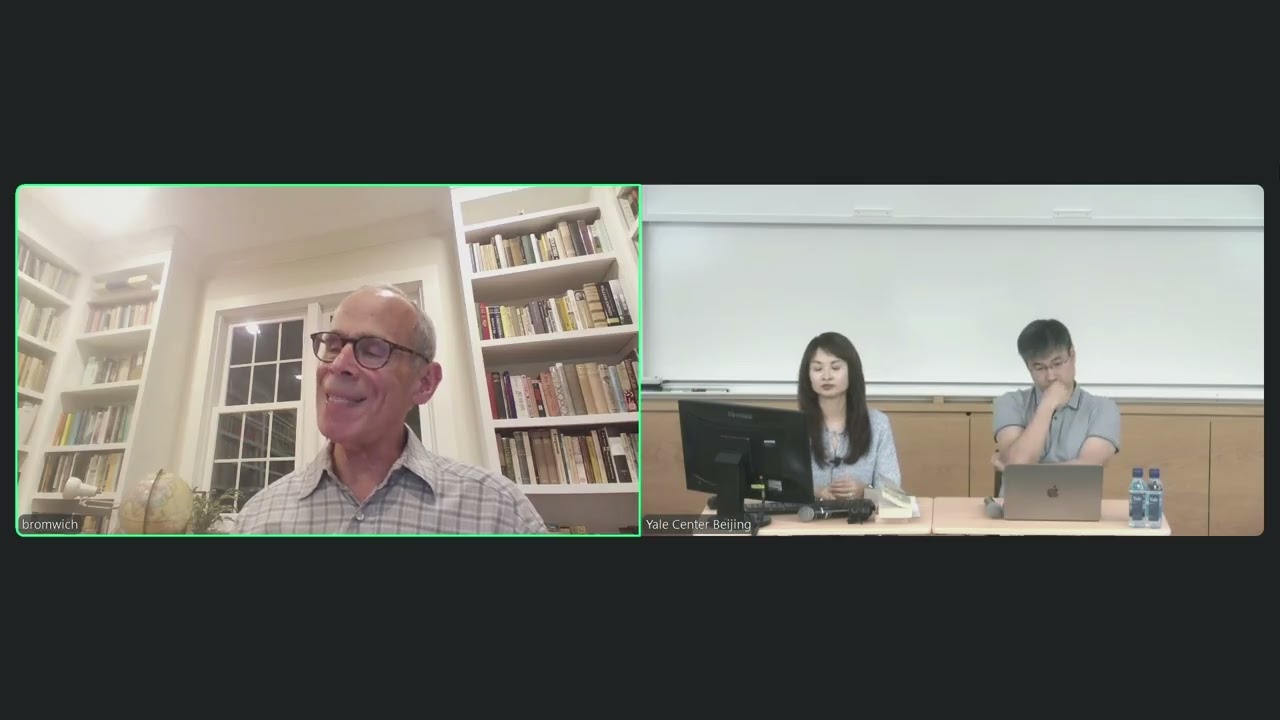
This session combines a guest lecture on Shakespeare’s Macbeth with a close reading of Dante’s Purgatorio (Cantos 5–14), framed as an imagined dialogue between Dante and Shakespeare.
Professor Bramitch on Macbeth and the nature of action
- The lecture centers on Aristotle’s idea that tragedy imitates “an action that is serious, complete, and of a certain magnitude,” and Heraclitus’s maxim “character is fate.” Macbeth is unusual among Shakespeare’s plays for its tight unity of action, where the moral weight of the deed is inseparable from Macbeth’s character.
- A key distinction is drawn between two statements: “What’s done is done” (a bland, modern shrug meaning “don’t dwell on it”) and “What’s done cannot be undone” (a fatalistic recognition that a deed permanently defines and fatefully binds the person who performed it). Lady Macbeth moves between the two, and the play’s tragedy lives in that gap.
- Macbeth’s great soliloquy at the end of Act I (“If it were done when ‘tis done…”) is analyzed as a speech that enacts judgment upon himself: he imagines consequences, acknowledges duty, recognizes Duncan’s goodness, and confesses that he has “no spur” except “vaulting ambition, which o’erleaps itself.” The speech shows a man who understands the moral wrong yet proceeds anyway.
- Lady Macbeth is read as someone who aspires to be “outside nature” (“unsex me here”) but cannot sustain that supernatural self-image; her later sleepwalking and hand-washing show the repressed awareness of the deed returning.
- The “tomorrow and tomorrow and tomorrow” speech is interpreted not as Shakespeare’s nihilistic wisdom about life but as Macbeth’s own evasion—a nihilism that belongs to a man consumed by ambition, locating death in a distant “hereafter” to avoid confronting the meaning of his life.
- On the witches, Bramitch suggests Shakespeare treats them naturalistically, as something people in that Scottish society believed in; Macbeth is a believer, and the prophecy functions like a statistical prediction that a superstitious person might use to justify violent action.
- On women, Bramitch argues Lady Macbeth is not Shakespeare’s statement about women; characters like Cordelia, Desdemona, Rosalind, and Cleopatra show Shakespeare’s wide and naturalistic range in portraying female character.
- On God and prayer, Bramitch offers a secular reading: Shakespeare takes seriously what people take seriously. A rare example of prayer is Claudius in Hamlet, who confesses his sin but finds his prayers do not reach heaven—a passing moment that shows ambition’s self-knowledge even in a damned man.
Dante’s concerns about Shakespeare, and the class discussion
- The instructor imagines Dante attending the premiere of Macbeth and raising three concerns over dinner: (1) Is Shakespeare fundamentally pessimistic about human agency and free will? (2) Does Shakespeare believe in God, given the witches’ power and the role of fortune-telling? (3) How does Shakespeare view women in society?
- Bramitch responds that Shakespeare is not pessimistic in a philosophical sense; he portrays nihilism as a human occurrence (e.g., Edmund in King Lear) but also shows the possibility of good triumphing over evil. Judgments come from characters, not from the author, and dramatic form differs from Dante’s epic poem in that it does not offer a single theological architecture.
- On God, Bramitch reiterates that Shakespeare reflects the beliefs of his characters and society; Macbeth does suggest a restoration of divinely supervised order by the end, but Shakespeare’s own theology remains opaque.
- On women, the discussion notes Lady Macbeth’s humanity even as a villain, and Bramitch points to Shakespeare’s varied and often admiring portrayals of women across the canon.
- A student asks whether Shakespeare’s sonnets reveal more of his real beliefs than the plays. Bramitch says the sonnets show aristocratic admiration mixed with wariness, and an erotic intensity that includes jealousy and suspicion, but they are also shaped by the Petrarchan genre.
Transition to Purgatorio: from Inferno to Purgatory
- The class clarifies that Beatrice could not have “made a deal” with Virgil to get him out of Hell; God is not transactional in Dante’s cosmos. What Beatrice does is give hope and expand the imagination.
- Hell and Purgatory are distinguished: Hell is mechanical, static, and absolute (Virgil’s view: no one leaves); Purgatory is organic, dynamic, and co-created. Souls exist in infinite dimensions, and even a soul in Hell can choose to leave. God does not impose eternal damnation; souls can choose it, but the door is never fully closed.
- The difference between Virgil’s Inferno and Dante’s Purgatorio is that Virgil’s underworld is a fixed place of shades, while Dante’s Purgatory is a growing, changing place where art, prayer, and self-reflection transform the soul.
- Limbo is a pleasant retirement community where souls sigh in hopelessness; Purgatory is arduous but filled with singing, curiosity, and hope. The difference is not the place but the attitude of those within it.
Purgatory Canto 5: fame, shadow, and the vanity of Dante
- Dante and Virgil encounter shades who gawk at Dante because he casts a shadow—he is still alive. The shades worship the shadow, which is a metaphor for fame and ego. Virgil is frustrated because Dante keeps slowing down to be adored.
- The shadow is an illusion, a leftover from Hell, yet Dante is addicted to it. The text reveals Dante’s vanity: he would rather be mobbed for his shadow than press on to meet Beatrice. Virgil’s earlier promise of “everlasting fame” has become a trap; Dante chases the shadow instead of God.
- The souls Dante meets died violently and repent at the last moment; they are in Purgatory because they turned to God at the end. Dante lists many real people from his life, consoling their families and reinforcing the power of prayer to reduce a soul’s time in Purgatory.
- Dante asks Virgil how prayers can help souls in Purgatory if God’s justice is perfect and not transactional. Virgil gives two answers: (1) his earlier statement applied to the pagan world before Christ; (2) Beatrice will explain everything at the summit. The instructor notes that Virgil is dodging the question, exhibiting cognitive dissonance and a fixed mindset, because he has already encountered Cato in Purgatory—a pagan who is there—and cannot reconcile it with his own worldview.
Purgatory Canto 7–8: Virgil’s fame, Sordello, and the lament for Italy
- Virgil meets Sordello, a fellow poet, and becomes ecstatic at being recognized. His speech is unusually long, flowery, and self-focused—full of “I” and ornamental language—showing how starved he is for recognition and how jealous he is of Dante’s shadow-fame.
- Sordello and Virgil embrace, and then launch into a bitter lament for Italy, describing it as a ship without a helmsman, full of tyrants and factional violence. Dante’s prophecy is sarcastic and prophetic, calling on divine justice to intervene.
- The instructor notes the apparent contradiction between Dante’s obsession with his own shadow and his prophetic concern for Italy’s fate, but explains that the two are related: fame is vain unless it serves a higher purpose. The absolute will (what you truly believe) and the contingent will (what you choose to do) must be aligned.
Purgatory Canto 9: the dream of Ganymede and Lucia’s intervention
- Dante falls asleep and dreams of an eagle (Ganymede myth) snatching him up. He wakes terrified. Virgil tells him that Lucia (a saint) came from heaven and carried him to the gate of Purgatory while he slept.
- The dream is interpreted as a divine rebuke: Dante has been chasing his shadow, and Beatrice (through Lucia) is pulling him back. The Ganymede myth carries overtones of being taken against one’s will, and Dante’s fear reflects his realization that he has been neglecting the love that brought him on this journey.
- The instructor defends Dante’s “lazy” writing: skipping the arduous journey to the gate is not laziness but theology—you cannot enter Purgatory without the love and prayers of others (family, friends, saints). Lucia’s intervention is a nudge that forces Dante to reflect on why he has been slowing down.
Purgatory Canto 9–10: the gate of Purgatory and the three steps
- At the gate, an angel guards the entrance. Unlike the demons in Hell, who are silent or hostile, the angel is welcoming and helpful. Virgil’s approach is met with enthusiasm.
- The gate has three steps: white marble (mirroring the pilgrim), dark cracked stone (symbolizing sin), and red porphyry (blood, sacrifice). The angel traces seven P’s (for peccato, sin) on Dante’s forehead and says to wash away the wounds once inside.
- The angel uses two keys (gold and silver) to open the gate, explaining that Peter gave them to him, and that he opens more often than he closes. The rule is: “whoever looks back returns again outside.” Entry is easy; commitment once inside is absolute.
- The gate’s roar is compared to the opening of the rock in Hell, but here the sound is accompanied by music and a Te Deum, signaling that Purgatory begins with song, not lamentation.
Purgatory Canto 10: the first terrace and the power of art
- Inside Purgatory, Dante sees marble carvings depicting scenes of humility: the Annunciation, David dancing before the Ark, and Trajan’s justice toward a poor widow. The carvings are so lifelike that Dante’s senses seem to hear singing and smell incense.
- The instructor uses this passage to explore why art makes us more virtuous. The process: beauty shocks the emotions into motion; the viewer empathizes with the artist and the subjects; this empathy leads to self-reflection and a reordered emotional state focused on love and truth.
- Beauty and truth are one because both reflect symmetry, proportion, and the mind of God. Great art gives access to the mind of God and activates love, which is the foundation of virtue. Plato would have rejected art as a shadow, but Dante embraces it as a path to God.
- The class discusses examples like the Mona Lisa and the Last Supper, noting how the viewer’s imagination co-creates the artwork, making it a living, participatory experience that enhances individuality and empathy.
Purgatory Canto 11–12: the first terrace (Pride) and the pavement carvings
- On the first terrace, souls carry heavy weights to purge themselves of pride. They move slowly, bent under their burdens, and sing the Lord’s Prayer, asking for forgiveness and strength.
- The difference between Hell and Purgatory is not the punishment but the attitude: souls in Purgatory accept their burden as an opportunity for growth, while souls in Hell see their punishment as unjust and eternal. The growth mindset is what makes redemption possible.
- Dante sees carved figures on the pavement: Lucifer, Nimrod, Saul, Arachne, Rehoboam, and the destruction of Troy. The carvings depict the consequences of pride and arrogance. Dante weeps at the sight, experiencing catharsis—a purging of emotion through empathy with the suffering of others.
- The instructor explains that crying is catharsis, a purging that connects us to the pain of others and builds community. Empathy is a divine emotion that connects the sparks of different souls and makes us less willing to inflict suffering.
Purgatory Canto 13: the second terrace (Envy) and the souls with sewn eyes
- On the second terrace, souls of envious people have their eyes sewn shut with iron wire, so they cannot look at others and feel envy. The punishment mirrors the sin: they spent their lives comparing themselves to others, and now they are forced to look inward.
- The difference between Hell and Purgatory is again one of attitude: in Hell, the envious would be driven insane by not being able to see, imagining others are looking at them; in Purgatory, the same punishment is accepted as an opportunity for self-reflection and growth.
- Dante meets Sapia of Siena, who confesses that she rejoiced in the misfortunes of others. She was saved only because Pierre Petti prayed for her. She asks Dante to help restore her family’s name, showing that even in Purgatory, the desire for earthly reputation lingers.
Purgatory Canto 14: Guido del Duca and the curse of envy
- Dante meets Guido del Duca, who describes the Arno river as a stream that passes through progressively more corrupt creatures—hogs, dogs, wolves, foxes—symbolizing the moral degradation of the region. Guido prophesies that a grandson will become a hunter of wolves.
- Guido delivers the key line: “Why do you set your heart there where our sharing cannot have a part?” This is the critique of zero-sum thinking: the belief that for one person to win, another must lose. Envy thrives on this scarcity mindset.
- The solution is generosity and co-creation: instead of fighting over a finite cake, make the cake bigger. Love and courtesy create infinite abundance, while perversity and envy poison the world. The passage ends with a lament for the noble families of Romagna, now extinct or corrupted.
Closing reflections
- The instructor asks students to reflect on how reading Dante has changed them and whether the experience has been life-transforming. Students share their thoughts, noting that Dante provides a moral framework, a sense of hope, and a way to reconcile paradoxes.
- A student asks why it took nine cantos to reach the gate of Purgatory but only three to reach the gate of Hell. The instructor explains the symmetry: Hell has an introductory canto, and Purgatory has an “anti-Purgatory” section before the gate, so the structure is parallel.
- The session ends with a preview of the next day’s reading (Canto 15 onward) and an invitation for students to share their personal journeys with Dante on the final day.