Joseph Stalin rose from poverty in Georgia to become the absolute ruler of the Soviet Union, then led it to victory in World War II, transforming a weak, divided nation into a global superpower. The speaker argues Stalin is “probably the greatest man who ever lived” because each of these achievements was historically improbable and was driven by his personal will rather than structural forces.
Russia’s revolutionary tradition and the role of the secret police
Russia’s internal contradictions—European and Asian, Christian and pagan, enlightened and reactionary—produced a long history of rebellion, from the Decembrist revolt of 1825 through the revolutionary movements of the late 19th century.
After Russia lost the Crimean War (1853–1856), Tsar Alexander II enacted liberal reforms including the emancipation of the serfs in 1861, aiming to modernize Russia along European lines.
Alexander II was a close admirer of Abraham Lincoln and the American Republic; during the American Civil War, he threatened to intervene on the Union’s side if Britain or France allied with the Confederacy, and sent Russian warships to New York and San Francisco as a show of support.
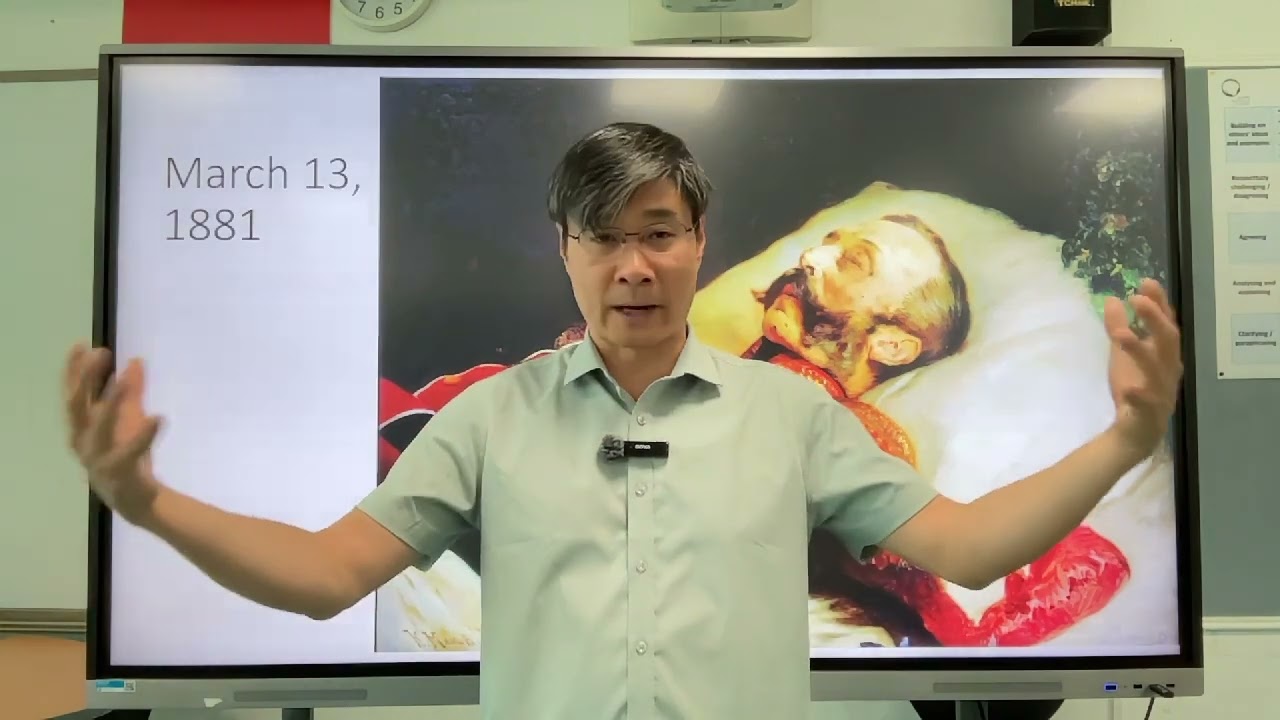
In 1881, Alexander II was assassinated by the terrorist group “People’s Will” on the very day he planned to announce a constitutional monarchy.
The speaker raises a puzzle: if the secret police (Okhrana) were efficient enough to quickly capture all the assassins, why did they fail to prevent the assassination? This leads to a broader argument about the secret police’s incentives.
The speaker argues that the Russian secret police had strong reasons to support rather than suppress extremist groups:
Extremists discredited the entire political opposition.
They could be used to split rival factions (e.g., Bolsheviks vs. Mensheviks).
Political violence justified expanded state control and larger secret police budgets.
Spies planted in extremist groups provided intelligence.
Extremists could be used to assassinate the regime’s political enemies.
False-flag operations could justify wars against foreign enemies.
The work was psychologically exciting for those involved.
Evidence: the Okhrana sent a spy, Roman Malinovsky, to act as a Lenin supporter within the Bolshevik party. The speaker argues the Okhrana also likely funded Lenin, giving the Bolsheviks a financial edge over rival socialist groups.
The Bolshevik rise to power
After Alexander II’s death, his reactionary son Alexander III took power, followed by the weak and inexperienced Nicholas II.
Russia’s loss to Japan in 1904, combined with famine and Bloody Sunday (1905), created revolutionary conditions.
The royal family’s association with Rasputin—a mystic who treated the hemophiliac heir Alexei—damaged the monarchy’s prestige through rumors of sexual misconduct and occult behavior.
World War I devastated Russia. In 1917, Nicholas II abdicated after spontaneous protests, and the Duma formed a provisional government that remained in the war.
Germany arranged Lenin’s return to Russia to destabilize the war effort. Lenin called for “land, peace, and bread” and organized the October 1917 coup against the provisional government.
The Russian Civil War followed. The Bolsheviks, controlling only a few cities, defeated the Whites (aristocrats and military remnants) for three reasons:
The Whites had no reform program and lost peasant support.
The Bolsheviks used the Cheka (secret police) to terrorize enemies.
Leon Trotsky organized the Red Army into a ruthless, meritocratic fighting force using blocking detachments (soldiers shot retreating troops) and promoting talent regardless of political background.
The pattern of revolutions: France and Russia
The speaker draws a structural parallel between the French and Russian revolutions:
A poet-philosopher (Rousseau / Marx) defines freedom.
A prophet (Robespierre / Lenin) leads through faith and fanaticism.
A messiah-conqueror (Napoleon / Stalin) secures the revolution—Napoleon by expanding the empire outward, Stalin by continuously purging enemies internally.
Stalin’s background and early career
Stalin was born poor in Georgia; his father lost a shoe factory and became an abusive alcoholic. Stalin did well in school but dropped out after encountering Marxism.
His background—poverty, ethnic marginalization, family dysfunction—made him a natural recruit for criminal networks, revolutionary movements, and the secret police. The speaker argues he was part of all three simultaneously.
Evidence suggesting secret police ties:
Fellow Marxists suspected Stalin was an Okhrana agent.
He was arrested and exiled to Siberia but escaped after only one failed attempt and about a month of effort—suspiciously easy.
Arrest and exile actually helped his revolutionary credentials.
Stalin was the Bolsheviks’ chief organizer and enforcer on the ground while Lenin and Trotsky wrote books in exile.
He funded the Bolshevik party through criminal activities: racketeering, counterfeiting, robbery, and kidnapping children of wealthy figures for ransom.
The speaker argues this financing was likely done on behalf of the secret police, since Stalin funneled the money to Lenin rather than keeping it.
Stalin’s rise to supreme power
After the revolution, Lenin’s health deteriorated in the 1920s. He favored Trotsky as successor because both believed in international communist revolution spreading to Europe.
Stalin disagreed, advocating “socialism in one country”—maintaining communism within Soviet borders and embracing nationalism.
Lenin wrote a secret memo warning that Stalin, as General Secretary with “unlimited authority,” was “too coarse” and might not use power cautiously.
Lenin then suffered convulsions and died. Medical observers have noted the symptoms were more consistent with poisoning than a stroke, though this remains a minority view.
Two other potential rivals died conveniently:
Zinoviev, Lenin’s former right-hand man and former General Secretary, died of illness in his 30s.
Felix Dzerzhinsky, head of the Cheka, died of a heart attack at a young age.
With these figures gone, Stalin placed his own loyalists in the Communist Party apparatus and the secret police.
The Great Purge (1936–1938)
Stalin killed at least 1 million party members, destroying the Old Bolshevik guard through layered purges: the secret police purged the army and party, then secret units within the secret police purged those units, and so on.
Show trials forced leading Bolsheviks to confess to being traitors, spies, and secret capitalists—all were innocent.
The speaker references Arthur Koestler’s Darkness at Noon to explain why they confessed: having sacrificed everything for the revolution, they would not admit it was all for nothing. Their confessions were a final act of self-sacrifice to preserve the revolution, akin to Christ cleansing original sin.
The purge devastated the Red Army’s leadership: 3 of 5 marshals, 13 of 15 army commanders, 8 of 9 admirals, 50 of 57 corps commanders, and 154 of 186 division commanders were removed.
This convinced Hitler to invade in 1941, believing the Soviets were leaderless.
The speaker argues the purge paradoxically helped the Soviet war effort by removing conservative, inflexible generals and making the military more innovative and adaptable—illustrated by a thought experiment comparing 100 stranded students (who would learn to survive) with 100 students plus 20 teachers (who would maintain hierarchy rather than solve problems).
Five reasons Stalin won
He cultivated powerful patrons (mafia bosses, secret police chiefs, revolutionaries) and remained loyal to them only as long as it was expedient, making each believe he was personally devoted to them.
He identified and promoted capable subordinates selflessly.
He understood that silence is more powerful than great speeches—he never gave speeches, so no one knew what he truly thought, and he avoided the hubris that trapped Lenin and Trotsky.
He retreated during internal conflicts (often through convenient arrests), which offended no one and carried no risk.
He let enemies destroy themselves by encouraging their worst tendencies—Trotsky’s ego alienated everyone, and Stalin facilitated this.
Stalin as spy vs. Bolsheviks as priests
The speaker frames the power struggle as priests (Lenin, Trotsky) vs. a spy (Stalin):
Priests have faith, conviction, and analytical intelligence; spies have multiple personalities and emotional intelligence.
Priests seek truth and God; spies seek only power.
This asymmetry meant the Bolsheviks never had a chance against Stalin.
World War II: German doctrine and Soviet adaptation
German military doctrine was Blitzkrieg—rapidly cutting off the enemy’s command and control to cause collapse. This worked against France but failed against the Soviet Union because the USSR was too vast to decapitate.
The Soviets fought a war of attrition using scorched-earth tactics (the same strategy that defeated Charles XII of Sweden and Napoleon).
The Germans were organizationally superior but inflexible; the Soviets, having lost their old leadership in the purges, adapted and eventually overwhelmed the Germans.
The Germans fought for Lebensraum (living space, especially Ukrainian oil); the Soviets fought for “Mother Russia,” giving them greater motivation.
The strategic logic of Operation Barbarossa
In 1941, spies, the Americans, and the British all warned Stalin that Hitler was about to invade. Stalin refused to believe it because:
He had a non-aggression pact with Hitler.
The USSR was supplying Germany with oil and food, making invasion seem suicidal.
He believed it was a British plot to undermine German-Soviet relations.
German defectors who brought invasion plans were shot as spies.
When Germany invaded, Stalin ordered Soviet forces to hold their positions rather than retreat, leading to the encirclement and capture of millions of Soviet soldiers in the first months.
The speaker’s controversial argument: Stalin deliberately allowed the invasion and the catastrophic early losses. His reasoning, analyzed through game theory:
Four possible scenarios existed for a German-Soviet war:
Soviet Union invades Germany and threatens Berlin → Americans intervene on Germany’s side → USSR loses.
Soviet Union invades Germany and is stopped at the border → Americans still intervene to save Germany → USSR loses.
Germany invades Soviet Union and is stopped at the border → Americans stay neutral, sell supplies to both sides, then destroy both → USSR loses.
Germany invades Soviet Union and threatens Moscow → Americans intervene on the Soviet side to prevent German conquest of all resources → USSR wins.
Only scenario 4 led to Soviet victory. Stalin found and implemented this one winning scenario, but it required the sacrifice of 26–27 million Soviet lives.
American Lend-Lease aid was massive: $11 billion (equivalent to $250 billion today), including over 400,000 jeeps and trucks, 12,000 armored vehicles, 7,000 tanks, 14,000 aircraft, and 1.75 million tons of food. Total deliveries were 17.5 million tons—roughly equal to what the American military itself consumed during the war.
The Americans entered the Soviet side because a German conquest of the USSR would have given Germany access to Soviet manpower, oil, and food, making it invincible.
After the war, American leaders like General Patton realized the mistake: the real enemy was the Soviet Union, not Germany. This realization led to the Cold War.
Stalin’s manipulation of all parties
Stalin tricked Hitler into invading (by appearing weak and unprepared), tricked Roosevelt into becoming an ally (through personal diplomacy and public images of friendship that constrained American policy), and outmaneuvered Churchill.
He was the only leader thinking globally rather than Euro-centrically, using the international communist movement’s spy network for superior intelligence.
The speaker draws a parallel to Vladimir Putin as a similar strategic thinker in the 21st century.
Stalin’s domestic authority and wartime mobilization
Only Stalin could have survived the catastrophic early months of the war because his power was absolute—built through the Great Purge’s divide-and-conquer system of spies spying on spies. Any other leader would have been removed for incompetence.
The Soviet people rallied because they wanted to save their nation from German conquest.
Stalin’s key theoretical contribution to communism was nationalism. Unlike Lenin and Trotsky, who pursued international revolution, Stalin understood that people die for each other and for their homeland, not for abstract ideas.
During the war, he revived Russian patriotism, reopened churches, and embraced traditional Russian culture—reversing earlier Soviet suppression of religion and national identity—to unify the population.
A famous (likely apocryphal) Stalin quote captures his understanding of psychology: “One million people die in a gulag—that’s a statistic. One man gets run over by a tractor—that’s a national tragedy.”
Why the outcome was not inevitable
In 1935, the Soviet Union’s survival seemed unlikely: Stalin was purging his own leadership, the world was dominated by capitalist powers (America, Britain, Japan, Germany), all of which saw communism as a major threat.
Race science and eugenics were popular; Americans, British, and Germans saw themselves as fellow “Aryan” or “Nordic” peoples who might unite against the Slavs.
American industrialists (General Motors, IT&T, Eastman Kodak, Standard Oil) heavily invested in Nazi Germany’s industrialization.
Given these conditions, the speaker argues, the Soviet Union should have been destroyed. That it survived and became a superpower was entirely due to Stalin’s individual agency—making him, in Nietzsche’s term, an Übermensch who stepped outside history and warped it to his will.